
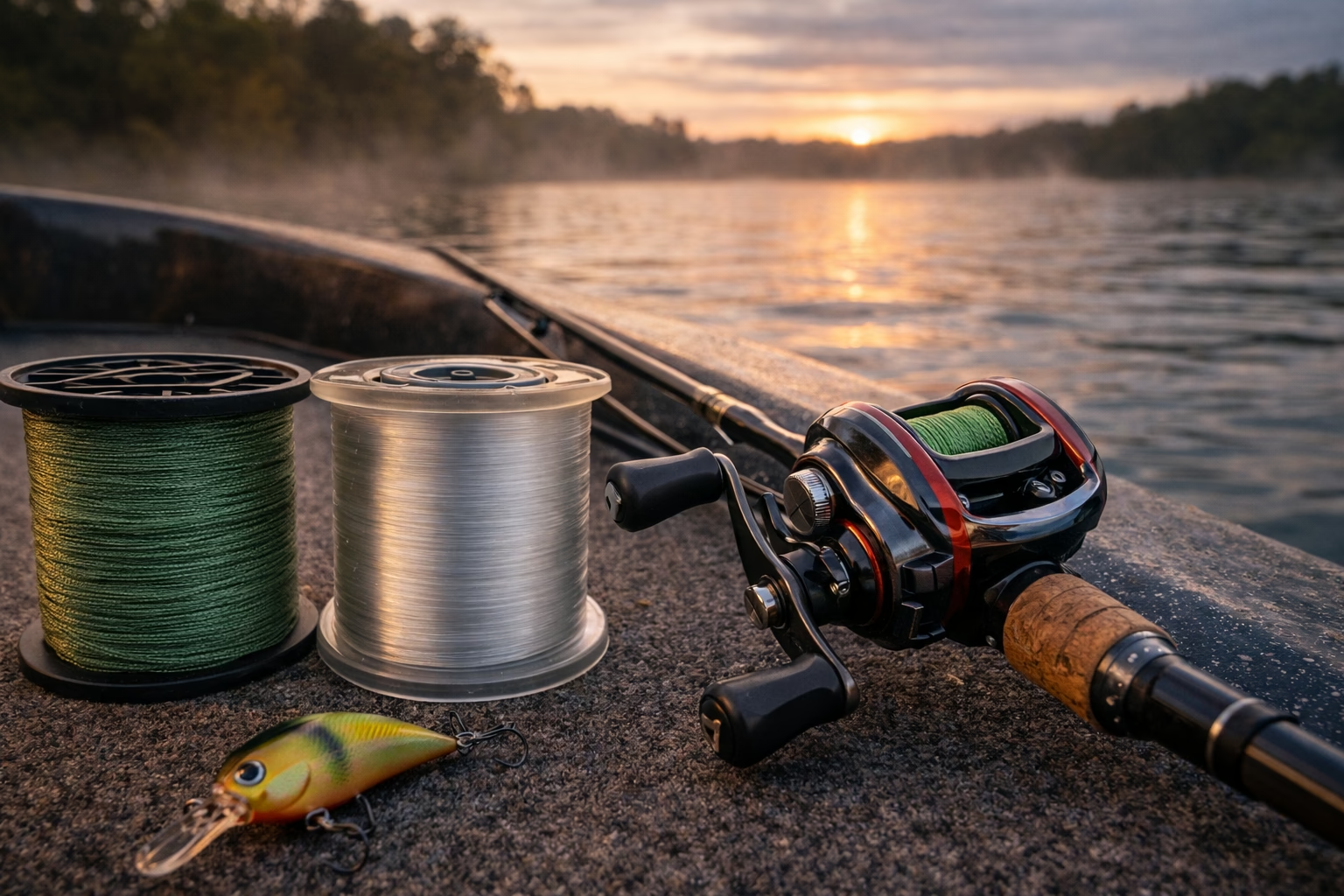
Few tackle innovations have stirred up more dock talk among bass fishermen than braided line.
By now, most of us have had some experience with the newer braided lines, and just about every fisherman seems to have an opinion about where they shine, where they fall short, and whether they belong on every reel or only a select few. For some, braided line has become a specialty tool. For others, it looked at first like the answer to every fisherman’s worst nightmare: breaking off a big fish.
As with most things in fishing, the truth lies somewhere in between.
When braided line first hit the market in a big way, it carried a kind of bulletproof reputation. With its tremendous strength, tiny diameter, and almost no stretch, it seemed as though it might solve every problem monofilament had ever given us. For some fishermen, maybe it did. But for me, and for a lot of anglers I have talked with over the past few years, braided line has not always proven quite as indestructible as many of us first imagined.
Now let me be clear. I am not saying braided line is weak.
Far from it.
What I am saying is that real-world fishing has a way of exposing the fine print in every new product. And when enough fishermen spend enough time with a piece of tackle, the honeymoon ends and the practical lessons begin. That is where the real education starts.
Like most middle-aged and younger fishermen, I grew up fishing monofilament. It took years to build confidence in it. Not just confidence in the line itself, but confidence in knowing which pound test belonged with which technique. It took time to learn how hard I could lean on a fish, how much pressure I could apply around timber, and when I could push the line right to its limits.
That kind of confidence does not happen overnight.
And that is one reason I think braided line has produced such a wide range of opinions. It has only been around in common use for a few years, and anglers are still learning exactly how to use it, how far to trust it, and how much they need to adjust the habits they built over a lifetime of fishing monofilament.
Of course, we all know the basic facts. Braided line is extremely strong, very thin in diameter, and has almost no stretch. Right away, that makes you think of techniques like flipping and pitching jigs or Texas rigs, where strong hooksets and close-quarters fish fighting are part of the game.
That is exactly where my own learning curve began.
When I first started using braided line for those techniques, I kept setting the hook as though I were still fishing monofilament. I would go into that old, eye-crossing hookset that years of mono had taught me to trust.
The results were memorable.
The first few times, I snapped hooks right at the bend of the shank on my Texas-rig worm hooks. On another hookset, I broke the reel seat and sent the reel flying through the first two guides of my rod. That will get your attention in a hurry.
Eventually, I learned that with braided line I could get the same hookup result with a much milder hookset. Once I backed off and let the line do more of the work, I started getting solid hookups without destroying tackle. Even then, every now and then I would still catch myself setting the hook too hard, and something would give. Maybe the hook, maybe the rod, maybe even the line itself.
One good way to guard against that is with your drag.
If you set the drag so it will slip just a bit on an extra-hard hookset, it can help absorb some of that force and save both your tackle and your fish. With braided line, that little bit of forgiveness can go a long way.
Of all the ways I have used braid, my favorite may be Carolina rigging.
That is where its low stretch and extreme sensitivity really shine. Because the line does not absorb so much of the feel, you stay in better contact with the bottom. Rocks, stumps, brush, shell, and little contour changes all come through more clearly. In fact, the sensitivity is so sharp that at times it almost feels as if you can hear the bottom through your hands.
That is hard to beat when you are dragging a bait across deep structure.
A lot of fishermen who use braid for Carolina rigs add a fifteen- to twenty-pound monofilament leader, and for good reason. That mono leader helps take some of the shock out of the hookset and gives you a bit more cushion when detecting a strike. It also helps in another practical way. If the rig hangs on the bottom and the hook snags, the monofilament usually breaks first. That means you often only have to replace the leader and hook rather than rebuilding the whole rig from scratch.
That is a smart system.
Some anglers also like braid for crankbait fishing because the thin diameter can help a bait dive deeper. And there is no question that braid can change the performance of a crankbait in that regard. But to me, cranking with braided line has always felt like changing to an entirely different rod-and-reel system.
It is simply not the same.
I grew up relying on the stretch of monofilament and the shock-absorbing nature of a fiberglass rod when fishing crankbaits. That combination has built years of confidence in me, and confidence is not easily replaced. Braid may offer some advantages there, but old habits built on success are hard to walk away from, and for good reason.
That is really what this braided-line question comes down to.
Not whether braid is better than monofilament in every situation, because it is not. And not whether mono is outdated, because it is not. The real question is where each one fits best in your own fishing.
Braided line can find a place in just about any angler’s arsenal. For me, it has become a dependable tool in some techniques, while in other situations I still drift back toward monofilament. I have confidence in both, and that may be the healthiest way to look at it.
Use each where it makes sense.
No line does everything perfectly. But when you understand the strengths and weaknesses of both braid and monofilament, you give yourself more options, more confidence, and ultimately more ways to catch fish.
And that is what matters.
There is little doubt that the new generation of young fishermen, the ones growing up with braided line from the start, will become even more comfortable with it than many of us ever were. Some of them will probably use it almost exclusively. And knowing fishermen, they will likely discover a few new tricks with it the rest of us never thought of.
That is the way fishing has always worked.
Every new tool teaches a few new lessons. The smart fisherman is the one willing to learn them.

0 Comments