
Some rivers don’t ask for attention.
They earn it.
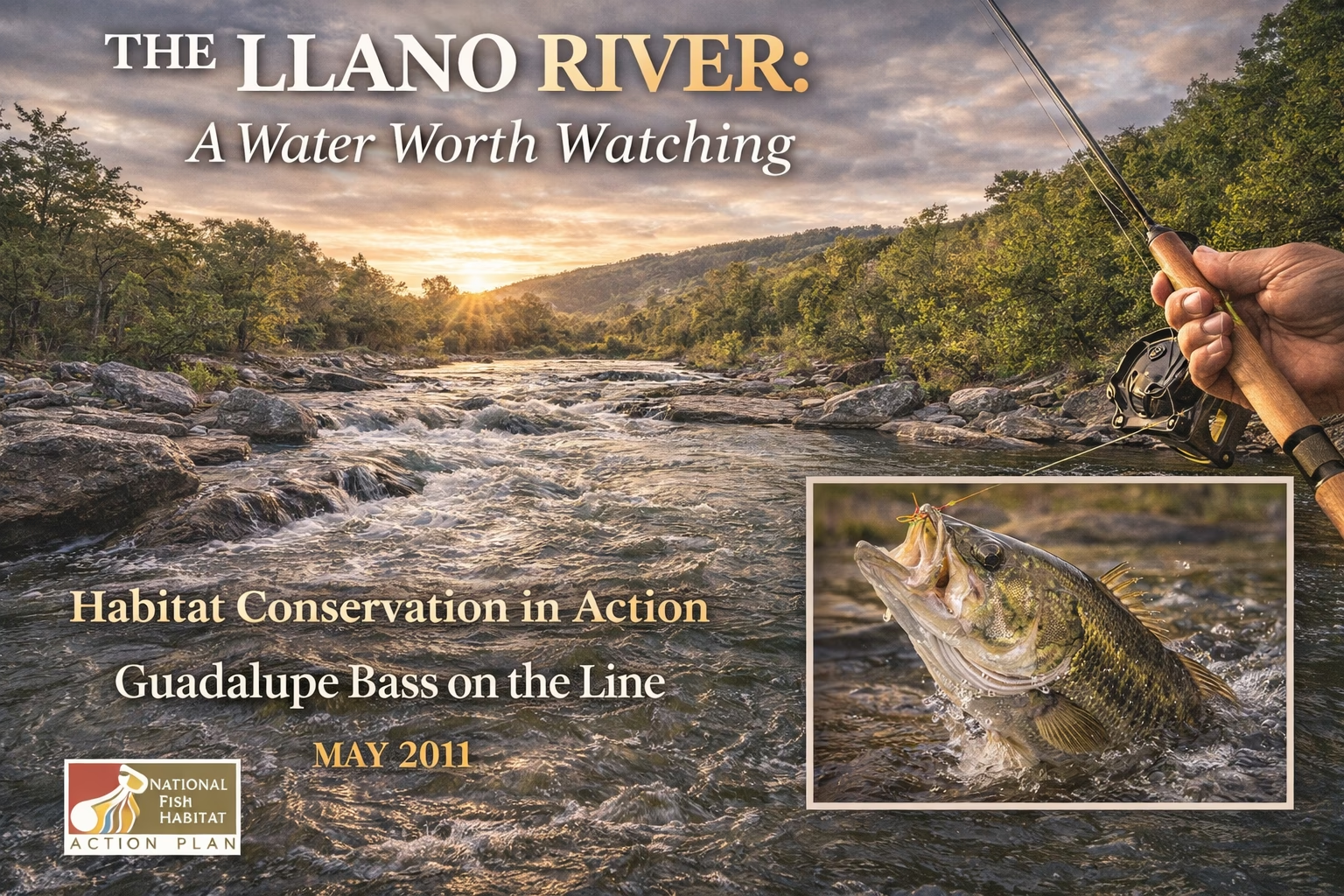
The Llano River has long been one of those quiet treasures of the Texas Hill Country—clear water sliding over granite, cypress-lined banks, and a fish that belongs nowhere else on earth. Now, it’s getting the recognition it deserves.
Named one of just ten “Waters to Watch” for 2011 under the National Fish Habitat Action Plan, the Llano isn’t being singled out because it’s failing—but because it’s worth protecting.
And more importantly, because it offers a blueprint for how to do it right.
A River Worth Fighting For
The “Waters to Watch” list highlights conservation efforts across the country—places where collaboration, science, and boots-on-the-ground work are making a real difference. Since its launch in 2006, the initiative has focused on reversing declines in aquatic habitats critical to fish, wildlife, and the people who depend on them.
In Texas, the mission centers on one fish:
The Guadalupe bass.
As the official state fish, the Guadalupe bass is as much a part of Texas as mesquite and limestone. But in recent years, its numbers have declined—pressured by habitat changes, reduced stream flows, and perhaps most significantly, hybridization with introduced smallmouth bass.
It’s a tough spot for a fish built for flowing water, now forced to compete in a changing landscape.
But there’s still time.
A Watershed Approach
The Llano River project isn’t focused on a single stretch of water—it’s about the entire watershed.
That means protecting not just the river itself, but the tributary streams that feed it, the surrounding hills that shape runoff, and the riparian zones that filter and sustain life along its banks. It’s a big-picture approach, built on the understanding that healthy rivers start far upstream.
And it’s working.
Many stretches of the Guadalupe bass’s native range remain remarkably intact—clear, flowing, and capable of supporting strong populations. But with population growth and increasing water demands across Texas, those conditions won’t hold without effort.
That’s where people come in.
Because unlike many parts of the country, most of this land is privately owned. Conservation here depends on cooperation—landowners, agencies, and organizations working together toward a shared goal.
Boots on the Ground
So far, the project has secured more than $1.4 million in grants and donations, with support from groups like the National Fish and Wildlife Foundation and Anheuser-Busch.
That funding is already being put to work.
Stream banks are being stabilized. Native vegetation is being restored. Road crossings that block fish movement are being redesigned or removed. In-stream habitat—root wads, logs, and boulder structures—is being added to create the kind of complexity fish need to thrive.
Even the uplands are part of the plan, with grassland restoration helping recharge springs and maintain natural water flows.
It’s not flashy work.
But it’s the kind that lasts.
Strength in Partnership
At the heart of the effort is the South Llano Watershed Alliance—a coalition of landowners and stakeholders committed to preserving the river through stewardship, education, and cooperation.
They’re joined by a long list of partners, including the Texas Parks and Wildlife Department, U.S. Fish and Wildlife Service, The Nature Conservancy of Texas, universities, fishing organizations, and local communities.
It’s a broad effort—exactly what it takes to protect something this important.
Since 2006, more than $12 million in federal funding has supported 257 habitat projects across 43 states, leveraging an additional $30 million from partners. The Llano stands as one of the clearest examples of what that investment can accomplish.
As National Fish Habitat Board Chairman Kelly Hepler put it, these projects show what’s possible when local, state, and federal partners work together—not just treating the symptoms of habitat decline, but addressing the causes.
Because rivers like the Llano don’t need saving in the dramatic sense.
They need care.
Attention.
And people willing to think ahead.
Do that, and the water stays clear…
the fish stay wild…
And the next generation gets to stand on those same granite banks,
watching a Guadalupe bass rise in a river that’s still very much alive.

0 Comments