
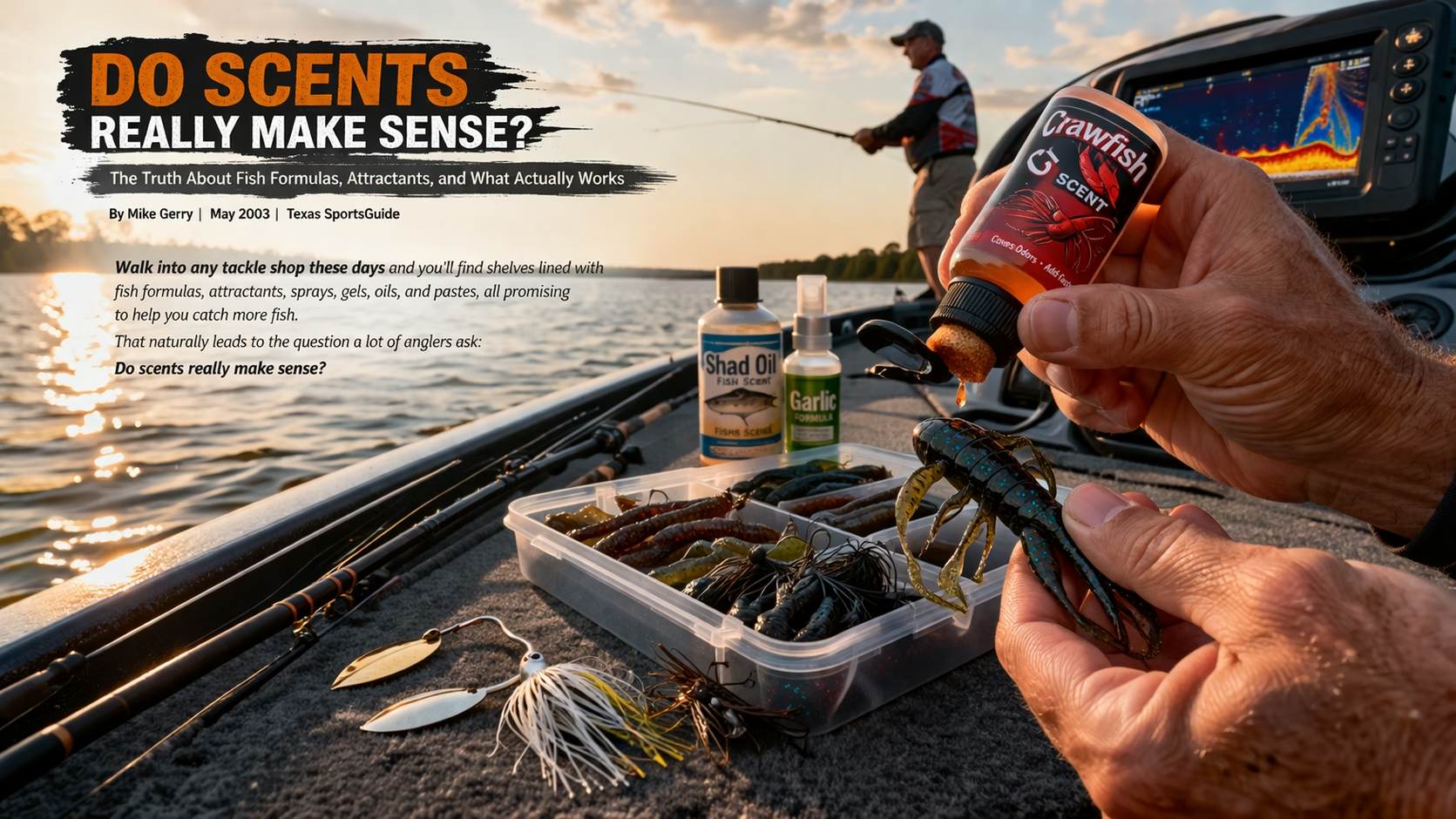
Walk into any tackle shop these days and you will find shelves lined with fish formulas, attractants, sprays, gels, oils, and pastes, all promising to help you catch more fish.
That naturally leads to the question a lot of anglers ask: Do scents really make sense?
I get at least a dozen emails and phone calls every week from fishermen wanting to know if fish formulas are worth the money. My answer is usually yes. As a matter of fact, I would not want to head out on the water without some kind of fish formula in the boat. But that answer comes with a little explanation, because there is a big difference between what these products are claimed to do and what they actually do.
The first thing we ought to clear up is one of the biggest myths in fishing.
There is really no such thing as a true fish attractant, at least not in the sense most anglers think of it. Unless you are chumming in saltwater, these products are not out there drawing fish in from half a mile away like a dinner bell. What most fish formulas really do is cover up unwanted odors and tastes that may already be on your bait.
That is a mighty important job.
Think of it this way. A deer hunter uses scent to help mask human odor while walking through the woods. Fish formulas work on much the same principle. They are less about attracting fish from a distance and more about covering up the gasoline, sunscreen, aftershave, food residue, rust, mold, must, or other foreign smells that may have gotten onto your hands and then onto your bait.
And yes, fish can detect that stuff.
A bass, along with many other species, has an astonishing sense of taste and smell. If you handle your bait after pumping gas into the boat, rubbing on sunscreen, or swatting at a sandwich, there is a good chance you are leaving behind enough foreign scent to make a fish short-strike or spit the bait in a hurry.
Here is a perfect example.
Let’s say you stop on the way to the launch and fill up your boat with gas. A little gasoline gets on your hands. You do not have a place to wash up, so you just keep going. When you reach your favorite fishing hole, you thread on a plastic worm and make your first cast. The fish are there, but the action is slow. Maybe you get a few short strikes, maybe no bites at all, and you cannot figure out why.
Chances are, that bait is carrying more gasoline than confidence.
That is where fish formulas come into play. Their biggest value is that they help cover unwanted scent and, in some cases, add a taste fish will hold onto just a little longer. Sometimes that extra split second is all the time you need to feel the bite and set the hook.
As for what kind of formula to buy, that is where the answer gets a little more complicated.
There are a lot of good products on the market, and I am hesitant to tell someone there is only one brand worth buying. There are too many manufacturers, too many formulas, too many scents, and too many delivery styles for that. Some come as liquids, some as sprays, some as jellies, and all have their own pros and cons.
Personally, I keep things simple.
For bass fishing, I rely on three basic scents that cover just about all my needs: crawfish, shad, and garlic.
I use crawfish formula on plastics and jig-and-pig combinations. I use shad oil or shad scent on action baits such as spinnerbaits, jerkbaits, crankbaits, and topwaters. And when things get slow, I often turn to garlic scent as a change-up.
If there is one point worth remembering, it is this: a crawfish is always a prime food source for bass, often even more dependable than baitfish. That alone makes crawfish scent a smart choice for a lot of situations.
Now let’s talk about the other side of the coin, because applying fish formula can sometimes be more aggravating than helpful.
Over the years I have tried just about every method imaginable. I have used spray-ons that turned a windy day into a drifting chemical cloud. I have used dip tubs that seemed more likely to coat my boat than my bait. I have poured formula straight from the bottle, only to discover that I was putting more money into the lake than onto my lure.
If you have ever spilled scent on boat carpet, watched it gum up on fiberglass, or had it drip all over your hands and gear, you know exactly what I mean.
For many years, that was one of the biggest drawbacks of using formulas. They worked, but applying them could be a mess. At times, I was going through seven or eight containers a season, and that gets expensive in a hurry.
Eventually, I started using formula almost like hand lotion, rubbing a little onto my hands so that anything I touched, especially artificial baits, would pick up the scent. That helped reduce contamination and cut down on waste. I even wrote about that method a few years ago in an article on fish attractants.
Then, shortly after that article was published, I got an email from a fellow angler named Darryl. He asked if I had ever heard of a product called the Scentbox, which he had invented. I told him I had never seen anything like it. He sent me one to try.
And I will say this plainly: it became one of the most useful fishing tools I have ever put in my boat.
Over the years I have seen plenty of products, some good, some bad, and some that should never have left the drawing board. But the Scentbox became part of my routine almost immediately. If I had to compare its usefulness, I would say it is as important to a fisherman using artificial lures as a hammer is to a carpenter.
I have used the Scentbox every time I have been on the water since it was introduced to me, and I would not want to be without it.
Here’s why.
First, it saves money. I now use about one container of formula per season instead of burning through seven or eight.
Second, it is clean. It keeps formula off your hands, off your carpet, off your fiberglass, and out of the water. It is essentially drip-free.
Third, it works so well that it became a true tool in my profession. Students in my three-day bass fishing school and many of my charter clients ended up wanting one after trying mine.
When a product saves money, solves a nagging problem, and helps put more fish in the boat, it deserves a serious look.
And that is really the point here.
I have written plenty of articles over the years aimed at helping anglers better understand fish, tackle, and technique. But every now and then a product comes along that is practical enough, simple enough, and useful enough that it needs to be passed along. In my view, the Scentbox is one of those products.
It is not just for bass fishermen, either. It can be useful for panfish anglers chasing crappie, bluegill, and perch, for freshwater fishermen of all stripes, and for saltwater anglers who rely on artificial lures. The company even offers the Scentbox in three sizes, one for panfish, one for freshwater fishing, and one for saltwater use.
The last time I mentioned a product without telling readers how to find it, I got swamped with emails. So this time I will save everybody the trouble.
The Scentbox can be seen online at scentbox.com. It is made by Lake Champlain Bait and Tackle, Inc., and more information is available toll-free at 1-800-331-2188.
So, do scents really make sense?
Yes, they do, but probably not for the reason most anglers think.
They are not magic potions. They will not call fish in from the next county. But they can cover up bad odors, help fish hold a bait a little longer, and improve your odds when the bite gets tough. And when paired with a clean, efficient delivery system like the Scentbox, they become even more valuable.
In fishing, little edges matter.
Sometimes the difference between a slow day and a good one is no bigger than a whiff of crawfish on a plastic worm.



0 Comments