
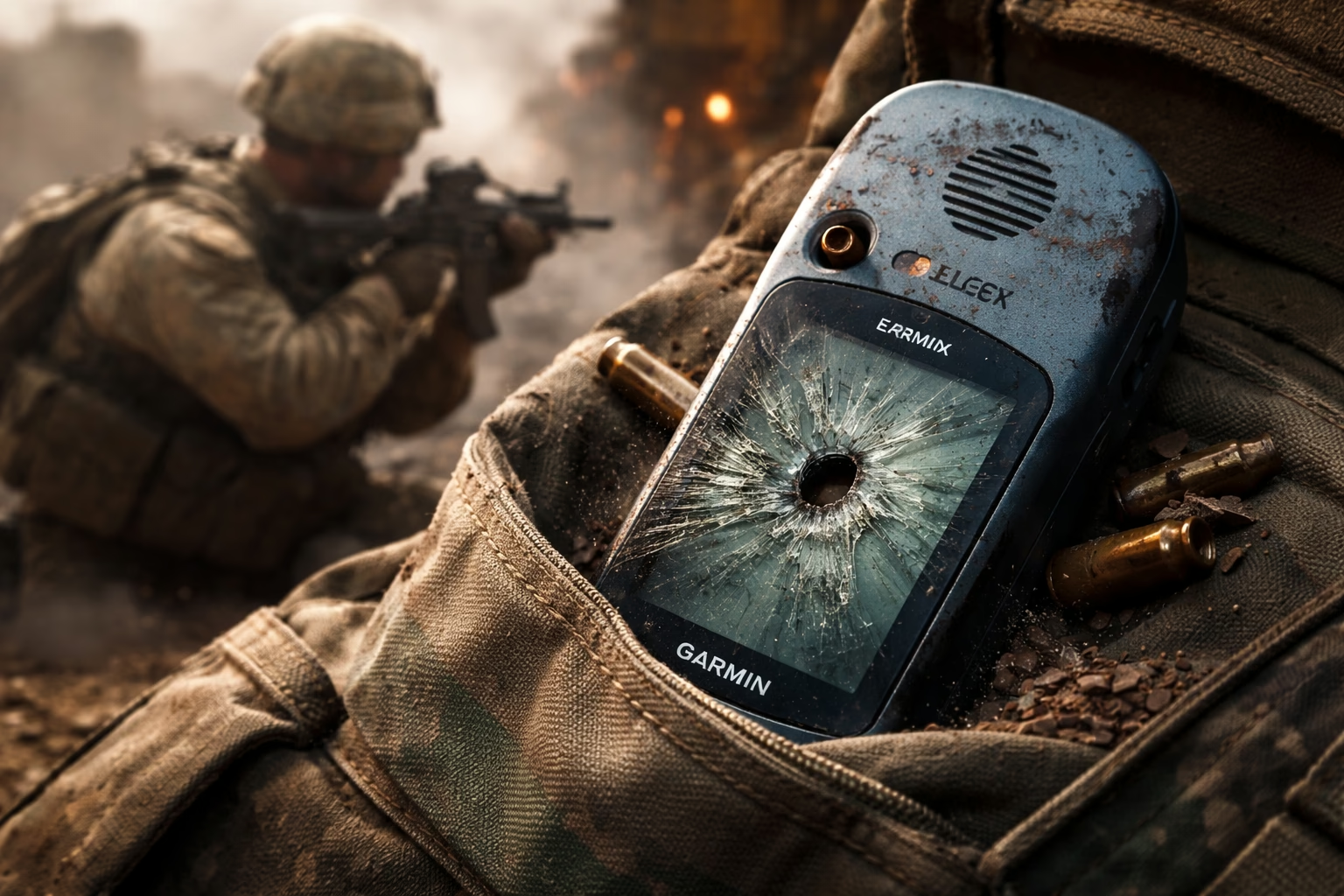
Sometimes a piece of gear earns its reputation the hard way. Not in a showroom, not on a spec sheet, but in the kind of moment where everything is on the line and there’s no room for second chances. This is one of those stories.
What follows is an edited account from a letter sent to Garmin, dated May 22, 2003.
I’d like to share a story about my son, Chris, and your Garmin eTrex Legend.
Chris is a Lance Corporal in the U.S. Marine Corps. Prior to Christmas, he asked for a GPS unit. We went to Circuit City in Poughkeepsie, New York, to look at options. Because he serves in an infantry unit, we knew whatever he carried had to be compact and lightweight. After looking things over, we chose the Garmin eTrex Legend.
In early January, his unit shipped out to Kuwait aboard a Navy vessel. Chris took the GPS with him, drawn to its reliability and ease of use. Whenever he pulled it from his pocket, it quickly became a focal point. Other Marines would gather around, eager to get a fix on their position in unfamiliar territory.
In a letter dated March 17—the day the war began—Chris wrote that his unit would be moving into Iraq to capture and hold two bridges. He mentioned they would have tank and artillery support from both Army and Marine Corps units. He closed that letter by saying it should be an easy mission.
The town was An Nasiriyah.
Because he trusted the GPS, Chris made the decision to carry it with him. For an infantryman, every ounce matters, and every item must justify its place. As it turned out, that small decision carried more weight than anyone could have imagined.
Nasiriyah became one of the fiercest early battles in the war against Saddam Hussein’s regime. Chris’s unit was hit in an ambush by Fedayeen fighters who had feigned surrender. Ten Marines were lost.
During the fight, Chris was moving with a group through the streets when he suddenly felt his pants pocket jerk sharply across his body. Instinct took over. He turned toward the source and fired. Chris had qualified as an expert marksman, and his shot hit its target, stopping the ambush before the attacker could fire again.
What made the difference was knowing where that shot had come from.
The bullet had struck the GPS unit in his pocket. The impact—and the way the unit shifted—gave Chris just enough directional information to react instantly. He later said the GPS may also have deflected the bullet slightly, possibly preventing a more serious injury.
The round tore through his pocket and destroyed the unit.
I believe, by the grace of God, that he had that GPS in his pocket at that exact moment.
Though the eTrex Legend was destroyed, its final act delivered something no engineer could have designed into it. It gave my son the information he needed in a split second—and that may have saved his life.
So while I thank your company for making a product my son trusted and relied on, I also thank you for providing a tool that became far more than it was ever intended to be.
Out on the water or in the field, we tend to measure gear by performance, durability, and features. Fair enough. But every now and then, a piece of equipment steps into a different role entirely. Not just a tool, but a silent partner when things go sideways.
That little handheld GPS didn’t just mark coordinates. On one hard day in Nasiriyah, it marked the difference between a close call and something far worse.

0 Comments