
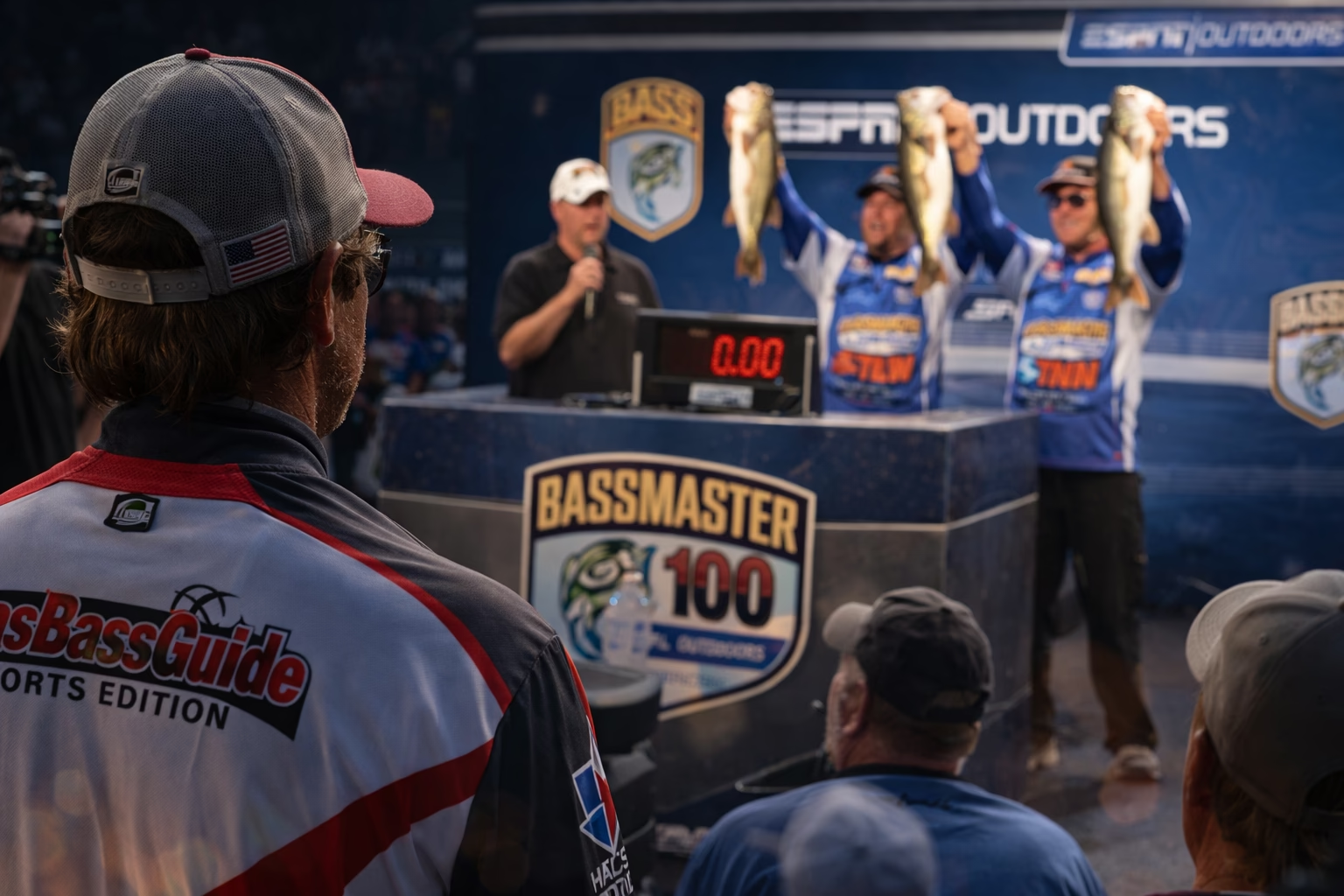
After fishing seven tournaments last fall, from Texas all the way to the Canadian border in New York, I came away with one strong conclusion: a bass is a bass, no matter where you find him.
I fished tournaments in New York, Virginia, Maryland, North Carolina, Missouri, and Texas, and while the scenery, terrain, and water color often changed dramatically from place to place, the fish themselves did not. Once I got around the bass, catching them was usually the easy part. The real challenge was learning to see past the unfamiliar country and trust what I already knew.
That was one of the biggest lessons of the fall.
When you travel far enough from home, it is easy to get distracted by different shorelines, different vegetation, different water, and different weather. But bass still position around shallow cover in much the same way, no matter what state you are in. Stumps, rocks, laydowns, grass, docks, and other shallow cover all held fish in very familiar ways, just as they do back here in Texas. The trick was not to get too caught up in what looked different and forget to rely on what stayed the same.
Last fall, I lived on the road for three and a half months, from mid-July through October. The tournaments were simply too far from home for me to travel back and forth between events, so instead I stayed out and pre-practiced for days on end before each tournament. That gave me a firsthand look at how some of the other Top 100 pros approach their schedules, and who does and does not spend extra time on the water before official practice ever begins.
Surprisingly, some of the anglers high in the standings do not pre-practice at all.
They show up to a tournament and fish it almost cold turkey. Now, many of those guys have years of experience on those waters and multiple events behind them, so they are not exactly blind. Still, it is impressive to watch some of them put together strong finishes with nothing more than the standard three days of practice. Their time is often limited by speaking engagements, sponsor obligations, and public appearances. Some of them are also filming television shows between tournaments. Men like Jimmy Houston, Roland Martin, and Larry Nixon have a lot more on their calendars than just the next takeoff.
Fishing the Top 100 has been an incredible experience.
Everybody in that field is there for a reason, and the competition is stout from top to bottom. There are no easy places to gain ground and no weak stretches where a man can relax. You are fishing against the best there is, and they have a way of exposing every weakness in your game.
For a long time, my goal in tournament fishing was simple: weigh in a limit every day of competition.
That is still important, of course, but the Top 100 has taught me something else. At that level, simply weighing in a limit is not enough. To be successful, a man has to weigh in a heavy limit every day. That is a different standard altogether. It is the difference between surviving and contending.
The best way I know to describe fishing the Bassmaster Top 100 is to compare it to professional golf.
Competing in the Top 100 has felt like getting a tour card and stepping onto the PGA Tour. In golf, there is no deeper, tougher weekly competition than the PGA Tour. The same can be said for the Top 100 in bass fishing. Every field is loaded. Every day matters. Every decision is magnified. And if you do not bring your best, the standings will remind you in a hurry.
That is what makes it so challenging, and so rewarding.
I still have four more B.A.S.S. Top 100 tournaments and four more B.A.S.S. Invitationals left in the second half of the season this spring. The road ahead will take me through Mississippi, Alabama, South Carolina, Georgia, North Carolina, and finally back to Texas for one at Lake Texoma.
It has been good to be home for the holidays. A little time off has a way of clearing a man’s head and letting him catch his breath.
But not for long.
Tournament fever is already starting to creep back in, and I can feel the trail calling again. There is still a lot to learn, a lot of water to cover, and a lot of fish to catch. And if the first half of the season has taught me anything, it is that the only way to hang with the Top 100 is to keep learning, keep adjusting, and keep swinging.
That is the road I am on now. And come spring, I will be glad to get back on it.

0 Comments