
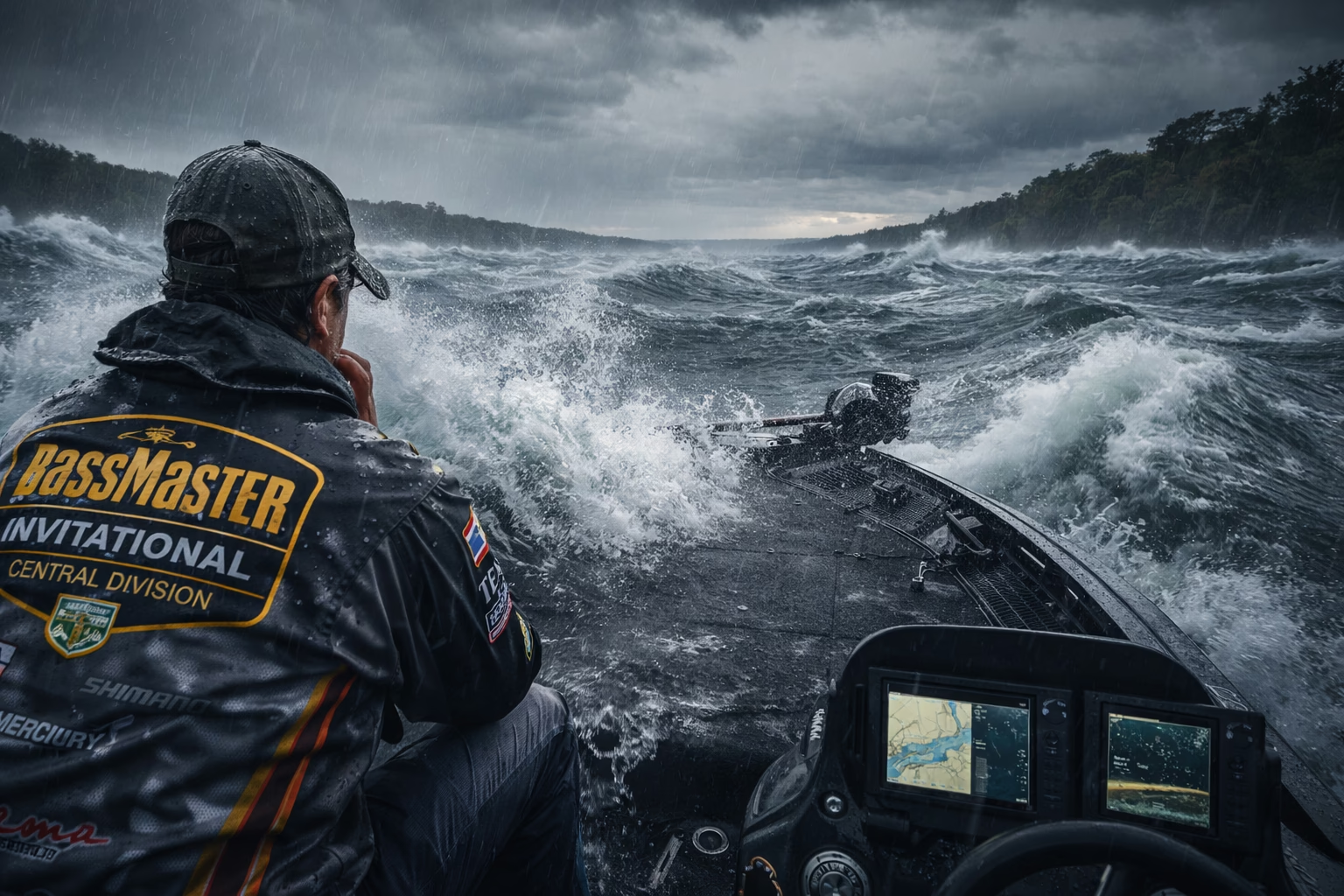
There are rough days on Texas lakes, and then there are days that make a bass fisherman wonder if he accidentally launched into the Gulf of Mexico.
I had one of those days last month on the opening day of the Texas Invitational at Sam Rayburn.
I have been on Toledo Bend, Livingston, Conroe, Rayburn, and Richland Chambers when the wind had those lakes standing on edge. I have seen all of them get mean under heavy weather. But what we faced that first day of the tournament on Rayburn went beyond ordinary rough water. It was the kind of water that gets your full attention and keeps it.
When we launched that morning, the wind was already blowing 15 to 20 miles per hour. It was rough, no question, but still manageable. Six hours later, it had doubled, and five- to eight-foot rollers were charging up from the south end of the lake.
That changed everything.
My partner and I were some twenty miles up the lake, and to get back to Twin Dikes Marina we had to head south, straight into that wind. The middle of the lake had turned into a field of monsters, waves big enough to swallow a bass boat whole if a man got careless. In that kind of weather, the middle of the lake is exactly where you do not want to be.
One of the first things to remember when big wind hits a reservoir is that the main lake channels the wind right up the middle. That usually means one bank or the other will offer the safest route back. It may not be comfortable, but it is often more protected than trying to bull straight through the center of the lake.
Any point that sticks out into the lake and breaks the wave action can also become your best friend. If you can run behind those points, even for part of the trip, they can give you a stretch of relative protection and a chance to gather yourself before heading back into the open water.
Of course, those protected stretches do not last forever.
When you run out of sheltered water, you simply have to power through the heavy stuff one wave at a time, and there is no room for impatience. Tacking back and forth can help because it lets you cut the waves at an angle rather than taking them straight on. That reduces the chance of spearing into a wave or submarining the bow, either one of which can turn a bad day into a dangerous one in a hurry.
Even choosing which side of the lake to run can be tricky in a true blow.
At one point that day, I rounded a main-lake point and found waves so large I could barely make progress at all. I knew of another point, roughly three miles across the lake, that extended far enough out to offer a protected stretch if I could just reach it. So I turned the boat across the wind and made a run for the opposite shoreline.
That move did not help me immediately. In fact, for a while it probably felt worse. But once I reached that other side, I was able to turn downlake, get behind the point, and make a much safer run for a couple of miles.
That is part of the challenge of running big water. You are constantly reading the lake, reading the wind, and trying to think two moves ahead. The wind curls around points, wraps into coves, and does not always behave the way you want it to. Still, using main-lake points as shields is one of the best tips I know for handling rough water on our bigger Texas lakes.
Just as important as boat handling, though, is keeping your head.
Patience and composure greatly increase your odds of getting through big water safely. Panic does the opposite. A man has to stay calm enough to think, because once fear starts making the decisions, trouble is usually not far behind.
And I will admit, somewhere in that mess on the first day, fear started to creep in.
The strange thing about truly big water is what it does to your senses. At one point, it was as if I could not hear anything at all. Not the wind. Not the water. I could only feel the isolation that comes when Mother Nature is close to getting the upper hand. It is a hard feeling to describe, but if you have ever been there, you know it. It is the loneliest feeling in the world.
That is why rough-water knowledge matters.
Hopefully, you never find yourself in that kind of situation. But if you do, remember a few simple things. Stay off the middle when you can. Use the bank. Use the points. Cut the waves at angles. Take your time. Keep your cool. And above all, respect big water before it forces you to.
Because on a calm morning, a Texas reservoir can feel like an old friend.
By afternoon, under the wrong wind, it can feel like something else entirely.

0 Comments