
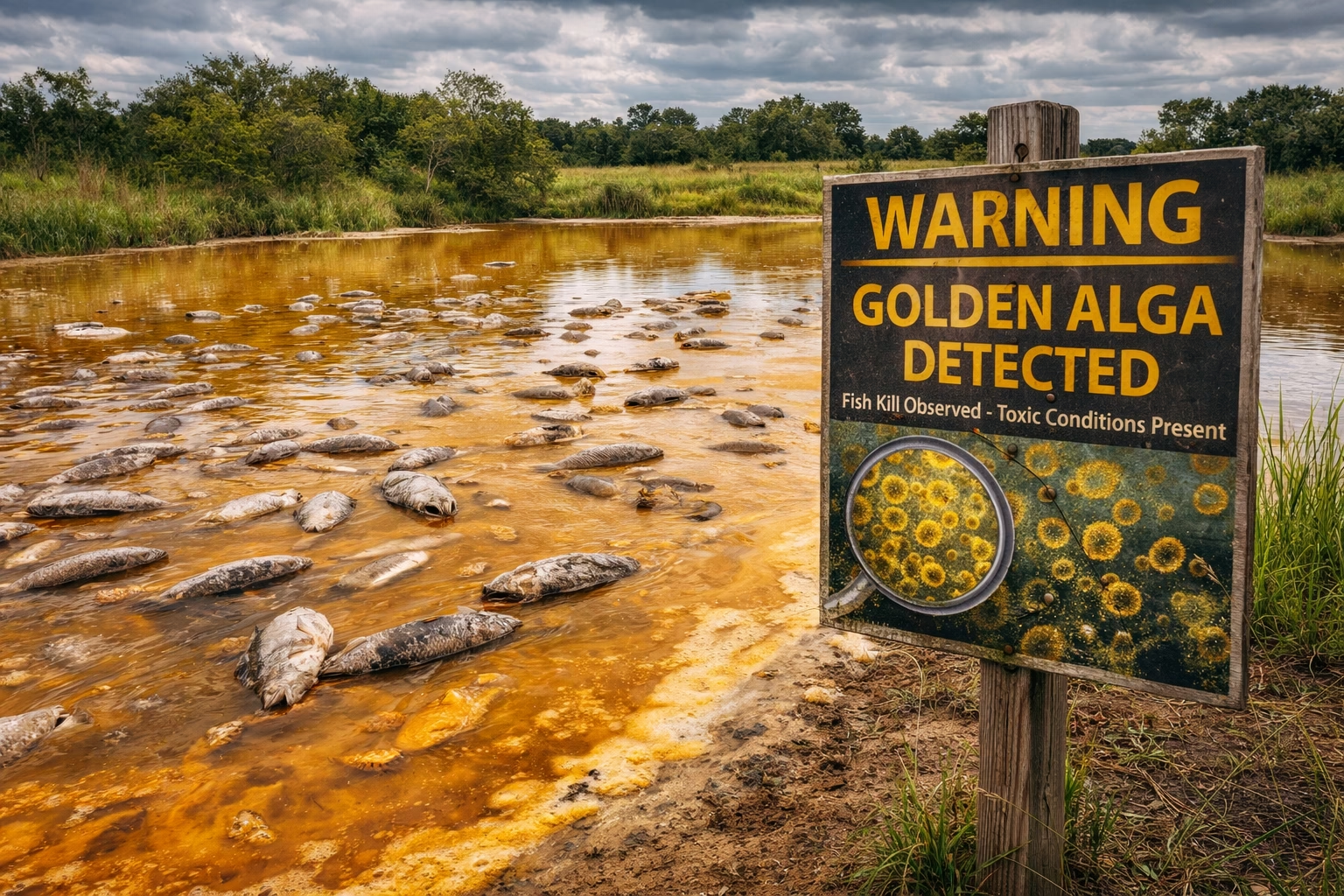
Golden Alga Creeps South: A Quiet Threat Beneath the Surface
It doesn’t arrive with warning sirens or rolling thunder. It slips in quietly, turning water the color of tarnished brass and leaving stillness where there should be life. Since January 2009, a microscopic organism long familiar to North and West Texas has begun showing up farther south—raising eyebrows and tightening lines among those who make their living and their memories on the water.
The culprit is Prymnesium parvum, better known as golden alga.
Confirmed this year at four South Texas locations—Corpus Christi, Kingsville, McAllen, and Jim Hogg County—the organism has already been linked to fish kills in private ponds. Investigations by the Texas Parks and Wildlife Department’s Kills and Spills Team found no evidence of impact to public waters, but the presence alone is enough to put biologists and anglers on notice.
Golden alga isn’t new to Texas. It first appeared in the Pecos River in 1985, marking its debut in the Western Hemisphere. Before that, it was largely a European resident, favoring brackish coastal waters. Since its arrival, it has steadily expanded its reach, now documented in inland waters across at least 15 states.
Under the right conditions, golden alga can multiply rapidly, forming what biologists call a bloom. When that happens, the water may take on a yellow or copper tint, sometimes accompanied by a telltale foam along the shoreline. The real danger, however, lies beneath the surface. During these blooms, the organism can release toxins that attack gill-breathing species—fish, clams, and mussels—often with devastating results.
There is, at least, a narrow margin of escape. Fish can sometimes avoid the worst effects by moving into areas of fresh, flowing water—creeks, inlets, or springs where dilution offers a temporary refuge. But when conditions align just right, even that escape can be hard to find.
Since 2001, golden alga has been responsible for seasonal fish kills across several major river systems, including the Canadian, Red, Brazos, Colorado, and Rio Grande basins. Notably, the lower Brazos River experienced two such events in 2006—an eastward shift from earlier patterns, where most outbreaks occurred west of Interstate 35.
What remains uncertain is why golden alga behaves differently in the United States than it does overseas. In Europe, the Mediterranean, and parts of New Zealand, it is primarily a coastal concern. Here, it has taken hold in freshwater systems. That adaptability, combined with its tolerance for a wide range of salinity levels, has raised a troubling possibility: that one day it could reach Texas bays and estuaries, triggering fish kills similar to those caused by red tide.
For now, Texas Parks and Wildlife is keeping a close watch. The agency is working alongside river authorities, universities, and other state partners to monitor outbreaks, study the organism, and better understand how to manage its effects. Research has yielded some success in controlling golden alga in ponds and small reservoirs, but those methods don’t scale well. On larger bodies of water, the challenge remains largely unsolved.
There are a few practical takeaways, particularly for landowners. Golden alga struggles to thrive in water with salinity below roughly 1.5 parts per thousand. Avoiding the use of salty groundwater or surface water to fill or top off ponds can help reduce the likelihood of a bloom—and limit the chance of spreading the problem downstream.
Like many things in the natural world, golden alga is neither villain nor invader in the traditional sense. It simply exists, waiting for the right conditions to tip the balance.
But when it does, the change can be swift and unforgiving—one more reminder that beneath even the calmest Texas water, there are forces at work we’re still learning to understand.

0 Comments