
On December 19, 1995, I stood in line at Houston Intercontinental Airport waiting to board a flight to London, England. From there I would catch another flight to Lagos, Nigeria. I was anxious to get the trip underway, not only to visit my parents, who were living in Lagos at the time, but also to experience some of the offshore fishing my dad had been telling me about.
At that point, all that stood between me and Africa was a ten-hour flight to London, a six-hour layover, and then another seven-hour flight across the Sahara to Lagos. I also had another mission. Along with my own luggage, I was carrying two suitcases packed with things my parents had trouble finding there, everything from Velveeta cheese to Spray ’n Wash, flour, and corn tortillas. In addition, I hand-carried a couple of boxes of offshore tackle my dad had specifically requested. That tackle was special cargo, and I intended to guard it with my life. Good fishing tackle, like a lot of other things, was not easy to come by in Lagos.
Twenty-six long hours later, I was standing in the living room of my parents’ high-rise flat. It sat about a mile from the coast, and from the balcony I could see the Gulf of Guinea stretching out into the Atlantic. Looking out over the city, the coastline, the homes, and the people, I got a quick lesson in perspective. A trip to another country has a way of doing that. It can change the way you look at your own life in a hurry.
After visiting awhile with my parents and sisters, jet lag finally caught up with me and hit like a hammer. It had been three years since I had traveled this far, and I had long since forgotten the little routine I used to follow on long international flights to keep from paying the price afterward. My parents had once lived in Sumatra, Indonesia, which was even farther away, but this was my first trip to Lagos, and by the time I arrived I felt every mile of it. I slept well into the next day.
A couple of days later I had adjusted to the time difference and was ready to fish.
My dad and I had fished or hunted together just about every weekend when I was growing up. The only thing that kept us from making a trip was one of my Little League games. But with his overseas assignments and me getting older, we no longer had the opportunities we once had to spend time together outdoors. These days, any trip we made together was special, and we were both looking forward to a few days of offshore fishing.
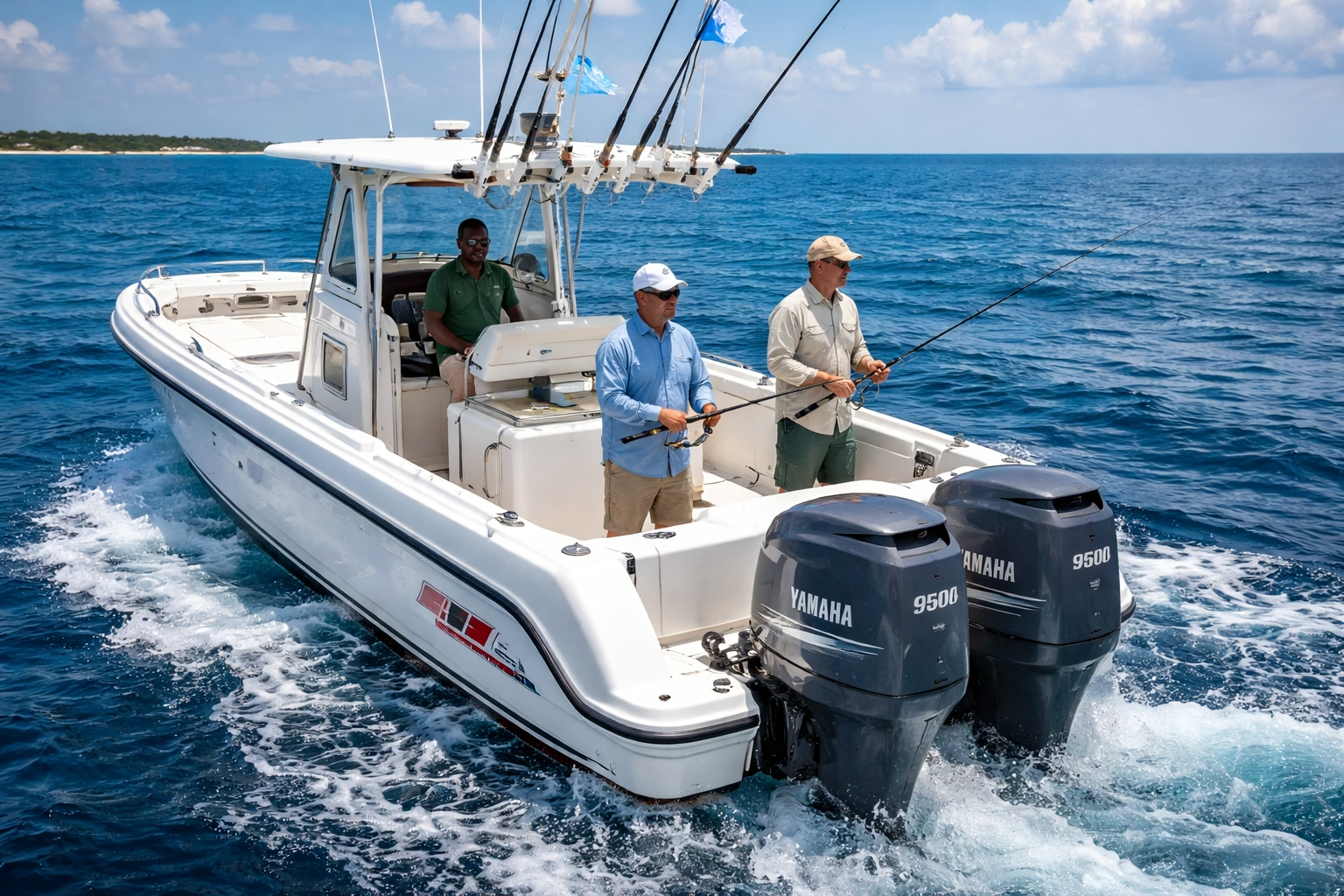
We left early on the 27th and headed down to the boat. Lucky, the Nigerian captain, was waiting for us with the twin 250-horsepower Yamahas already warming on the back of a 28-foot Boston Whaler center console. My dad had told me the boat was impressive, and he had not exaggerated. Edwin, the security guard, came along as well and helped us get the gear aboard.
We eased out of Lagos around 7:30 that morning and headed toward a GPS coordinate where they had previously caught barracuda, wahoo, dorado, and the occasional marlin. Off that stretch of West Africa there is a shelf they referred to as “the drop.” The bottom slopes gradually away from the mainland for about twenty miles until it reaches around 600 feet, and then, according to the topography charts, it plunges to 7,000 to 9,000 feet. Along that break, marlin and sailfish roam, and other game fish gather around the trash line that often forms nearby under normal conditions.
The coordinates we were running to marked a particular draw in the drop that they called “the Hole.”
We ran out of the harbor, down the ship channel, and through the jetties. In some ways it reminded me of heading offshore from Freeport. As soon as we cleared the jetties, Dad and I started rigging rods and setting out tackle. We had about an hour’s run before reaching the area.
The seas were calm, just three- to four-foot rollers spaced maybe twenty-five or thirty yards apart. As we neared the drop, we came across the trash line first. Lucky slowed the Whaler and paralleled the line while Dad and I started setting out baits. Way back in the spread we had a “bird” running ahead of a big marlin plug. At about the same distance we also had two large, blunt-headed marlin baits. Those were trolled on heavy tuna sticks matched with Penn 50s spooled with 80-pound line.
Closer to the boat we ran three one-ounce feather jigs on seven-foot spinning rods spooled with 25-pound test.
It did not take long.
Dad and I hooked up almost simultaneously on two of the spinning rods. For the next three or four minutes we both had our hands full. When we finally worked the fish to the boat, we found ourselves doubled up on bluefin tuna in the six- to seven-pound class. They were not giants, but they fought with all the power and determination that tuna are known for.
Lucky bumped us back up to trolling speed, and we settled in again, waiting for the next strike.
It came soon enough. I hooked up on my spinning rod, and this fish was noticeably stronger than the tuna. Before I could ever turn it, the fish burned off about fifty yards of line. The water was sky blue, and when it neared the boat we could see it deep below us, maybe thirty or forty feet down. At first it looked like a barracuda or perhaps a kingfish, but once I got it closer there was no doubt. It was a wahoo, probably in the twelve- to fifteen-pound class.
We worked the trash line and the drop until around noon, catching tuna, wahoo, and dorado. Then Lucky, who had the sort of sharp eyes offshore captains are born with, spotted a ship anchored just on the horizon and suggested we troll past it. Dad and I reeled in the lines, and Lucky pushed the throttles down toward the distant vessel.
Fifteen minutes later we approached the ship and put the spread back out. It was a tanker from South America, anchored and waiting to enter the harbor. We trolled past it once, and then one of the heavy rods got hit.
The drag screamed as line poured from the reel.
I moved quickly to the rod, fastened on my fighting belt, clipped into the reel, and dropped the rod into the belt holster. Lucky turned the boat toward my side since the fish had run hard out to port. Dad cleared the rest of the rods, and then it was just me and the fish.
After the initial run, it did not take much more line, but it held stubbornly about a hundred yards from the boat. I pumped and reeled, pumped and reeled, until my arms began to burn. About ten minutes later we could see a long, silvery shape under the boat. I eased it up, and Dad and Lucky both reached with the gaffs and boated it.
It was a barracuda, around thirty pounds.
After that quick battle I was worn out, and I could not help but wonder how I might fare if I ever hooked a marlin that wanted to fight for two hours instead of ten minutes.
We made several more passes by the ship, catching additional tuna, and Dad boated a fine dorado that weighed around twenty-five pounds. We fished until 4:00 that afternoon and then turned back toward Lagos.
By the time we got back, the coolers held tuna, wahoo, dorado, and the barracuda. It had been a day full of action, the first of several good days we would get to spend fishing while I was there. Lucky proved himself to be a savvy offshore captain, and I had no doubt my dad would continue to rely on his knowledge of those waters.
On another day, we even had a marlin hookup. Lucky estimated the fish at around 250 pounds. It hit, came out of the water, and ripped line for about forty-five seconds before throwing the hook. That one got away, but that is fishing.
Overall, it was a trip I will always remember. I hope to make it back again someday, whether in summer or the following fall. Traveling to another country is always interesting. You get to see how people live, how they work, and how they go about their days. But when you add in the chance to fish unfamiliar water with your father, the trip becomes something more than travel.
It becomes an adventure.
And no matter where in the world you find yourself, that is still one of the finest reasons there is to go.

0 Comments