
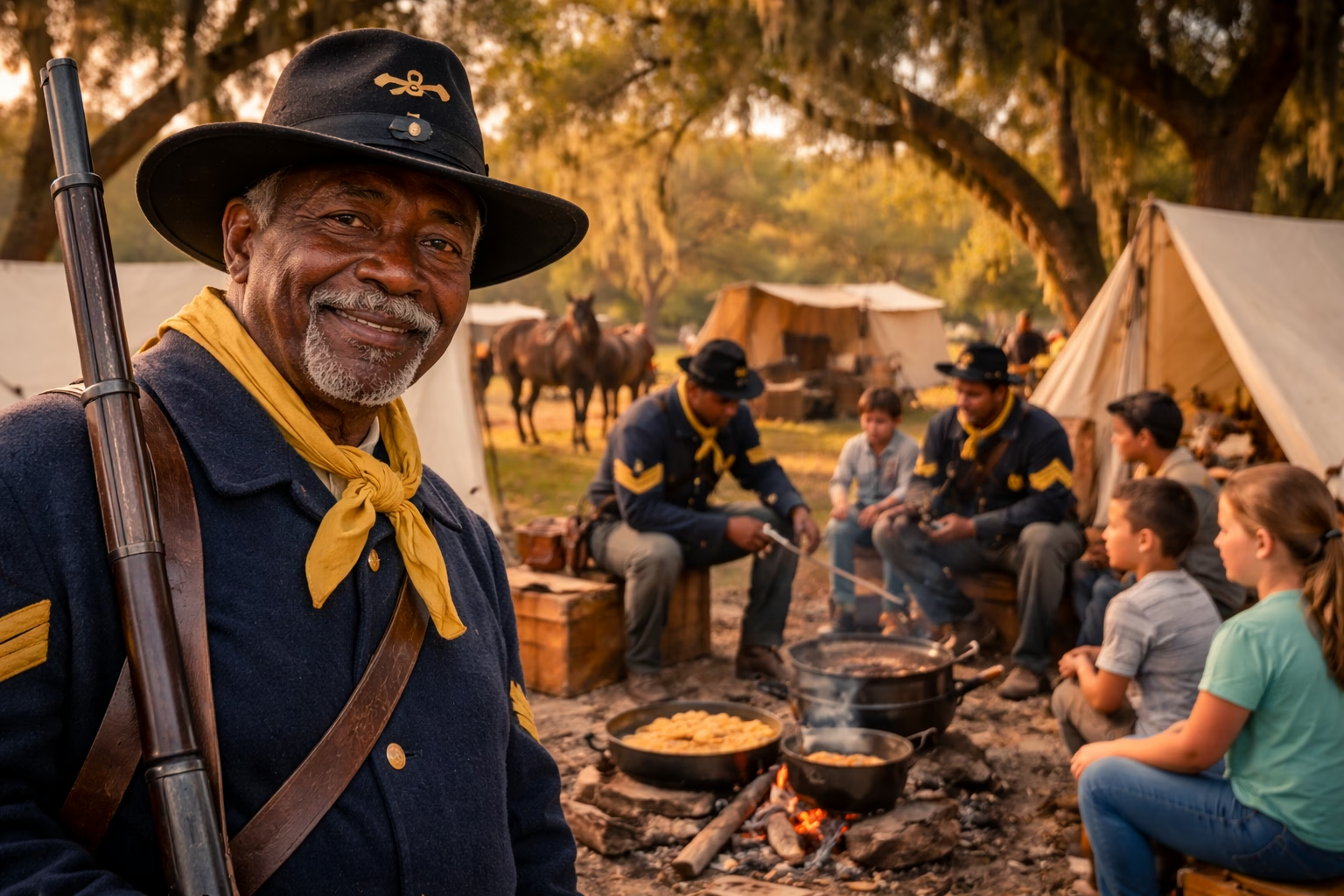
Some stories don’t disappear—they just wait quietly in the shadows until someone takes the time to bring them back into the light. Tucked inside an unassuming gray warehouse on the edge of downtown Austin, one of those stories is being carefully gathered, preserved, and retold.
From the outside, you’d likely drive right past it. A small Texas Parks and Wildlife Department seal on the glass door is the only hint of what’s inside. Step through that door, though, and you’ll find yourself standing in the middle of living history.
“Up until 1990, I didn’t know anything about Buffalo Soldiers,” said Ken Pollard, TPWD outreach coordinator. “A lot of Black history focused on slavery—picking cotton, slaughtering hogs. When you hear about the Buffalo Soldiers, people get excited. It’s a new story, and it’s an uplifting story.”
Pollard has made it his mission to help Texans rediscover that story.
With the help of volunteers and reenactors, the Buffalo Soldiers living history program has grown into a traveling classroom, bringing the legacy of African American regiments to schools, historic sites, and communities across the state. These were the soldiers who helped shape the Texas frontier after the Civil War—men given the nickname “Buffalo Soldiers” by American Indians, who saw in them both the strength and spirit of the buffalo.
What started as a single story has grown into something much broader. Today, the program introduces young Texans to a fuller picture of frontier life—one that includes not only African American soldiers, but also frontier women, American Indians, and Mexican communities, all woven into the fabric of Texas history.
That effort hasn’t gone unnoticed. The Texas Legislature designated July as Texas Buffalo Soldiers Heritage Month, and in just over a decade, the program has reached more than a million Texans. It stands as a testament to what a small, dedicated group can accomplish with enough passion and persistence.
Behind it all is Pollard.
His office sits tucked among artifacts—uniforms, letters, and reminders of a life spent connecting people with the past. More often than not, you’ll find him on the phone with a teacher or principal, or scanning a packed schedule of upcoming events.
It’s hard to believe that this chapter of history came into his life relatively late.
Growing up in Lampasas in the 1960s, Pollard dreamed of becoming a park ranger. Back then, though, opportunity didn’t always match ambition.
“If you did go to a park, you had a Black section and a white section,” he recalled. His family rarely visited state parks.
Later, while working as a cadet with the Waco Police Department, he learned about the TPWD game warden academy and applied. He came close—very close—to becoming the first African American game warden in Texas. But timing got in the way.
“I still wouldn’t have been able to carry a gun for a couple of months,” he said of missing the age requirement by a narrow margin.
Instead, he found his way into the parks system, eventually becoming the ranger he had imagined as a boy. His career carried him through assignments at Lake Whitney and Mother Neff State Park, then on to earn a degree in Industrial Maintenance. By the 1980s, he had broken new ground again, becoming the first African American regional supervisor in the TPWD state parks division.
It was in Abilene, working as a maintenance supervisor, that Pollard first encountered the Buffalo Soldiers story. A meeting with the “Soldiers in Blue Committee”—a volunteer group dedicated to preserving that history—set everything in motion.
They started small. Just nine blue wool uniforms.
Today, the program fills a warehouse the size of a school gymnasium.
On any given day, Pollard can be found walking through that space, pointing out buffalo hides, period tents, cooking gear, and carefully crafted replicas of frontier life. There are toys and musical instruments, dresses and tools—each one telling a small part of a much larger story.
He pulls a simple doll from a chest. At first glance, it’s nothing special—a modest figure with a plain dress. Then he flips the skirt inside out, revealing a second doll hidden within.
“You’d love to get this for Christmas,” he says with a grin. “Two for one.”
Details like that matter.
The program strives for authenticity in every corner, right down to the wildlife that might have surrounded a soldier’s camp. Snakes, raccoons, and other native species—often confiscated from poachers—are brought in as part of the educational experience.
“The military was camped out just like you’d go camping today,” Pollard explains. “You’d have these critters around you.”
For many kids, it’s the first time they’ve seen such animals up close.
“Just seeing an armadillo on its feet instead of on its back—that’s unique,” he says. “They see these things on television, but not like this. When we say ‘living history,’ it becomes that.”
Even the food is part of the lesson.
“We’d look pretty funny in an 1800s uniform holding a McDonald’s hamburger,” Pollard jokes.
Instead, meals are prepared over campfires and Dutch ovens—egg rolls, menudo, venison, frog legs—foods that reflect the diverse cultural roots of the frontier.
It’s history you can see, touch, and even taste.
And it’s built to last.
With recognition from the Legislature and growing public interest, Pollard believes the Buffalo Soldiers program has secured its place in Texas history.
“After we’re gone, it will live on,” he says.
Still, he’s not in any hurry to step away.
There are more stories to tell. More classrooms to visit. More young Texans who have yet to hear about the soldiers who rode across this land long before them.
“I’m still having fun,” he says. “I’m in no rush.”
And maybe that’s the heart of it.
History doesn’t always come from textbooks or museum cases. Sometimes it lives in the hands of folks willing to carry it forward—one story, one campfire, one wide-eyed kid at a time.
Out there on the Texas landscape, where past and present tend to blur together, the Buffalo Soldiers are riding again—not in battle, but in memory. And thanks to people like Ken Pollard, they won’t be forgotten.


0 Comments