
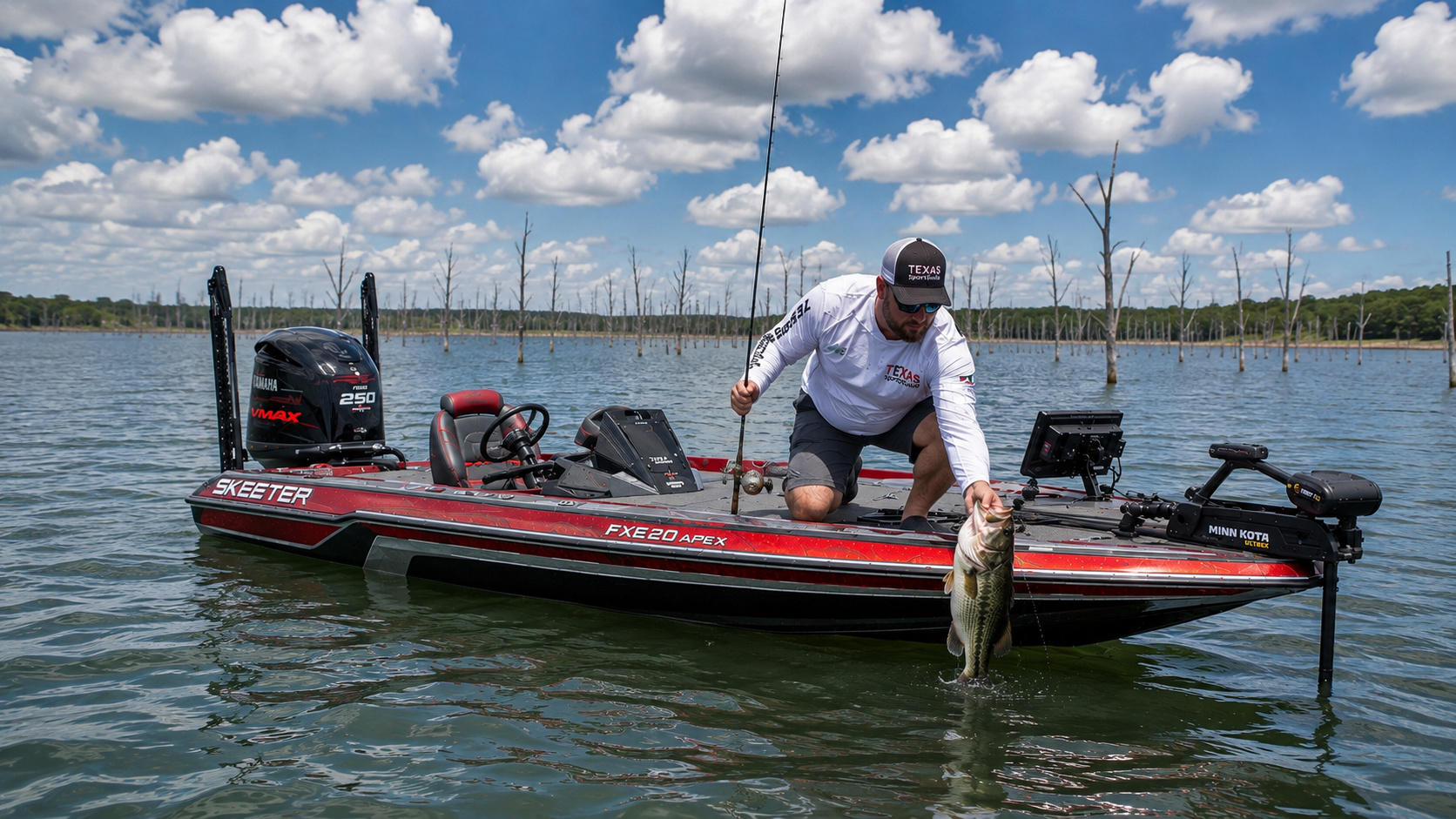
Standing timber, lotus, creek arms, riprap and twelve-pound largemouth bass just beyond the eastern edge of Dallas
Why Lavon Lake Texas Bass Fishing Deserves More Attention
There are Texas bass lakes that arrive with a reputation already attached to them.
Mention Fork, Sam Rayburn, Toledo Bend or Falcon around a group of bass fishermen and nobody needs an introduction.
Lavon Lake is different.
Sitting northeast of Dallas in Collin County, Lavon is easy to overlook on a map crowded with North Texas reservoirs. Yet beneath its greenish water lies a 21,400-acre fishery filled with standing timber, old creek channels, rocky structure, water willow, American lotus and enough largemouth bass to earn a good rating from Texas Parks and Wildlife.
And every now and then Lavon reminds fishermen not to underestimate it.
On March 16, 2021, Gilbert L. Miller caught a 12.06-pound largemouth bass from the reservoir on a Norman Middle N crankbait. That fish remains the current TPWD rod-and-reel lake record.
Twelve pounds of largemouth is enough to make any Texas fisherman pay attention.
Lavon is not a lake where I would expect to spend the day blindly running down the shoreline. It is a reservoir where understanding creek channels, timber, rock, seasonal movement and water level pays dividends.
So let's back the Skeeter down the ramp before daylight, ease away from the dock, lower the Minn Kota and take a proper look at Lavon Lake Texas Bass Fishing.
Where Is Lavon Lake Texas?
Lavon Lake lies in Collin County, approximately four miles northeast of Wylie and northeast of Dallas, with Texas Highway 78 providing one of the principal approaches.
Texas Parks and Wildlife lists the reservoir at:
Surface area: 21,400 acres
Maximum depth: 59 feet
Conservation pool: 492 feet above mean sea level
Normal water clarity: Moderate, with a greenish color
The original reservoir was impounded in 1953, then enlarged substantially in 1974. The U.S. Army Corps of Engineers controls the lake.
U.S. Army Corps of Engineers, Lavon Lake
3375 Skyview Drive
Wylie, TX 75096
Phone: 972-442-3141
U.S. Army Corps of Engineers Lavon Lake information
At 21,400 acres, Lavon is plenty big enough to develop several personalities.
The lower lake near the dam offers deeper water and riprap.
Travel uplake and the reservoir increasingly becomes a timber-and-creek-channel fishery.
Move into the East Fork Trinity River arm or Sister Grove/Pilot Grove system and you encounter the kind of cover that makes a bass fisherman start reaching for a Texas rig.
That's part of Lavon's appeal.
You don't have to fish the same kind of water all day.
What Rivers and Creeks Feed Lavon Lake?
The East Fork Trinity River Is the Main Artery
Lavon Lake is part of the East Fork Trinity River watershed.
That river system is one of the defining features of the reservoir and creates the major western/northern arm.
The watershed also contains several important tributaries.
Pilot Grove Creek flows approximately 36 miles before entering Lavon's eastern arm.
Sister Grove Creek flows approximately 29 miles before reaching the same general arm.
Wilson Creek flows southeast through Collin County and into the western arm of the reservoir.
For bass fishermen, tributaries aren't merely sources of water.
They're migration routes.
Imagine an old creek channel as a country road that existed before the reservoir did. The lake flooded the landscape, but bass still use that submerged road.
During late winter, they travel it toward spawning water.
During summer, the same channel gives them access to depth.
During fall, creek arms become highways for shad, and bass follow dinner.
A fisherman who learns the old drainage system beneath Lavon has already solved one piece of the puzzle.
What Fish Species Live in Lavon Lake?
Texas Parks and Wildlife identifies the principal sportfish as:
-
Largemouth bass
-
White bass
-
Channel catfish
-
Blue catfish
-
Crappie
Sunfish are also plentiful, and the TPWD lake-record database contains records for spotted bass, hybrid striped bass, striped bass and several additional species.
TPWD currently rates Lavon's largemouth bass fishing as good. Crappie and blue catfish receive excellent ratings, while white bass and channel catfish are also rated good.
There is a spotted bass record in the books as well: 2.40 pounds, caught January 22, 2013, by William C. Dudley on a Zoom worm.
But for this trip, our attention is on the green fish.
What Is the Current Lavon Lake Water Level?
This is one of those figures that should always carry a date.
As of August 9, 2026, Water Data for Texas reports Lavon Lake at 93.0% full.
Check the current Lavon Lake water level
TPWD describes normal water-level fluctuation as moderate, with a conservation-pool elevation of 492 feet.
That matters to a bass fisherman.
When water rises into water willow, lotus, cattails or newly flooded terrestrial cover, largemouth may move with it.
When water falls away from shoreline habitat, look toward:
-
Outside vegetation edges
-
Creek channels
-
Timber lines
-
Drop-offs
-
Rock piles
-
Points
-
Submerged concrete and roadbeds
The fish didn't leave the lake because the shoreline moved.
They simply adjusted to the new floor plan.
What Kind of Bass Habitat Is in Lavon Lake?
Standing Timber Is the Big Player
If you're going to understand Lavon Lake Texas Bass Fishing, begin with wood.
TPWD says most of Lavon's structure consists of standing timber, particularly uplake in the East Fork Trinity River arm and Sister Grove/Pilot Grove Creek arm.
That's an enormous amount of potential bass habitat.
The problem is that fishermen often see 500 trees and treat all 500 alike.
Bass don't.
Look for the tree that's different.
Maybe it's beside a channel bend.
Maybe it's standing alone.
Maybe several trees form a little point.
Perhaps one sits in 12 feet while everything around it is six.
The tree itself may not be the reason the bass is there.
The location of that tree may be the reason.
Aquatic Vegetation on Lavon Lake
TPWD identifies water willow as native emergent vegetation and notes the presence of floating American lotus. Aquatic vegetation generally occurs in the backs of Lavon's numerous small bays and coves. Infrequent stands of cattails surrounded by water can also provide excellent fish habitat.
This isn't a reservoir where I would build my entire game plan around vast hydrilla beds.
Instead, treat vegetation as an additional piece of cover.
A little water willow beside a creek ditch can be more valuable than a hundred yards of uniform shoreline.
A lotus edge beside deeper water deserves attention.
A flooded cattail clump isolated from the bank can be even better.
Bass fishermen learn to appreciate irregularity.
Nature seldom draws straight lines, and bass frequently live where one kind of habitat collides with another.
Riprap Along Lavon Dam
TPWD specifically calls the riprap along the dam excellent largemouth bass habitat.
That's valuable information because riprap is dependable structure.
Grass comes and goes.
Water levels rise and fall.
Trees deteriorate.
Rocks remain rocks.
The dam can hold bass during every season, although their depth and exact location will change.
The Winter Warm-Water Pattern
Lavon also has a feature worth remembering during cold weather.
TPWD notes that outflow from the electric generating plant on the east side of the eastern arm can attract fish during winter when surrounding water temperatures fall.
Warm-water areas can concentrate forage.
Where forage gathers, predators aren't usually far behind.
I wouldn't automatically assume every bass in the lake moves there, but during a hard North Texas winter front, any area offering even a small temperature advantage deserves investigation.
Lavon Lake Weather Throughout the Fishing Year
Lavon sits in North Texas, which means fishermen get four legitimate seasons and occasionally several of them during the same week.
Climate data from the nearby Wylie area show January average highs around 57°F and lows around 35°F. By July and August, average highs climb into the mid-90s, with August averaging about 96°F. May is typically among the wetter months, while March and April can be windy.
Winter
December through February can range from comfortable sunny afternoons to freezing northers.
Water temperatures slow bass metabolism, making precise presentation increasingly important.
Spring
March through May brings warming temperatures, strong winds and thunderstorms.
It also brings the year's premier shallow-water bass movement.
Summer
June through August is hot.
Early mornings, deeper structure and shaded cover become increasingly valuable.
Fall
September through November gradually cools the reservoir.
Shad move, bass feed heavily and fishing can improve dramatically.
Whatever the season, remember that 21,400 acres of open water can become rough in strong wind.
The best fishing decision some days is turning around.
Driving Distance to Lavon Lake From Major Texas Cities
Distances vary according to your chosen ramp, but Wylie and the southwestern portion of Lavon provide a practical reference point.
Dallas to Lavon Lake
Approximately 30 to 40 miles.
A common route uses US-75 north and President George Bush Turnpike or eastern Metroplex routes toward Wylie, then TX-78.
Allow roughly 45 minutes to an hour depending on traffic.
Fort Worth to Lavon Lake
Approximately 65 to 75 miles.
Travel east through the Metroplex, generally using I-30 and connecting highways toward Wylie.
Allow roughly 1¼ to 1¾ hours.
Austin to Lavon Lake
Approximately 220 to 235 miles.
Take I-35 north toward the Metroplex, then work east toward Wylie and TX-78.
Allow approximately 3½ to 4 hours.
Houston to Lavon Lake
Approximately 250 to 270 miles.
Take I-45 north toward Dallas, then use eastern Metroplex routes toward Wylie.
Allow approximately four to 4½ hours.
San Antonio to Lavon Lake
Approximately 300 to 320 miles.
Take I-35 north through Austin and Waco before turning east toward the lake.
Allow approximately five hours.
Corpus Christi to Lavon Lake
Approximately 430 to 450 miles.
Take I-37 north toward San Antonio and then I-35 north.
Allow roughly 6½ to 7 hours.
And when towing a bass boat across Dallas, add a little reserve time.
The largemouth may cooperate more readily than the traffic.
Boat Ramps on Lavon Lake
Lavon has unusually good public access.
The Army Corps of Engineers operates 15 lakeside parks with boat ramps, and its current ramp listing includes facilities at Avalon, Bratonia, Brockdale, Caddo, Clear Lake, East Fork, Elm Creek, Highland, Lakeland, Lavonia, Little Ridge, Mallard, Pebble Beach, Tickey Creek and Twin Groves. Collin Park provides additional marina-operated ramps.
Rather than list every launch, here are several useful choices.
Collin Park Boat Ramps
Address: 2200 St. Paul Road, Wylie, TX 75098
Phone: 972-442-3567
Email: Contact form available through marina website
Collin Park Marina and boat-ramp information
Collin Park has north, central and south ramp areas and puts fishermen directly beside the lake's primary full-service marina. The marina also provides fuel, boat slips, a ship store and campground facilities.
East Fork Park Boat Ramp
Location: East Fork Park, Wylie, TX
Operator: U.S. Army Corps of Engineers
USACE Lake Office: 3375 Skyview Drive, Wylie, TX 75096
Phone: 972-442-3141
Email: Contact through the Corps lake office
TPWD identifies East Fork as one of the lake's developed access facilities with parking, courtesy docks, picnic facilities and camping.
Lavon Lake boat-ramp information
Lavonia Park Boat Ramps
Location: Lavonia Park, Lavon Lake
Operator: U.S. Army Corps of Engineers
Phone: 972-442-3141
Email: Contact through the Corps lake office
The Corps currently lists both Lavonia North and Lavonia South launch areas.
Clear Lake Park Boat Ramps
Location: Clear Lake Park, Lavon Lake
Operator: U.S. Army Corps of Engineers
Phone: 972-442-3141
Both north and south ramps are listed by the Corps, with the north facility seasonal from April 1 through September 30.
Because Corps ramps can temporarily close for high water, low water, maintenance or other conditions, check status before towing any considerable distance. TPWD specifically recommends verifying Corps closure information.
Marinas on Lavon Lake
Collin Park Marina
Collin Park Marina official website
Address: 2200 St. Paul Road, Wylie, TX 75098
Phone: 972-442-3567
Email: Use the marina's online contact form
Collin Park Marina sits on a western peninsula and has more than 500 covered and uncovered slips, a fuel dock, ship store, campground and restaurant. The adjoining campground has full-hookup RV sites and boat/trailer parking.
TPWD also identifies a full-service marina at East Fork Park. Because marina operators and contact arrangements can change, I recommend verifying current services with the Corps before building a trip around fuel or marina access.
Lodging and Camping Near Lavon Lake
Lavon's proximity to Wylie, Rockwall, Allen, Plano and McKinney provides a broad range of hotels, but fishermen hauling boats should always verify trailer parking before making reservations.
For the most fishing-oriented overnight option, staying directly at the lake makes a lot of sense.
Collin Park Marina RV Park and Campground
Address: 2200 St. Paul Road, Wylie, TX 75098
Campground phone: 972-442-5755
Marina phone: 972-442-3567
Email: Contact form through official website
Collin Park Marina RV Park and Campground
The campground offers full-utility RV sites along with boat and trailer parking.
East Fork Park Camping
Location: East Fork Park, Wylie, TX
Phone: 972-442-3141
Operator: U.S. Army Corps of Engineers
Email: Contact through the Corps lake office
TPWD lists camping among the available East Fork Park amenities.
Lakeland Park Camping
Lakeland Park is another Corps access area where TPWD lists camping and picnic facilities.
For fishermen, there's considerable appeal in staying at the lake.
Wake up.
Make coffee.
Walk outside.
Look at the wind.
Then go fishing.
No interstate required.
Spring Lavon Lake Texas Bass Fishing
March Through May: The Year's Main Event
Texas Parks and Wildlife says largemouth bass are most active during spring when they move shallow to spawn. TPWD specifically recommends Carolina-rigged 6-inch lizards, Texas-rigged 7-inch worms and crankbaits.
That is our starting point.
During late winter and early prespawn, concentrate on migration routes between deeper winter habitat and spawning areas.
Look for:
-
Creek-channel bends
-
Secondary points
-
Timber near deeper water
-
Rock piles
-
Old concrete structure
-
Channel edges
-
First substantial break outside spawning coves
Recent 2026 TPWD reports showed winter largemouth around rock piles, concrete structures, laydowns and sharp drop-offs in roughly 15 to 20 feet, with 12-foot-diving crankbaits, squarebills, Carolina-rigged presentations and jigs producing fish.
As water warms, follow those fish progressively shallower.
Best Spring Depths
Early prespawn: 8 to 20 feet
Late prespawn: 4 to 12 feet
Spawn: 1 to 6 feet
Postspawn: 4 to 15 feet
Best Spring Lures
Carolina-Rigged Lizard
Size: 6 inches
Colors: Watermelon red, green pumpkin, pumpkin
Drag it slowly across points and channel edges.
TPWD specifically recommends this presentation for spring Lavon bass.
Texas-Rigged Worm
Size: 7 inches
Colors: Green pumpkin, watermelon red, black-and-blue
Pitch timber and vegetation or work it along creek-channel edges.
Again, that 7-inch Texas-rigged worm comes directly from TPWD's Lavon recommendations.
Medium-Diving Crankbait
Size: 2 to 3 inches
Colors: Crawfish, chartreuse/black, shad
The current Lavon record deserves remembering here.
That 12.06-pound largemouth ate a Norman Middle N crankbait in March.
That's about as persuasive a spring-crankbait recommendation as a lake can give you.
Fishing the Lavon Lake Spawn
As water temperatures settle into the 60s, largemouth move into protected coves and bays.
Look for:
-
Water willow
-
Lotus edges
-
Cattails
-
Protected timber
-
Hard-bottom pockets
-
Secondary ditches
A 5-inch weightless stick worm in green pumpkin is difficult to beat.
A 4-inch creature bait on a light Texas rig is another fine choice.
And don't overlook the first substantial piece of cover outside a spawning pocket.
Not every big female stays shallow long.
Summer Lavon Lake Bass Fishing
June Through August: Fish Early, Then Follow the Channels
At dawn, I'd begin shallow.
Try:
-
Lotus edges
-
Water willow
-
Timber
-
Main-lake points
-
Riprap
A walking topwater, buzzbait or spinnerbait can produce during the low-light period.
Best Early-Summer Topwaters
Walking bait: 4 to 5 inches
Colors: Bone, chrome, shad
Buzzbait: 3/8 ounce
Colors: White or black
As the sun climbs and water temperatures rise, start backing away from shore.
Target:
-
Creek-channel bends
-
Rock piles
-
Brush
-
Standing timber
-
Main-lake points
-
Humps
-
Old roadbeds and concrete structure
Start in approximately 12 to 25 feet, but let baitfish and electronics determine the actual depth.
Best Summer Lures
Texas-rigged worm: 7 to 10 inches
Colors: Plum, junebug, black grape, green pumpkin
Football jig: 1/2 to 3/4 ounce
Colors: Green pumpkin, brown, black/blue
Deep-diving crankbait: Shad or chartreuse-based patterns
Carolina rig: 6-inch worm or creature bait
Drop shot: 4- to 6-inch finesse worm
Summer is also when that 59-foot maximum depth becomes useful.
Not because every bass moves to 50 feet, but because deeper channels give fish thermal and structural options close to feeding areas.
Fall Lavon Lake Texas Bass Fishing
September Through November: The Second Peak
TPWD explicitly identifies fall as Lavon's second major largemouth bass peak, when fish begin feeding actively before winter.
This is when I would start thinking about shad.
Look around:
-
Creek mouths
-
Shallow flats
-
Timber edges
-
Riprap
-
Vegetation
-
Windblown points
TPWD recommends white spinnerbaits with gold blades in roughly 1½ to 3 feet of water, along with crawfish-mimicking crankbaits.
That's unusually specific advice, and worth paying attention to.
Best Fall Lures
Spinnerbait
Weight: 3/8 to 1/2 ounce
Color: White
Blades: Gold
Run it shallow around timber, vegetation and windblown banks.
Crawfish Crankbait
Size: 1.5 to 2.5
Colors: Red craw, brown/orange, natural craw
Bounce it through rock and along hard-bottom transitions.
Lipless Crankbait
Weight: 1/4 to 1/2 ounce
Colors: Chrome/blue, shad, red craw
Paddle-Tail Swimbait
Size: 3 to 4 inches
Colors: Pearl white, shad
When gulls start working over bait, pay attention.
They may be following white bass, but they are also pointing at the most important commodity in the reservoir.
Food.
Winter Lavon Lake Bass Fishing
December Through February: Rock, Timber and Deep Structure
Winter Lavon fishing becomes more deliberate.
The 2026 TPWD reports provide particularly useful information here.
In January and February, black bass were reported around laydowns and rock piles in 15 to 20 feet, along with sharp drop-offs around 15 feet. Squarebill crankbaits, 12-foot divers, Carolina-rigged jigs and 5/8-ounce jig/minnow combinations were producing. By February 25, anglers were still catching largemouth around rock piles and concrete structure near 15 feet.
That gives us a strong starting point.
Best Winter Areas
-
Rock piles
-
Dam riprap
-
Concrete structure
-
Deep timber
-
Sharp drops
-
Creek-channel bends
-
Warm-water influence from the generating plant
Best Winter Lures
Diving crankbait: approximately 12-foot running depth
Colors: Shad or crawfish
Jig: 3/8 to 5/8 ounce
Colors: Brown, green pumpkin, black/blue
Carolina rig: finesse worm or creature bait
Soft-plastic minnow: natural shad colors
Suspending jerkbait: 4 to 5 inches
Slow down.
Cold-water bass haven't lost their appetite entirely.
They've simply become less inclined to run across the dining room.
Best Areas for Lavon Lake Texas Bass Fishing
East Fork Trinity River Arm
TPWD specifically identifies this area for its extensive standing timber.
Fish channel-related trees rather than simply attacking every trunk.
Sister Grove and Pilot Grove Creek Arm
This is another major timber zone specifically identified by TPWD.
Spring migration routes, coves and creek-channel structure make this arm particularly interesting.
Lavon Dam Riprap
The dam is excellent largemouth habitat according to TPWD.
Fish parallel to the rock when possible.
That keeps a crankbait or jig in the productive depth zone longer.
Backs of Small Bays and Coves
This is where TPWD says aquatic vegetation generally develops.
These areas deserve special attention during spring and fall.
Generating-Plant Area
The warmer outflow on the east side of the eastern arm can attract fish during cold weather.
Put a mental star beside that one for January.
Lavon Lake Largemouth Bass Record
Here's the number every bass fisherman wants to know.
According to the current TPWD water-body records, updated July 5, 2026:
Largemouth bass: 12.06 pounds
Angler: Gilbert L. Miller
Date: March 16, 2021
Lure: Norman Middle N crankbait
TPWD also recognizes a 24-inch catch-and-release largemouth record, caught February 21, 2016, by Clifton B. Allen.
And here's the part I particularly like.
The record bass wasn't caught on some mysterious lure requiring a laboratory coat and three batteries.
It ate a crankbait.
There's something reassuring about that.
Zebra Mussels and Lavon Lake
Lavon has been invaded by zebra mussels.
TPWD reminds boaters to Clean, Drain and Dry boats, trailers, livewells, bait buckets and equipment before traveling to another body of water. Draining water is required by Texas law, and transporting zebra mussels is illegal.
If you're fishing Lavon today and Ray Hubbard tomorrow, take the extra time.
Good fishermen protect the next lake too.
Five More Texas Bass Fishing Trips From Texas SportsGuide
Lavon fits naturally into a North Texas bass-fishing tour, and the Texas SportsGuide archive provides several useful next stops.
For another reservoir just east of Dallas where hydrilla, riprap and standing timber dominate the conversation, read our Lake Ray Hubbard Texas Largemouth Bass Fishing guide.
Head west into the Metroplex and our Grapevine Lake Texas Bass Fishing guide explores a genuine three-species black-bass fishery where largemouth, smallmouth and spotted bass share rocky structure. TPWD's current records include a 12.09-pound largemouth and an impressive 6.11-pound smallmouth there.
Nearby Lewisville Lake Texas Bass Fishing provides a larger reservoir experience built around standing timber, creek channels, rocky shoreline and limited pondweed.
For a complete change of scenery, our Possum Kingdom Lake Texas Largemouth and Smallmouth Bass Fishing guide heads west into rocky canyon country, limestone bluffs and classic structure fishing.
And farther south, the Texas SportsGuide archive includes Lake Travis Bass Fishing, where clear Hill Country water, steep structure and deep-water techniques offer a completely different bass-fishing education.
Five lakes.
Five personalities.
That's one of the pleasures of bass fishing in Texas.
Frequently Asked Questions About Lavon Lake Texas Bass Fishing
Is Lavon Lake Good for Largemouth Bass?
Yes.
Texas Parks and Wildlife currently rates largemouth bass fishing as good.
How Big Is Lavon Lake?
TPWD lists Lavon at 21,400 surface acres with a maximum depth of 59 feet.
What Is the Best Bass Habitat on Lavon Lake?
Standing timber is the dominant structural cover, particularly in the East Fork Trinity River and Sister Grove/Pilot Grove Creek arms. Water willow, American lotus, cattails and dam riprap provide additional habitat.
Does Lavon Lake Have Aquatic Vegetation?
Yes.
TPWD identifies native water willow and floating American lotus, with vegetation generally occurring in protected bays and coves.
What Is the Best Season for Bass Fishing?
TPWD identifies spring as the primary largemouth activity peak and fall as the second major feeding peak.
What Is the Best Spring Lure?
TPWD recommends Carolina-rigged 6-inch lizards, Texas-rigged 7-inch worms and crankbaits. The current 12.06-pound lake-record largemouth was caught on a Norman Middle N crankbait in March.
What Is the Lavon Lake Largemouth Bass Record?
The current TPWD rod-and-reel record is 12.06 pounds, caught by Gilbert L. Miller on March 16, 2021.
Final Thoughts on Lavon Lake Texas Bass Fishing
If I were launching the Skeeter on Lavon tomorrow morning, I'd probably begin before the sun cleared the eastern horizon.
I'd have a spinnerbait lying on the front deck.
A crankbait would be beside it.
There would be a Texas-rigged worm for the timber and a Carolina-rigged lizard ready for a creek-channel point.
And because a twelve-pound Lavon largemouth once decided a Norman Middle N looked like breakfast, I'd make certain there was at least one medium-running crankbait tied on.
Then I'd start looking.
Not merely casting.
Looking.
Where does that old creek channel bend toward the timber?
Why is there one isolated tree outside the rest?
Where does the lotus stop?
Is there a ditch running through the back of that cove?
Does that stretch of dam riprap change from small rock to larger stone?
Is the wind pushing shad onto one side of the point?
Those questions are where bass fishing becomes interesting.
After enough years on the water, you discover that catching bass isn't usually about finding the magic lure.
It's about putting a good lure in the right place.
Lavon rewards that kind of fisherman.
It has enough standing timber to keep you busy for years, enough creek structure to make good electronics worthwhile, enough vegetation to provide seasonal shallow cover and enough rock to keep fish relating to hard structure through every month on the calendar.
And somewhere in those 21,400 acres is another largemouth capable of challenging that 12.06-pound record.
Maybe she's sitting beside a submerged tree in the East Fork.
Maybe she's staging along a Pilot Grove creek-channel bend.
Maybe she's cruising the dam riprap on a warm March afternoon.
Or maybe she's tucked against a little patch of water willow everybody else drove past.
That's one of the things that has kept fishermen making casts generation after generation.
We don't know.
We suspect.
We study.
We remember.
Then we cast.
And every once in a while the line jumps, the rod loads deeply, and something heavy on the other end decides it wants no part of our plans.
For a few wonderful seconds, there isn't a Dallas skyline, a highway, a telephone or a clock.
There's just a fisherman, a bent rod and a largemouth bass somewhere beneath that greenish North Texas water.
That's Lavon Lake Texas Bass Fishing.
And that's reason enough to come back tomorrow.

0 Comments