
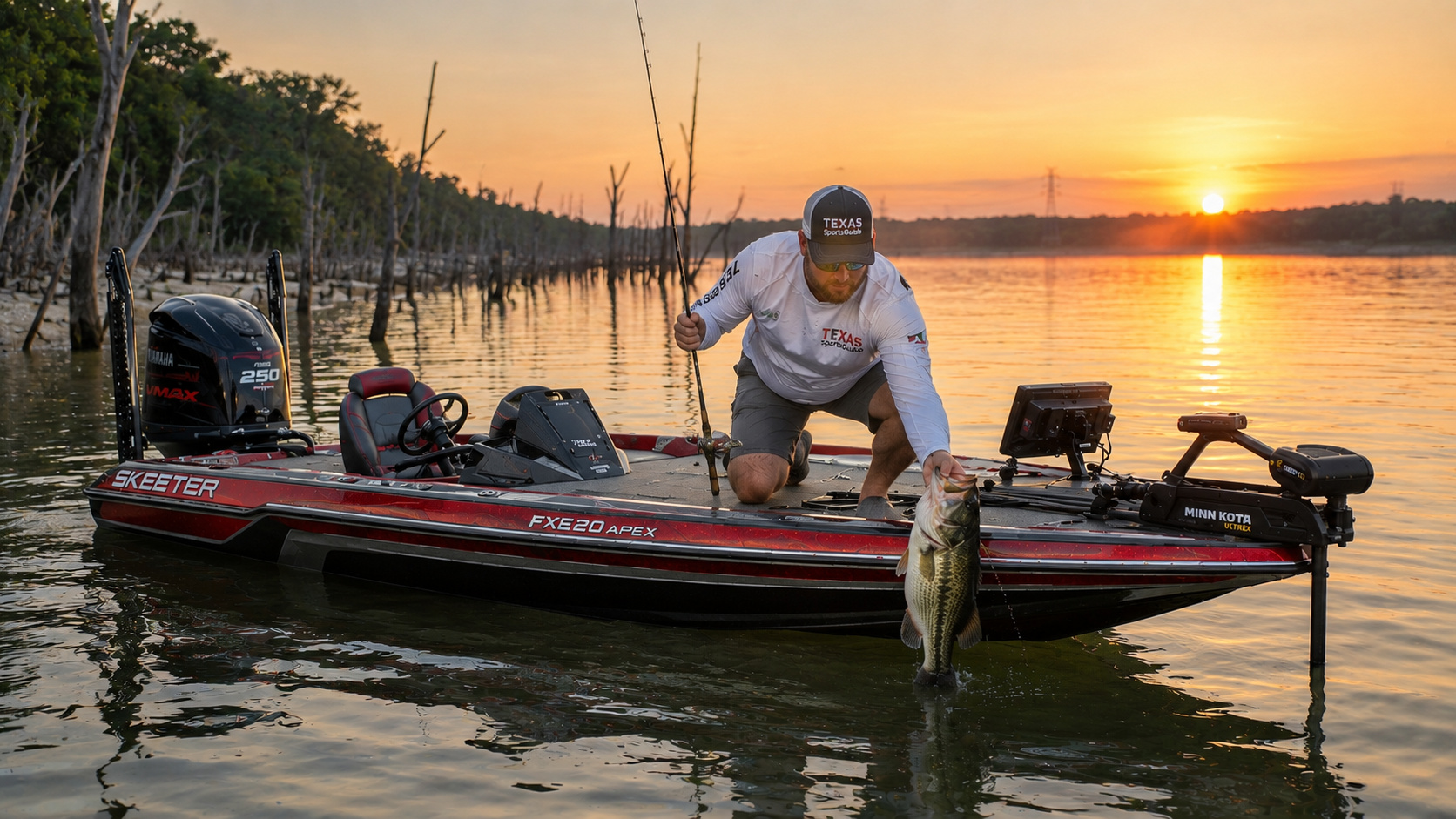
Standing timber, pondweed, creek channels, spotted bass and thirteen-pound largemouths in the heart of North Texas
Why Lewisville Lake Texas Bass Fishing Is Worth Learning
Some bass lakes introduce themselves politely.
Lewisville Lake isn't one of them.
At nearly 30,000 acres, it is a big, busy North Texas reservoir where a fisherman can spend the morning pitching a worm beside standing timber, cross open water looking for a better pattern, and by afternoon find himself probing a creek-channel edge while pleasure boats churn the main lake behind him.
And yet, beneath all that activity, Lewisville remains a legitimate bass lake.
Texas Parks and Wildlife currently rates both largemouth bass and spotted bass fishing as good. TPWD points anglers toward standing timber in coves and along shorelines as important largemouth habitat, while its fisheries surveys describe a reservoir dominated by natural shoreline, rocky shoreline and standing timber.
There are big fish here, too.
The current TPWD largemouth bass record stands at 13.63 pounds, caught in November 2005. The spotted bass record is a hefty 3.73 pounds.
That tells me Lewisville deserves considerably more respect than it sometimes receives from fishermen driving past it toward more famous Texas water.
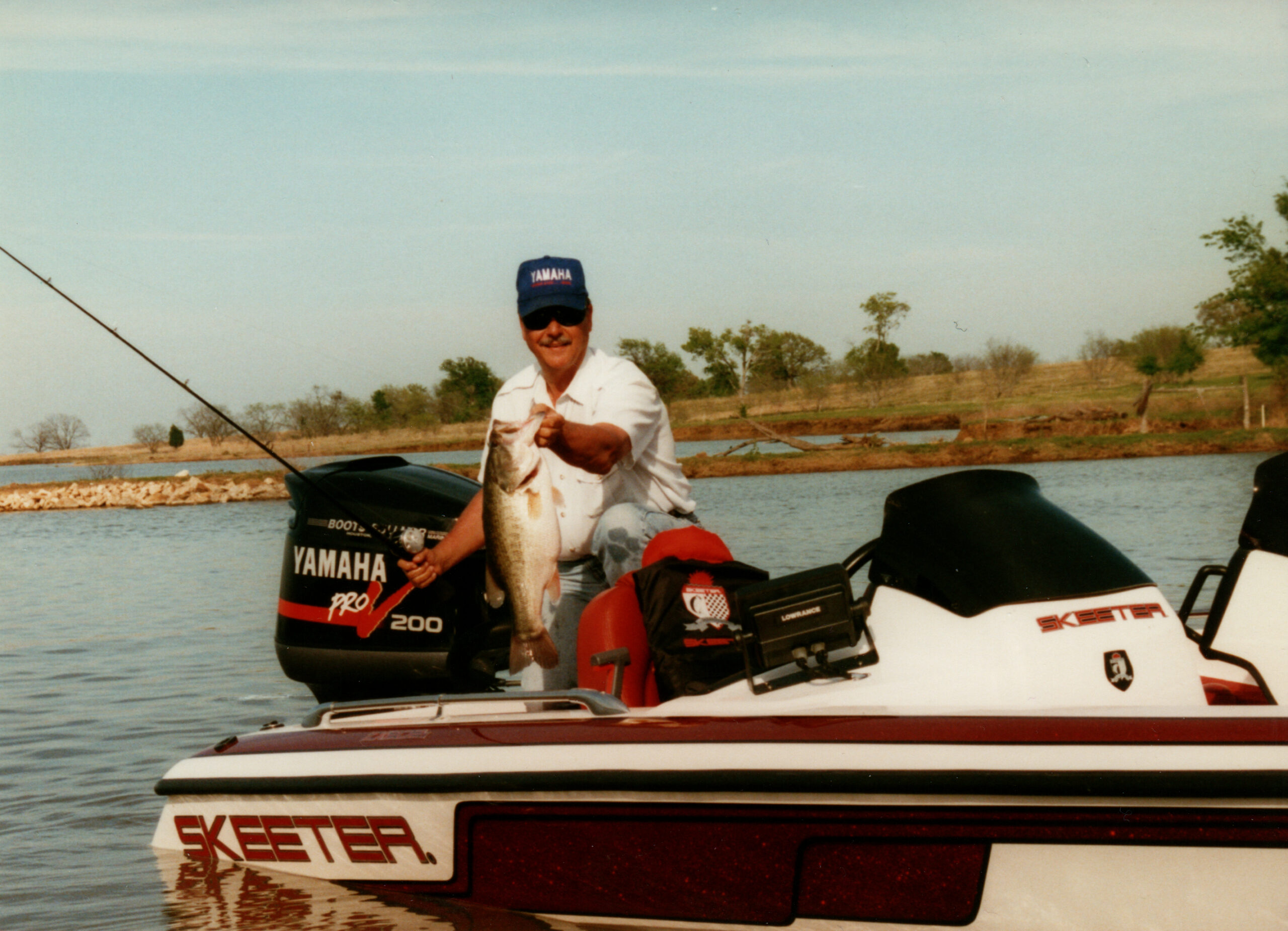
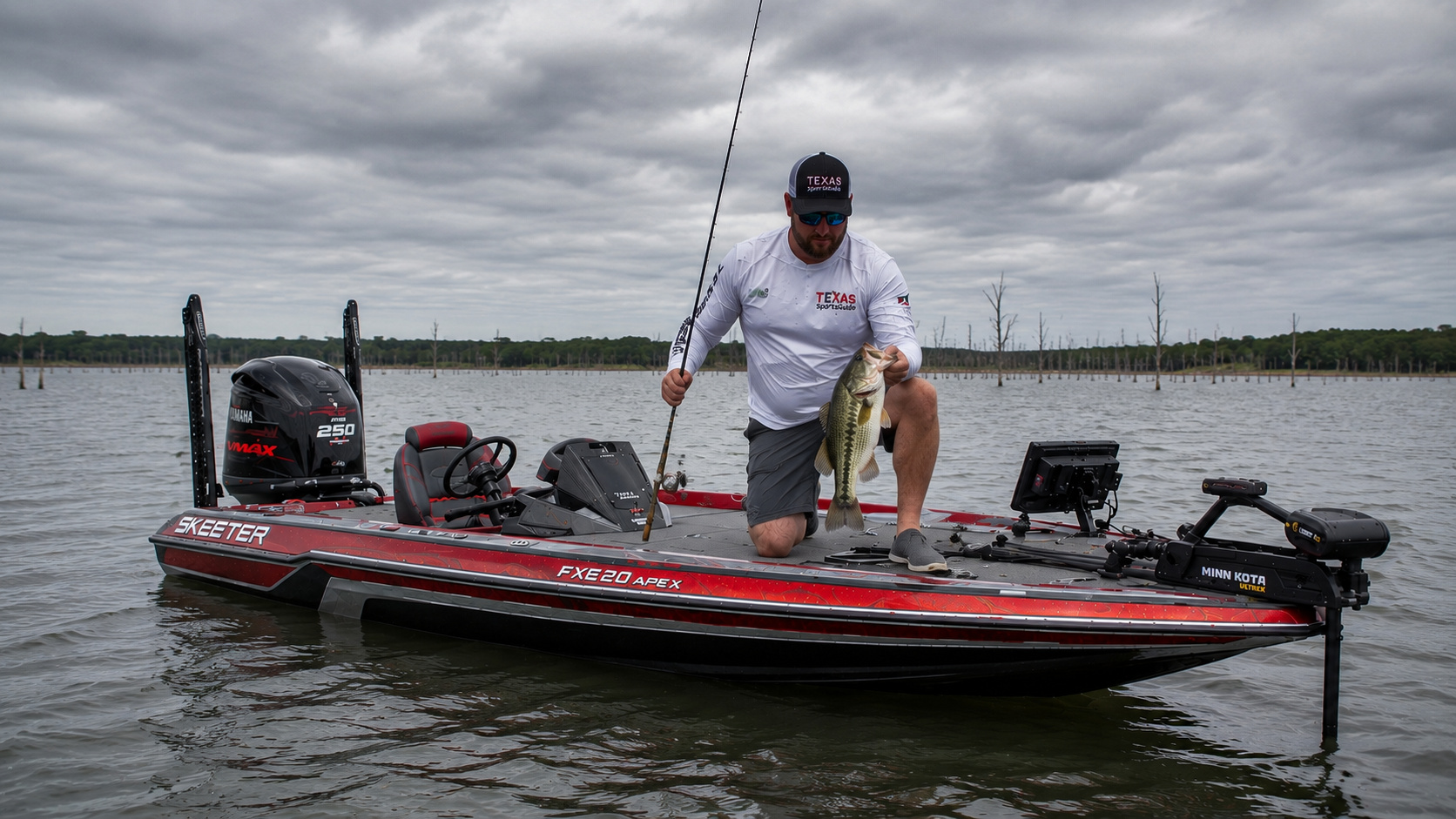
So let's back the Skeeter down the ramp, fire up the Yamaha and have a look at Lewisville Lake Texas Bass Fishing.
Where Is Lewisville Lake Texas?
Lewisville Lake lies on the Elm Fork of the Trinity River in Denton County, roughly 25 miles northwest of Dallas.
TPWD lists the reservoir at 29,592 surface acres, with a maximum depth of 67 feet. The lake was impounded in 1954, although its history reaches farther back through the earlier Lake Dallas reservoir.
The U.S. Army Corps of Engineers controls the reservoir.
U.S. Army Corps of Engineers
1801 N. Mill Street
Lewisville, TX 75057
Phone: 469-645-9100
TPWD lists a conservation-pool elevation of 522 feet above mean sea level, with normal annual fluctuations of approximately 4 to 8 feet. Water clarity is normally stained.
Those characteristics help define the bass fishery.
Lewisville isn't a crystal-clear canyon reservoir where you expect to spend all day staring into 20 feet of water.
It is a big, stained North Texas lake where timber, shoreline cover, rock, pondweed, creek channels and depth changes give largemouth bass places to hide.
What Rivers and Creeks Feed Lewisville Lake?
The Elm Fork of the Trinity River Is the Main Artery
Lewisville Lake impounds the Elm Fork of the Trinity River, which provides the principal river system feeding the reservoir.
Other important tributary systems include Hickory Creek, Little Elm Creek and numerous smaller feeder creeks and drainage channels.
For the bass fisherman, those tributaries are far more than names on a map.
They are highways.
During late winter and early spring, largemouth use creek channels as migration routes toward spawning areas.
After spawning, those same channels lead fish back toward deeper summer habitat.
When autumn arrives and shad begin moving toward creek arms, bass follow the groceries.
I have always believed that learning a reservoir's creek channels is one of the best investments a fisherman can make.
Modern electronics make that job easier than it was when many of us started fishing, but the principle hasn't changed.
Find the channel.
Find where it bends.
Then look for something different nearby.
Timber.
Rock.
A point.
A hump.
A secondary ditch.
That's where things begin getting interesting.
What Fish Species Live in Lewisville Lake?
Texas Parks and Wildlife lists the predominant sportfish as:
-
Largemouth bass
-
Spotted bass
-
White bass
-
Hybrid striped bass
-
White crappie
-
Blue catfish
-
Channel catfish
TPWD currently rates largemouth bass and spotted bass as good, while catfish, crappie and white bass receive excellent ratings. Hybrid striped bass fishing is also rated good.
That makes Lewisville an unusually diverse urban fishery.
White bass and crappie actually generate more overall angling activity than largemouth bass according to TPWD, but black-bass fishermen have plenty to keep them occupied.
And don't overlook the spotted bass.
Lewisville's TPWD record is 3.73 pounds, a substantial spotted bass anywhere.
What Is the Current Lewisville Lake Water Level?
Water level matters on every reservoir, but particularly on one where TPWD says normal annual fluctuation can reach four to eight feet.
As of August 9, 2026, Water Data for Texas reports Lewisville Lake at approximately 95.1% full, with a mean water elevation of 520.97 feet and a surface area of approximately 26,323 acres.
Check the current Lewisville Lake water level
That number will change, so check it before every trip rather than relying on an evergreen fishing article.
Water level affects:
-
Boat-ramp usability
-
Shoreline cover
-
Pondweed depth
-
Timber
-
Spawning habitat
-
Creek-channel relationships
-
Bass positioning
When water rises into fresh shoreline cover during spring, largemouth may follow it.
When the lake falls, those same fish often retreat toward the first substantial break, creek channel, timber edge or offshore structure.
Bass don't disappear when water levels change.
They rearrange themselves.
What Is the Bass Habitat Like on Lewisville Lake?
Standing Timber Is One of the Keys
Texas Parks and Wildlife specifically identifies standing timber in several portions of Lewisville Lake as important largemouth bass habitat.
TPWD recommends fishing available structure, particularly timber in coves and along the shoreline.
That sounds simple until you pull into a cove containing hundreds of trees.
The trick isn't finding timber.
It's finding the right timber.
Look for a tree that:
-
Stands beside a creek channel
-
Is isolated from the others
-
Sits on a depth change
-
Marks a point
-
Has submerged branches
-
Is close to a spawning flat
-
Has baitfish nearby
The difference between a tree in six feet of featureless water and one standing beside a 14-foot creek channel can be the difference between casting practice and catching bass.
Rocky Shoreline
The most recent TPWD fisheries survey describes Lewisville habitat as primarily natural shoreline, rocky shoreline and standing timber.
Rock becomes particularly valuable during colder months because it can absorb solar heat.
It also provides habitat for crawfish and other forage.
Rock transitions deserve special attention.
A stretch where gravel becomes chunk rock or chunk rock meets clay is worth several casts.
Bass love edges.
Aquatic Vegetation and Pondweed
Lewisville isn't Sam Rayburn when it comes to grass.
TPWD reports small stands of pondweed rather than extensive submerged vegetation.
That makes isolated vegetation more valuable, not less.
A little patch of healthy pondweed surrounded by otherwise bare shoreline can become a bass magnet.
Fish:
-
Outside edges
-
Points
-
Holes
-
Isolated clumps
-
Creek-channel intersections
Whenever you find grass touching timber or rock, slow down.
Two kinds of habitat together are usually better than either one alone.
Lewisville Lake Weather and Bass Fishing
North Texas weather doesn't lack imagination.
Winter
December through February can bring afternoons in the 50s and 60s followed by a hard norther that sends temperatures tumbling.
Bass generally become less willing to chase and more structure-oriented.
Spring
March through May is prime bass season.
Warming water brings prespawn and spawning movements, but spring also means wind and severe thunderstorms.
A large reservoir such as Lewisville can get rough quickly.
Summer
June through August means heat.
Temperatures commonly reach the 90s, and triple-digit afternoons aren't unusual.
Bass fishing becomes an early-morning, shade and offshore-structure affair.
Fall
September through November gradually brings cooler nights.
Shad movement becomes increasingly important, and largemouth often follow bait toward creek arms and shoreline structure.
Fall can provide some of the year's most comfortable fishing.
Driving Distance to Lewisville Lake From Major Texas Cities
Travel distances depend on your chosen boat ramp, but these estimates will put you in the neighborhood.
Dallas to Lewisville Lake
Approximately 25 to 30 miles.
A common route follows I-35E north directly toward Lewisville.
Allow about 30 to 45 minutes outside heavy traffic.
Fort Worth to Lewisville Lake
Approximately 35 to 45 miles.
Routes commonly use TX-121 and connecting Metroplex highways.
Allow approximately 45 minutes to an hour.
Austin to Lewisville Lake
Approximately 210 to 225 miles.
Take I-35 north, following I-35E toward Lewisville.
Allow approximately 3½ hours.
Houston to Lewisville Lake
Approximately 265 to 280 miles.
Take I-45 north toward Dallas and continue toward Lewisville.
Allow roughly 4½ hours.
San Antonio to Lewisville Lake
Approximately 300 to 315 miles.
Take I-35 north through Austin and Waco, then I-35E toward Lewisville.
Allow approximately five hours.
Corpus Christi to Lewisville Lake
Approximately 435 to 450 miles.
Take I-37 north to San Antonio, then I-35 north.
Plan on roughly 6½ to 7 hours.
When towing a bass boat through DFW, add some cushion.
The fish may be predictable.
Metroplex traffic occasionally isn't.
Lewisville Lake Boat Ramps
Lewisville has an unusually large selection of public access points. TPWD lists Corps, municipal and privately operated ramps around the reservoir.
Lewisville Lake Park Boat Ramp
Location: Lake Park Road, Lewisville, TX
Phone: 972-219-3550
Email: Contact through City of Lewisville
Website: City of Lewisville / Visit Lewisville
TPWD lists 11 launch lanes with parking capacity for approximately 108 vehicles. Fees apply and the facility is normally open year-round.
That's serious ramp capacity, and tournament fishermen will appreciate it.
Arrowhead Park
Location: I-35E just north of the Lewisville Lake bridge, Lake Dallas area
Phone: 940-497-2528
Email: Contact through Town of Hickory Creek
Website: Town of Hickory Creek
TPWD lists a six-lane concrete ramp and parking for approximately 50 vehicles.
Copperas Branch Park
Location: West access road of I-35E north of Lewisville, Highland Village
Phone: 972-317-7430
Email: Contact through City of Highland Village
Website: City of Highland Village
Four concrete launch lanes provide good capacity, with parking for approximately 50 vehicles.
Little Elm Park
Location: Off FM 720, Little Elm, TX
Phone: 972-731-3296
Email: Contact through City of Little Elm
Website: Town of Little Elm
TPWD lists a three-lane concrete ramp and parking for approximately 50 truck-and-trailer combinations.
Hidden Cove Park
Location: Off Texas Highway 423, approximately two miles north of The Colony
Phone: 972-294-1443
Email: Contact through City of The Colony
Website: City of The Colony
The facility has a three-lane concrete ramp and parking for approximately 50 vehicles.
Marinas on Lewisville Lake
Eagle Point Marina
Address: 1 Eagle Point Road, Lewisville, TX 75077
Phone: 972-436-6561
Email: eaglepoint@suntex.com
Eagle Point is a full-service marina with approximately 700 slips, dry storage, trailer parking, boating services and other amenities.
For a fisherman, the important part is simple: it's directly on the lake and provides convenient access to a large portion of Lewisville.
The Tribute Marina
Address: 7600 Castlebridge, The Colony, TX 75056
Email: tribute@suntex.com
Phone: Check with marina for current contact number
As of August 2026, this new marina is advertising an anticipated fall 2026 opening, so don't plan a current fishing trip around its services until the facility confirms that it is operating. Plans call for 399 slips, a ship's store, deli, boat club and rentals.
That is precisely the sort of information worth dating in an online fishing guide. A marina that is coming soon is considerably less useful when you're sitting in the truck with the boat attached.
Lodging Near Lewisville Lake
Being inside the Metroplex gives Lewisville fishermen an enormous selection of hotels.
Hilton Garden Inn Dallas Lewisville
Hilton Garden Inn Dallas Lewisville
Address: 785 State Highway 121, Lewisville, TX 75067
Phone: 972-459-4600
Email: DALLE_GM@hilton.com
The hotel provides free parking and is convenient to I-35 and the Lewisville area.
For anyone towing a 20-foot bass boat, I'd still call before booking and confirm where management wants the truck and trailer parked.
Camping at Lewisville Lake Park
For fishermen who would rather stay closer to the water, Lewisville Lake Park includes RV and tent camping along with boating and recreational facilities. The City of Lewisville manages the 622-acre park on the lake's south shore.
There's something to be said for waking before daylight and knowing the boat ramp is nearby.
Coffee tastes a little better when the rods are already rigged.
Spring Lewisville Lake Texas Bass Fishing
February Through May: Follow the Creek Channels Toward Shore
Spring is when Lewisville largemouth begin making predictable movements.
During late winter and early prespawn, start around:
-
Creek-channel bends
-
Secondary points
-
Timber near deeper water
-
Rocky transitions
-
Protected coves
-
Pondweed edges
Begin in roughly 8 to 18 feet during colder prespawn conditions.
As several warm days raise water temperature, follow bass progressively shallower.
Best Prespawn Lures
Suspending jerkbait: 4 to 5 inches
Colors: ghost shad, chrome/blue, translucent minnow
Jig: 3/8 to 1/2 ounce
Colors: black-and-blue, green pumpkin, brown
Spinnerbait: 3/8 to 1/2 ounce
Colors: white/chartreuse, white or shad
Medium-diving crankbait: 2 to 3 inches
Colors: crawfish, chartreuse/blue, shad
When fishing timber, don't just cast at the trunk.
Bring the bait alongside the tree and allow it to fall naturally.
A prespawn female may suspend beside vertical cover rather than sit directly on the bottom.
Spawning Largemouth Bass on Lewisville Lake
As water temperatures move through the 60s, bass begin spawning in protected areas.
Look for:
-
Protected coves
-
Hard-bottom pockets
-
Shallow timber
-
Pondweed
-
Gravel
-
Shoreline cover
Productive depths may range from 1 to 8 feet, depending on clarity and water elevation.
Best Spawning Lures
Stick worm: 5 inches
Colors: green pumpkin, watermelon red
Creature bait: 4 inches
Colors: green pumpkin, black/blue
Lizard: 6 inches
Colors: watermelon red, pumpkin
Compact jig: 3/8 ounce
Colors: black/blue or green pumpkin
Fish slowly.
A shallow spring bass has probably already heard several trolling motors and watched enough soft plastics fall past her nose to qualify for a tackle-store loyalty card.
Summer Lewisville Lake Bass Fishing
June Through August: Beat the Sun, Then Go Deeper
Early summer mornings can provide good shallow fishing.
At daylight, try:
-
Timber
-
Rocky points
-
Pondweed
-
Shaded shoreline
-
Creek mouths
Early-Morning Lures
Walking topwater: 4 to 5 inches
Colors: bone, chrome, shad
Buzzbait: 3/8 ounce
Colors: white or black
Paddle-tail swimbait: 3 to 4 inches
Colors: pearl or shad
Once the sun climbs, move deeper.
Start around 12 to 25 feet, adjusting according to baitfish and weather.
Look for:
-
Creek-channel bends
-
Humps
-
Timber edges
-
Main-lake points
-
Ridges
-
Hard-bottom transitions
TPWD specifically identifies humps and ridges on Hickory Creek and the main lake as important structure for hybrid striped bass. Those same structural features deserve investigation by bass fishermen, particularly when bait is present.
Best Summer Lures
Texas-rigged worm: 7 to 10 inches
Colors: plum, junebug, black grape
Football jig: 1/2 to 3/4 ounce
Colors: green pumpkin or brown
Carolina rig: 6- to 8-inch worm
Colors: watermelon red, green pumpkin
Deep-diving crankbait: shad patterns
Drop shot: 4- to 6-inch finesse worm
Fall Lewisville Lake Bass Fishing
September Through November: Follow the Shad
Autumn is one of my favorite times on any Texas reservoir.
Summer loosens its grip.
Recreational traffic gradually decreases.
And baitfish begin moving.
Look for largemouth around:
-
Creek mouths
-
Timber
-
Rocky points
-
Windblown shoreline
-
Pondweed
-
Baitfish schools
Fall bass can range from 2 to 15 feet deep.
Best Fall Lures
Squarebill: 1.5 to 2.5 size
Colors: shad, chartreuse/black, sexy shad
Lipless crankbait: 1/4 to 1/2 ounce
Colors: chrome/blue, chrome/black
Spinnerbait: 3/8 ounce
Colors: white or shad
Paddle-tail swimbait: 3 to 4 inches
Colors: pearl, white, shad
Walking topwater: 4 to 5 inches
Colors: bone or chrome
Watch for birds.
TPWD specifically recommends following gulls to locate schooling white bass during summer.
Those birds tell a largemouth fisherman something too.
They tell you where the groceries are.
Winter Lewisville Lake Bass Fishing
December Through February: Slow Down Around Structure
Winter fishing on Lewisville shouldn't be dismissed.
In fact, the lake-record largemouth was caught November 28, right on winter's doorstep.
Cold-water bass often favor:
-
Deep timber
-
Rocky points
-
Creek channels
-
Drop-offs
-
Humps
-
Protected banks warmed by afternoon sun
Try approximately 15 to 30 feet, adjusting shallower during prolonged warming trends.
Best Winter Lures
Football jig: 3/8 to 1/2 ounce
Colors: brown, green pumpkin, black/blue
Suspending jerkbait: 4 to 5 inches
Colors: natural shad
Drop shot: 4-inch finesse worm
Jigging spoon: 1/2 ounce
Colors: silver or white
Ned-style bait: 2.5 to 3 inches
Colors: green pumpkin
Winter rewards patience.
Make repeated casts to good structure.
A bass in cold water doesn't necessarily stop eating.
She simply becomes less interested in chasing your lure across half the lake.
Best Areas for Lewisville Lake Texas Bass Fishing
Timbered Coves
TPWD specifically recommends standing timber in coves and along shoreline areas for largemouth bass.
Concentrate on timber near creek channels or depth changes.
Hickory Creek
Hickory Creek contains humps, ridges and channel-related structure.
While TPWD particularly identifies those areas for hybrids, they deserve exploration for largemouth and spotted bass whenever forage is present.
Little Elm Arm
Creek channels, coves, shoreline structure and access to varying depths make this arm worth exploring through multiple seasons.
Main-Lake Points
Main-lake structure becomes particularly valuable during summer and winter.
Look for rock, nearby channels and baitfish.
Pondweed
Because Lewisville has only limited stands of pondweed, don't drive past a healthy patch.
Isolated cover often concentrates fish.
Lewisville Lake Bass Records
TPWD's Lewisville Reservoir record database was updated July 26, 2026.
Largemouth Bass Record
Weight: 13.63 pounds
Length: 24.25 inches
Angler: Jon Babich
Date: November 28, 2005
Lure: Fin-S Albino Shad
Thirteen pounds and change is a serious largemouth anywhere.
Spotted Bass Record
Weight: 3.73 pounds
Length: 19.50 inches
Angler: Kent Andries
Date: May 11, 2006
Lure: Crankbait
That spotted bass record is worth remembering when something small and angry tries to pull the rod out of your hand on a rocky point.
Zebra Mussels and Lewisville Lake
Lewisville Lake has an established zebra mussel population.
TPWD instructs boaters to Clean, Drain and Dry boats, trailers, livewells, bait buckets and other equipment before traveling to another water body. Texas law requires draining water, and transporting zebra mussels is illegal.
For fishermen moving from Lewisville to Grapevine, Ray Roberts or another reservoir, this is particularly important.
Protecting the next lake is part of fishing the one we're on today.
Five More Texas Bass Fishing Adventures From Texas SportsGuide
If Lewisville's combination of Metroplex convenience and structure-oriented bass fishing appeals to you, several other Texas SportsGuide articles make natural companions.
For rocky structure and a genuine mixed black-bass fishery, visit our Grapevine Lake Texas Bass Fishing guide. Grapevine offers largemouth, spotted bass and an increasingly impressive smallmouth population.
Just east of Dallas, Lake Ray Hubbard Texas Largemouth Bass Fishing offers a different combination of hydrilla, riprap, timber and creek structure.
For a change of scenery farther west, our Possum Kingdom Lake Texas Largemouth and Smallmouth Bass Fishing guide explores rocky canyon country and one of Texas' better-known smallmouth fisheries.
Central Texas anglers can explore Belton Lake Texas Largemouth and Smallmouth Bass Fishing, where limestone points, deep channels and rocky structure provide another thinking man's bass fishery.
And farther south, Lake Whitney Texas Largemouth and Smallmouth Bass Fishing offers clear water, limestone bluffs, rocky points and both largemouth and smallmouth opportunities.
Those five lakes provide quite a tour through the different personalities of Texas bass water.
Frequently Asked Questions About Lewisville Lake Texas Bass Fishing
Is Lewisville Lake Good for Largemouth Bass?
Yes.
TPWD currently rates the largemouth bass fishery as good and specifically recommends timber in coves and along shorelines.
Does Lewisville Lake Have Spotted Bass?
Yes.
TPWD rates spotted bass fishing as good. The current lake record is 3.73 pounds.
Does Lewisville Lake Have Smallmouth Bass?
TPWD does not list smallmouth bass among Lewisville's predominant sportfish or current angling opportunities. Don't confuse the lake-record listing for smallmouth buffalo, which is a completely different species, with smallmouth bass.
That's one of those little details worth getting right.
How Deep Is Lewisville Lake?
TPWD lists a maximum depth of approximately 67 feet.
How Big Is Lewisville Lake?
TPWD lists the reservoir at 29,592 acres at normal conditions. Current surface area varies with elevation.
What Is the Best Bass Habitat?
Standing timber is the principal largemouth cover specifically identified by TPWD. Natural and rocky shorelines are also widespread, while small stands of pondweed provide additional cover.
What Is the Lewisville Lake Largemouth Bass Record?
The current TPWD record is 13.63 pounds, caught by Jon Babich on November 28, 2005.
Final Thoughts on Lewisville Lake Texas Bass Fishing
If I were launching my Skeeter on Lewisville tomorrow morning, I'd want to be away from the ramp before the eastern horizon began showing much color.
I'd have a walking bait tied on.
A spinnerbait would be lying beside it.
There would be a Texas-rigged worm for timber, a football jig for deeper structure and probably a crankbait ready for any rocky point that looked particularly inviting.
Then I'd start looking.
Not simply casting.
Looking.
Where does the creek channel swing closest to the trees?
Which point has rock instead of mud?
Where does that little stand of pondweed end?
Why are shad flickering beside one group of trees but not another?
What is the graph showing beneath the boat?
Bass fishing has always rewarded curiosity.
That's particularly true on a lake like Lewisville.
At nearly 30,000 acres, you can waste an extraordinary amount of time fishing water that merely looks good. The trick is narrowing all that water into a handful of places where depth, cover, structure and forage come together.
Find those combinations and Lewisville begins shrinking.
A 29,592-acre reservoir becomes one creek channel.
Then one point.
Then one patch of timber.
Finally, your entire world becomes a few feet of fishing line disappearing into stained North Texas water.
And sometimes that line starts moving sideways.
That's when all the maps, electronics, lure colors, seasonal patterns and early alarm clocks suddenly become worthwhile.
You reel down.
The rod loads.
A heavy largemouth comes boiling out beside the boat.
And for a few seconds, Dallas, Fort Worth, traffic, schedules and everything else might as well be a thousand miles away.
That's the part of Lewisville Lake Texas Bass Fishing that no map can show you.
And it's the reason we'll keep making one more cast.
0 Comments