
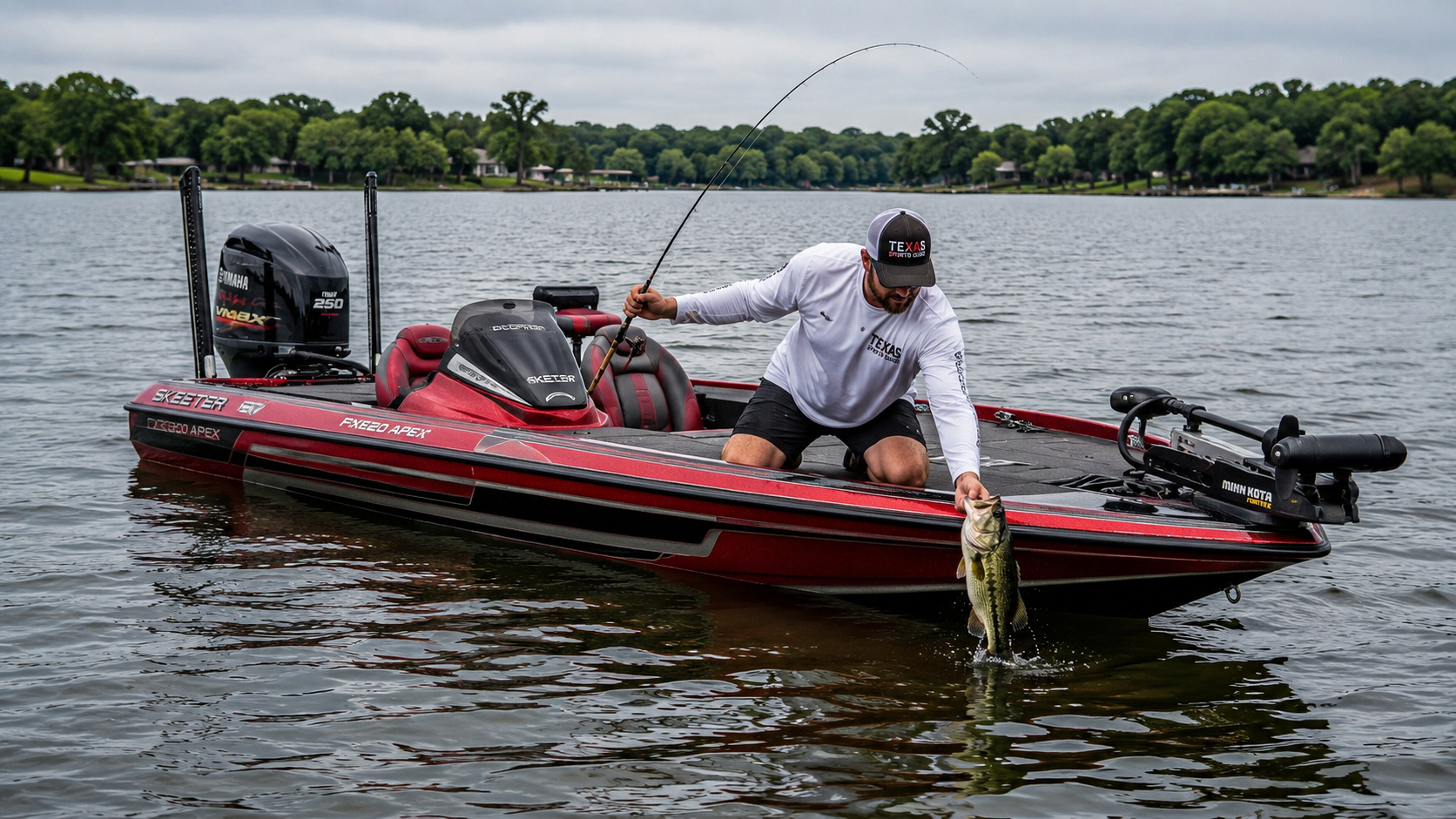
Hydrilla, riprap, standing timber and fourteen-pound largemouths hiding practically in the shadow of the Dallas skyline
Lake Ray Hubbard Texas Bass Fishing Is Closer to the City Than You Might Expect
There is something wonderfully contrary about Lake Ray Hubbard.You can leave Dallas with traffic humming around you, cross Interstate 30 with restaurants, subdivisions and office buildings never far away, and a few minutes later put the trolling motor down beside a hydrilla edge where a largemouth bass may never know that several million people live practically next door.That is Lake Ray Hubbard Texas Largemouth Bass Fishing.It isn't wilderness fishing in the traditional sense. You aren't going to mistake the horizon for Sam Rayburn or the Rio Grande canyons of Amistad. Yet once the outboard goes quiet and you're working a spinnerbait beside standing timber on an early spring morning, the city seems to fade into the background.And Ray Hubbard has something else going for it.It can grow a mighty respectable largemouth.The current Texas Parks and Wildlife Department record for Ray Hubbard is 14.10 pounds, caught by Leonard Nuttall on December 27, 2002, on a black-and-blue jig. That's not a fish you apologize for anywhere in Texas. TPWD currently rates largemouth bass fishing on Ray Hubbard as good, noting that improving submerged vegetation has benefited the fishery. So let's launch the boat and have a closer look.
Where Is Lake Ray Hubbard Texas?
Lake Ray Hubbard sits immediately east of Dallas and touches Collin, Dallas, Rockwall and Kaufman counties. TPWD places the reservoir about one mile west of Rockwall on the East Fork of the Trinity River.The lake was impounded in 1968 and is controlled by the City of Dallas through Dallas Water Utilities.According to TPWD, Lake Ray Hubbard covers approximately 21,671 surface acres and has a maximum depth of about 40 feet. Its conservation pool elevation is 435.5 feet above mean sea level, and normal water fluctuation is relatively modest at approximately one to three feet. Water clarity is normally stained. Those numbers tell us something about fishing the lake.This isn't a tremendously deep Highland reservoir where bass can disappear into 80 feet of water. Ray Hubbard is comparatively shallow, fertile and stained, with plenty of accessible structure.That makes it a good old-fashioned Texas bass lake.
What Rivers and Creeks Feed Lake Ray Hubbard?
The East Fork Trinity River Is the Main Artery
The principal river associated with Lake Ray Hubbard is the East Fork of the Trinity River.The East Fork enters the upper reservoir and creates the riverine environment that distinguishes the northern end from the broader lower lake.Other tributary creeks and drainage systems contribute runoff around the reservoir, including Rowlett Creek and smaller creeks and draws.For bass fishermen, the names matter less than understanding what those tributaries do.A creek channel is a travel route.A creek entering a shallow flat provides runoff, nutrients and often stained water after rain. During spring, bass follow those channels toward spawning country. During summer and winter, the same channels provide nearby deeper water.When I look at a reservoir map, I don't just see contour lines.I see roads.Bass use them much the same way we do.
What Fish Species Live in Lake Ray Hubbard?
TPWD identifies the principal sportfish as:
- Largemouth bassWhite bassHybrid striped bassBlue catfishChannel catfishWhite crappie
Hybrid striped bass and blue catfish have become particularly abundant, while TPWD rates largemouth bass fishing as good and says increasing submerged vegetation has improved largemouth opportunities. There is an interesting historical footnote for bass fishermen, too.The TPWD lake-record database includes not only largemouth bass but a 2.11-pound smallmouth bass caught in 1999 and a 1.86-pound spotted bass caught in 2017. Those records don't make Ray Hubbard a destination smallmouth or spotted-bass lake, but they are interesting evidence of the reservoir's fisheries history. For our purposes, though, largemouth bass are the quarry.
What Is the Current Lake Ray Hubbard Water Level?
As of August 9, 2026, Water Data for Texas reported Lake Ray Hubbard at approximately 94% full. That number will naturally change after this article is published, so anglers should check current conditions before traveling. Check the current Lake Ray Hubbard water levelTPWD says Ray Hubbard normally fluctuates only about one to three feet. Even relatively small elevation changes, however, can alter bass positioning around hydrilla, shoreline vegetation and shallow cover. When water rises into fresh cover, I start looking shallow.When it falls away from the bank, I start looking at the first available break, outside vegetation line or channel edge.Bass don't vanish when the water drops.They simply move their chairs.
What Kind of Bass Habitat Is in Lake Ray Hubbard?
Hydrilla Has Become Increasingly Important
This may be the most important development for modern Lake Ray Hubbard Texas Largemouth Bass Fishing.TPWD reports stands of emergent vegetation on shallow flats and hydrilla in several portions of the reservoir. The department specifically notes that submerged vegetation has become more abundant and that largemouth bass fishing has improved with it. Hydrilla is bass habitat with several floors.The shallow inside edge may hold fish early.Irregular grass points become ambush positions.Holes provide feeding windows.The deep outside edge becomes a travel corridor.When hydrilla intersects another structural feature, things get particularly interesting.Give me hydrilla crossing an old creek channel or wrapping around a hard point and I'll spend some time there.
Standing Timber Dominates Above I-30
TPWD identifies standing timber above Interstate 30 as the most abundant cover in that part of Lake Ray Hubbard. Timber can be intimidating because there is so much of it.Don't fish every tree.Look for the tree that's different.Maybe it sits on a channel bend.Maybe three trunks form a small cluster.Maybe there's eight feet of water around most trees but one sits beside 14.That difference can be everything.
Riprap Is One of Ray Hubbard's Most Dependable Patterns
TPWD specifically calls the rock riprap along roadways crossing the reservoir excellent fishing habitat and says largemouth bass are commonly found along riprap or vegetation. That makes the various bridge and causeway areas obvious targets.Riprap provides:
- Crawfish habitatBaitfish coverHeat retentionQuick depth changesCurrent breaksSpawning opportunities
And unlike vegetation, rocks don't die back in winter.Riprap works twelve months a year.
Lake Ray Hubbard Weather and Bass Fishing Conditions
North Texas gives fishermen four genuine seasons, although July sometimes seems determined to swallow August whole.Winter: Expect many days in the 40s through 60s, interrupted by hard cold fronts.Spring: Temperatures often range from the 50s into the 80s, with thunderstorms, rapidly changing wind and excellent bass fishing.Summer: Daytime highs commonly reach the 90s and occasionally 100°F or more. Dawn and night fishing become attractive.Fall: Cooling nights and pleasant days return, often accompanied by excellent shad-oriented bass fishing.Ray Hubbard is a large, relatively open reservoir. Strong wind can make it rough quickly.Check the forecast before launching, particularly during spring thunderstorm season.A largemouth will still be there tomorrow.
Driving Distance to Lake Ray Hubbard From Major Texas Cities
These are approximate distances and travel times to the Rockwall/Lake Ray Hubbard area. Traffic, particularly around Dallas, can change the arithmetic considerably.
Dallas to Lake Ray Hubbard
Approximately 20 to 25 miles, generally east on I-30.Allow roughly 25 to 40 minutes in favorable traffic.
Fort Worth to Lake Ray Hubbard
Approximately 55 to 65 miles.Take I-30 east through the Metroplex.Allow roughly 1 to 1½ hours.
Austin to Lake Ray Hubbard
Approximately 215 miles.Take I-35 north, transitioning through the Dallas area toward I-30 east.Allow approximately 3½ hours.
Houston to Lake Ray Hubbard
Approximately 240 to 260 miles.A typical route follows I-45 north toward Dallas and then east toward the lake.Allow about four hours.
San Antonio to Lake Ray Hubbard
Approximately 300 miles.Take I-35 north through Austin and Waco, then continue toward the eastern Metroplex.Allow approximately 4½ to 5 hours.
Corpus Christi to Lake Ray Hubbard
Approximately 430 miles.A practical route follows I-37 north to San Antonio, then I-35 north toward Dallas.Plan on roughly 6½ to 7 hours before fuel, food and the inevitable construction barrel.
Lake Ray Hubbard Boat Ramps and Marinas
TPWD currently lists multiple public and private access facilities around Ray Hubbard. Ramp conditions can change with maintenance and water level, so verify before towing any distance.
Paul Jones Park Boat Ramp
Address: 4099 Zion Road, Garland, TX 75043
Phone: 972-205-2750
Operator: City of Garland
Email: Contact through City of Garland
Website: City of GarlandTPWD lists four concrete boat lanes, parking for up to 50 vehicles, no launch fee and year-round access.
Harbor Bay Marina
Address: 3701 Windjammer Drive, Rockwall, TX 75087
Phone: TPWD currently lists 972-771-0071
Email: Verify with marina
Website: Verify current marina site before travelTPWD lists a two-lane concrete ramp, parking for about 50 vehicles, a fishing barge, year-round access and a launch fee.
State Highway 66 Boat Ramp
Location: Highway 66 crossing, Rockwall
Phone: 972-771-7740
Operator: City of Rockwall
Email: Contact through City of Rockwall
Website: City of RockwallTPWD reports two single-lane ramps plus one double-lane concrete ramp, parking for approximately 40 vehicles, no fee and year-round operation.
Terry Park Boat Ramp
Address: 100 Terry Lane, Heath, TX 75032
Phone: 972-771-6228
Email: Contact through City of Heath
Website: City of HeathTPWD lists a two-lane concrete ramp, two courtesy docks, parking for about 30 vehicles, no fee and year-round access.
Captain's Cove Marina
Address: 5965 Marina Drive, Garland, TX 75043
Phone: 972-226-7100
Email: Verify directly
Website: Verify current marina website before travelTPWD lists four concrete boat lanes, parking for approximately 50 vehicles, a launch fee and year-round access.
Sapphire Bay Ramp
Address: 9051 Marina Vista, Rowlett, TX 75088
Phone: 972-412-1977
Email: Verify directly
Website: Contact the facility for current informationTPWD lists a two-lane concrete ramp with courtesy docks, approximately 50 parking spaces, year-round access and no launch fee.
Lodging Near Lake Ray Hubbard
Ray Hubbard's Metroplex location gives fishermen far more lodging choices than most Texas reservoirs.
Hilton Dallas/Rockwall Lakefront
Hilton Dallas/Rockwall LakefrontAddress: 2055 Summer Lee Drive, Rockwall, TX 75032
Phone: 214-771-3700
Email:
Website: Official Hilton websiteThe property sits directly on Lake Ray Hubbard beside The Harbor. Hilton describes it as approximately 22 miles east of downtown Dallas. For a fishing trip where your spouse might prefer restaurants and lakefront walks to sorting crankbaits in the motel parking lot, this is a mighty civilized option.Other national-chain hotels are available throughout Rockwall, Rowlett and Garland. Because hotel ownership, phone numbers and email addresses change more frequently than reservoir structure, I recommend verifying contact information when booking.
Spring Lake Ray Hubbard Texas Largemouth Bass Fishing
February Through May: Follow the Fish Toward Shallow Water
Spring is the season when Ray Hubbard shows its best bass-fishing personality.As late-winter water begins warming, largemouth leave deeper winter holding areas and begin staging on:
- Creek-channel bendsSecondary pointsRiprap transitionsOutside hydrilla edgesTimber near spawning pockets
Start in 6 to 15 feet during the earliest prespawn period.A 1/2-ounce football or casting jig in black-and-blue, green pumpkin or brown can be excellent.And remember what caught the lake-record bass.A black-and-blue jig.I'm not suggesting bass read record books, but I wouldn't leave mine at home.As temperatures rise, move toward shallow protected water.Current angler-pattern reporting for Ray Hubbard points to Texas-rigged plastics around flooded cover and grass edges during the prespawn, with bass moving into creek arms and pockets as water warms.
Best Spring Lures
Spinnerbait: 3/8 to 1/2 ounce
Colors: white/chartreuse, white, shadChatter-style bladed jig: 3/8 to 1/2 ounce
Colors: green pumpkin, white/shadTexas-rigged creature bait: 4 to 6 inches
Colors: green pumpkin, watermelon red, black/blueSuspending jerkbait: 4 to 5 inches
Colors: ghost shad, chrome/blue, translucent shadJig: 3/8 to 1/2 ounce
Colors: black/blue or green pumpkinAround riprap, parallel the bank instead of constantly casting perpendicular to it.That keeps the lure in the productive depth zone much longer.
Summer Lake Ray Hubbard Largemouth Bass Fishing
June Through August: Fish Early, Then Follow Structure
Summer begins with a pleasant lie.At daylight, bass may be shallow and aggressive enough to convince you they'll stay that way all day.They won't.Start early around hydrilla, points and riprap with:
- Walking topwatersBuzzbaitsPoppersSmall swimbaits
A 4- to 5-inch walking bait in bone or shad color is hard to beat.As sunlight strengthens, shift toward deeper structure.Try 10 to 20 feet around:
- Outside hydrilla edgesMain-lake pointsCreek-channel bendsRiprap dropsHumpsBrush
Because Ray Hubbard reaches only about 40 feet at maximum depth, "deep" is relative.
Best Summer Lures
Texas-rigged worm: 7 to 10 inches
Colors: plum, junebug, black grape, green pumpkinFootball jig: 1/2 to 3/4 ounce
Colors: brown, green pumpkin, black/blueDeep-diving crankbait: shad or chartreuse/blue patternsCarolina rig: 6- to 8-inch worm or creature baitDrop shot: 4- to 6-inch finesse wormDuring hot weather, I'd also pay attention to shade and current.A bridge riprap corner receiving wind or water movement may outperform acres of apparently prettier shoreline.
Fall Lake Ray Hubbard Largemouth Bass Fishing
September Through November: Follow the Shad
Fall bass fishing is frequently less about structure and more about groceries.As nights cool, shad move.Bass follow.Look for baitfish around:
- Creek mouthsRiprapWindblown pointsHydrilla edgesShallow flatsTimber
Productive depths can range from 2 to 12 feet.This is a fine time for moving baits.
Best Fall Lures
Squarebill crankbait: 1.5 to 2.5 size
Colors: shad, chartreuse/black, sexy shadLipless crankbait: 1/4 to 1/2 ounce
Colors: chrome/blue, chrome/black, shadSpinnerbait: 3/8 ounce
Colors: white or white/chartreusePaddle-tail swimbait: 3 to 4 inches
Colors: pearl white or shadTopwater walking bait: 4 to 5 inches
Colors: bone or chromeIf gulls or terns suddenly begin working bait, pay attention.The birds may be feeding over white bass or hybrids, but largemouth frequently use the same bait-rich neighborhood.
Winter Lake Ray Hubbard Largemouth Bass Fishing
December Through February: Slow Down and Fish the Hard Places
Winter Ray Hubbard bass aren't necessarily inactive.They're economical.Cold water makes chasing food expensive, so presentation becomes important.Start around 8 to 20 feet, adjusting according to weather and water temperature.Look for:
- RiprapCreek-channel edgesDeep timberHydrilla edgesMain-lake pointsWarm-water influences
TPWD specifically identifies the heated discharge area on the west side south of I-30 as productive for multiple sportfish species.
Best Winter Lures
Jig: 3/8 to 1/2 ounce
Colors: black/blue, brown, green pumpkinSuspending jerkbait: 4 to 5 inches
Colors: translucent shad or chromeDrop shot: 4-inch finesse wormNed-style bait: 2.5 to 3 inchesSlow-rolled spinnerbait: 1/2 ounceAnd don't overlook sunny riprap after several hours of warming.Rock absorbs heat.A degree or two of water-temperature difference doesn't sound like much to us.To a cold-blooded bass in January, it can be the difference between breakfast and fasting.
Where Are the Best Largemouth Bass Areas on Lake Ray Hubbard?
Above I-30
TPWD points directly toward standing timber above I-30. Concentrate on channel-related timber rather than randomly fishing every visible tree.
Riprap and Road Crossings
This is one of the most dependable year-round patterns on the reservoir.Fish corners, transitions and irregular sections rather than featureless stretches.
Hydrilla Beds
Where hydrilla is established, fish:
- Inside edgesOutside edgesPointsHolesIsolated clumps
A grass point intersecting a drop is worth repeated casts.
Heated Discharge Area
The western area south of I-30 deserves special winter attention because TPWD specifically identifies it as a productive location for sportfish.
Main-Lake Points and Humps
Although TPWD particularly mentions these for white and hybrid striped bass, largemouth anglers should still inspect nearby cover, vegetation and transitions, especially when baitfish are present.
Lake Ray Hubbard Largemouth Bass Record
Here's the number that should make every bass fisherman sit a little straighter.According to the TPWD water-body record database, the Lake Ray Hubbard largemouth bass record is:14.10 poundsLength: 25.50 inches
Angler: Leonard Nuttall
Date: December 27, 2002
Lure: Black-and-blue jig A fourteen-pound largemouth from a lake surrounded by one of America's largest metropolitan areas is impressive.The fact that she ate a jig in December makes the story even better.It is also a reminder not to put the rods away just because Christmas has passed.
Is Lake Ray Hubbard Good for Bank Fishing?
Yes.TPWD specifically identifies Robertson Park as a large day-use area with excellent bank-fishing access, although the agency notes there is no camping around Lake Ray Hubbard itself. Riprap, parks, bridge approaches and public shoreline areas can give bank fishermen access to productive habitat.For bass anglers on foot, I'd favor areas where deep water comes relatively close to shore.A pretty bank isn't necessarily a productive bank.Depth nearby makes all the difference.
Frequently Asked Questions About Lake Ray Hubbard Texas Largemouth Bass Fishing
Is Lake Ray Hubbard a Good Largemouth Bass Lake?
Yes. TPWD currently rates largemouth bass angling as good and says increasing submerged vegetation has improved the fishery.
What Is the Best Bass Cover in Lake Ray Hubbard?
Hydrilla, emergent vegetation, standing timber and riprap are the major habitat types identified by TPWD.
How Deep Is Lake Ray Hubbard?
The maximum depth is approximately 40 feet.
How Big Is Lake Ray Hubbard?
TPWD lists 21,671 surface acres.
What Is the Biggest Largemouth Bass Caught From Lake Ray Hubbard?
The current TPWD rod-and-reel lake record is 14.10 pounds, caught in December 2002 on a black-and-blue jig.
What Are the Best Lure Colors?
In stained water, start with black-and-blue, chartreuse/white and stronger shad patterns.When water clears around vegetation, green pumpkin, watermelon red and natural shad colors become excellent choices.
Final Thoughts on Lake Ray Hubbard Texas Largemouth Bass Fishing
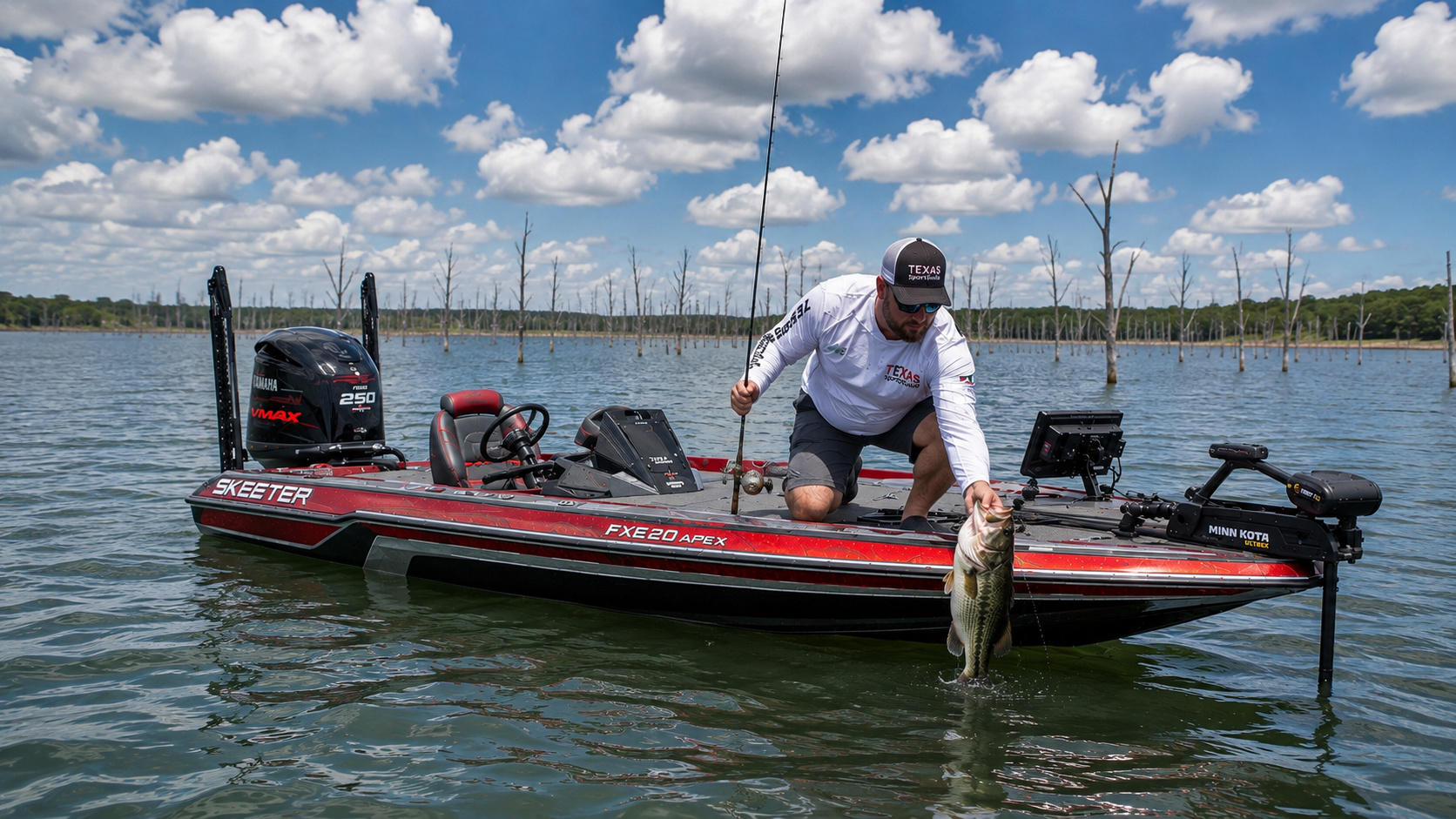
If I were backing my Skeeter into Ray Hubbard tomorrow morning, I'd want the boat floating before sunrise.I'd have a walking bait lying on the front deck.There would be a spinnerbait ready beside it.A Texas-rigged worm would be waiting for the grass.And I'd absolutely have a black-and-blue jig tied on.Fourteen pounds and ten ounces worth of history says that's probably a sensible idea.I'd start somewhere that two kinds of habitat meet.Maybe hydrilla against a creek channel.Maybe riprap beside deeper water.Maybe a little group of standing timber that doesn't look quite like the hundred trees around it.That's one of the lessons bass fishing teaches after enough years.The obvious place is rarely enough.Look for the difference.A depth change.A rock transition.A point in the grass.A single laydown.One stump standing just outside the others.Ray Hubbard is a particularly good lake for that style of fishing because it gives you so many kinds of habitat within a relatively compact reservoir.And there's something else I like about it.You don't have to travel to the farthest corner of Texas to find good bass water.Sometimes wildness survives right beside civilization.The interstate can be humming.The Dallas skyline can be somewhere behind you.A jet may be climbing toward the clouds.None of it matters when a six-pound largemouth buries your rod beside a hydrilla edge.For those few seconds, your entire world becomes a bent fishing rod, a tight line and a green fish trying desperately to get back where she came from.That's Lake Ray Hubbard Texas Largemouth Bass Fishing.Close to town.Easy to reach.Complicated enough to keep you thinking.And with a 14.10-pound lake record, just dangerous enough to make every cast interesting.

0 Comments