
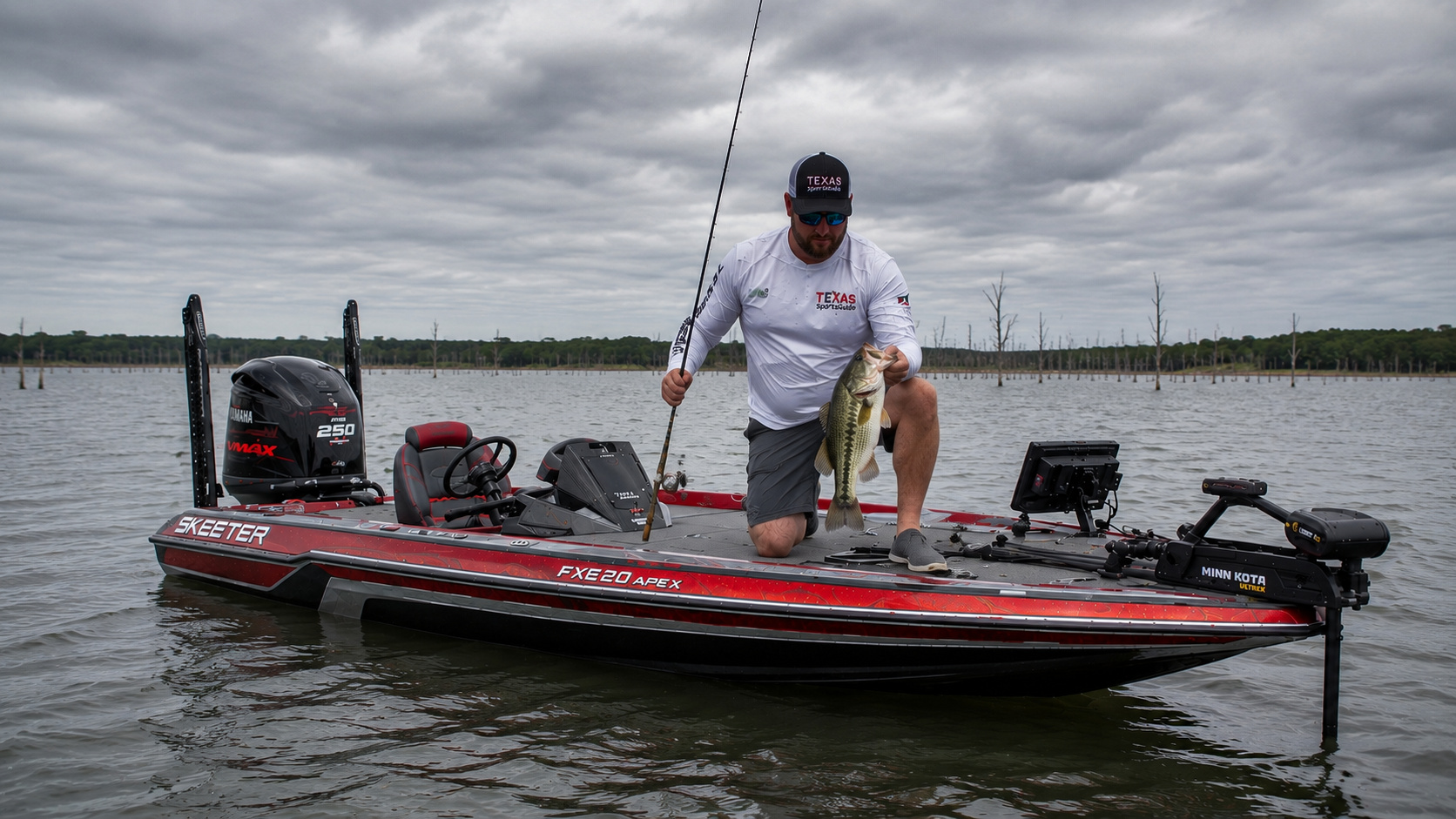
Nearly 38,000 acres of East Texas water, scarce cover, shallow spring bass, autumn schooling fish, and a 14-pound largemouth hiding in a lake better known for stripers and giant blue cats
Lake Tawakoni Texas Bass Fishing Is a Different Kind of East Texas Experience
Lake Tawakoni has always struck me as a lake with two reputations.
Ask a Texas catfisherman about Tawakoni and you'll probably hear about blue cats large enough to make a landing net look undersized. Ask a striper fisherman and the conversation turns toward open water, slabs, shad and screaming drags.
Ask about largemouth bass and you may get a pause.
That's unfortunate.
Lake Tawakoni Texas Bass Fishing isn't built around endless hydrilla beds or acres of flooded bushes. Texas Parks and Wildlife describes largemouth bass as a popular sportfish here, but currently rates the fishery fair. Habitat is limited, aquatic vegetation fluctuates dramatically with water level, and flooded timber is scattered rather than abundant. Those conditions make available cover disproportionately important.
And Tawakoni has proven beyond argument that it can grow a giant.
The current TPWD lake record is a 14.00-pound largemouth bass, caught by Warren Sprague on May 29, 2018, on a plastic worm.
Fourteen pounds.
That will get my attention.
Tawakoni rewards fishermen who resist the temptation to treat all 37,879 acres alike. The bass fisherman needs to shrink this enormous reservoir into smaller pieces: a pier, a boathouse, a patch of smartweed, a shoreline tree, a creek mouth, a piece of riprap or an isolated clump of flooded cover.
Find something different.
Then fish it carefully.
That's where our trip begins.
Where Is Lake Tawakoni Texas?
Lake Tawakoni lies approximately 50 miles east of Dallas in Hunt, Rains and Van Zandt counties, near Quinlan, West Tawakoni, East Tawakoni, Point and Wills Point.
Texas Parks and Wildlife lists the reservoir at:
-
37,879 surface acres
-
70 feet maximum depth
-
437.5 feet conservation-pool elevation
-
Moderately stained normal water clarity
-
Considerable normal fluctuation of approximately 3 to 9 feet
The lake was impounded in 1960 and is controlled by the Sabine River Authority of Texas.
That 3-to-9-foot fluctuation deserves a red circle in a bass fisherman's notebook.
Tawakoni's shoreline habitat changes enormously with elevation.
At or near conservation pool, water can flood smartweed, water willow, terrestrial vegetation and other shallow cover.
Drop the lake several feet and much of that habitat may be high and dry.
This is not a reservoir where last year's shoreline photograph necessarily tells you where this year's bass will live.
What Rivers and Creeks Feed Lake Tawakoni?
Tawakoni Sits at the Headwaters of the Sabine River System
Lake Tawakoni was constructed across the upper Sabine River drainage.
TPWD describes the reservoir as lying on Caddo Creek and the South Fork and Cowleech Fork of the Sabine River.
Those tributaries create a broad system of creek arms, flats, channels and shallow upper-lake habitat.
For bass fishermen, old channels are underwater highways.
During late winter, largemouth can use channel edges and nearby structure as staging areas before moving shallow.
During spring, those routes lead toward protected spawning water.
As summer arrives, channels provide access back toward deeper water.
Then autumn reverses the traffic when shad move toward tributaries and shallow feeding areas.
When studying a Tawakoni map, I would look particularly hard at places where an old creek channel intersects something else.
A point.
A bridge.
A patch of timber.
A hard shoreline.
A pocket.
A little bit of vegetation.
Bass fishing often improves where two ordinary features meet and become something extraordinary.
What Fish Species Live in Lake Tawakoni?
Lake Tawakoni is one of the most diverse fisheries in North and East Texas.
TPWD lists the predominant sportfish as:
-
Largemouth bass
-
Striped bass
-
Hybrid striped bass
-
White bass
-
Blue catfish
-
Channel catfish
-
Flathead catfish
-
Crappie
Striped, hybrid striped and white bass are especially important to the local fishery. TPWD stocks striped and hybrid bass annually and currently rates the open-water fisheries excellent. Catfishing is also rated excellent.
Largemouth bass receive a fair rating.
That doesn't mean there aren't good bass.
It means this is not a lake where I'd expect largemouth fishing to be easy simply because the reservoir is large.
Sometimes the harder lakes teach us more.
What Is the Current Lake Tawakoni Water Level?
Here's a number that should always be dated.
As of August 9, 2026, Water Data for Texas reports Lake Tawakoni at approximately 97.2% full.
Check the current Lake Tawakoni water level
That relatively high level is important because TPWD says Tawakoni's vegetation becomes much more useful when the reservoir approaches conservation pool.
At higher water, stands of water willow, smartweed and flooded terrestrial plants can provide abundant shallow cover. American lotus can also become significant in some areas. When water remains low, much of that vegetation becomes exposed and loses value to fish.
On Tawakoni, checking the water level isn't merely preparation for launching the boat.
It helps determine your fishing strategy.
What Aquatic Vegetation Grows in Lake Tawakoni?
Think Emergent Vegetation More Than Hydrilla
Tawakoni is not primarily a submerged-grass lake.
TPWD identifies:
-
Water willow
-
Smartweed
-
American lotus
-
Flooded terrestrial vegetation
Submerged plants such as coontail and hydrilla are generally scarce.
That's a useful distinction.
When Tawakoni rises into smartweed and terrestrial vegetation, I would fish those areas much as I would flooded bushes on another reservoir.
Look for:
-
Points in the vegetation
-
Small drains
-
Isolated clumps
-
Open pockets
-
Deeper water nearby
-
Hard-bottom transitions
-
Baitfish
If you find a hundred yards of uniform vegetation, don't necessarily fish every foot.
Find the irregularity.
That's often where the bass is.
What Kind of Bass Structure Is in Lake Tawakoni?
Limited Habitat Makes Good Cover More Valuable
This may be the most important lesson in the entire article.
TPWD says flooded timber exists in scattered areas but is not abundant, while aquatic vegetation is sparse and vulnerable to lake drawdowns.
The department makes an unusually direct observation:
Because habitat is limited, available cover tends to attract and hold largemouth bass.
That is practically a fishing plan written for us.
Concentrate on:
-
Piers
-
Boathouses
-
Shoreline trees
-
Vegetation
-
Scattered flooded timber
-
Bridge-related structure
-
Riprap
-
Creek-channel intersections
TPWD specifically advises largemouth fishermen to target piers, boathouses, vegetation and shoreline trees.
Don't spend an hour fishing empty water because it looks pretty.
On a lake with limited cover, cover is currency.
Lake Tawakoni Weather Throughout the Year
Lake Tawakoni State Park provides a useful local climate snapshot.
TPWD lists an average January low around 30°F, an average July high around 95°F, and average annual rainfall of approximately 42.4 inches.
Winter
December through February can bring mild afternoons interrupted by strong northers and freezing weather.
Water temperatures can fall into the 40s.
Spring
March through May means warming water, wind, thunderstorms and the year's primary shallow-water largemouth movement.
Summer
June through August is hot and humid.
Mid-90s are normal territory, and afternoon heat can be substantial.
Early mornings become increasingly attractive for both fish and fishermen.
Fall
September through November gradually brings cooler nights and active baitfish.
TPWD specifically identifies fall as one of Tawakoni's peak fishing periods because of schooling fish.
Tawakoni is nearly 38,000 acres, so wind deserves respect.
A broad East Texas reservoir can turn ugly considerably faster than it took you to leave the boat ramp.
Driving Distance to Lake Tawakoni From Major Texas Cities
These are approximate distances to the central Lake Tawakoni area. Your exact mileage will depend on the boat ramp or marina you choose.
Dallas to Lake Tawakoni
Approximately 50 to 60 miles.
A common route follows US-80 east, then TX-34/TX-276 or other local approaches depending on your destination.
Plan on roughly an hour to 1¼ hours.
Fort Worth to Lake Tawakoni
Approximately 85 to 100 miles.
Travel east through the Metroplex, generally using I-30 or US-80 connections toward the lake.
Allow approximately 1½ to 2 hours.
Austin to Lake Tawakoni
Approximately 240 to 260 miles.
Travel north on I-35 toward the Dallas area and then east toward Tawakoni.
Allow roughly four hours.
Houston to Lake Tawakoni
Approximately 230 to 250 miles.
A practical route runs north on I-45, then east/northeast through local highways toward the lake.
Allow roughly four hours.
San Antonio to Lake Tawakoni
Approximately 325 to 345 miles.
Take I-35 north through Austin and Waco, then turn east toward the lake.
Allow roughly 5 to 5½ hours.
Corpus Christi to Lake Tawakoni
Approximately 450 to 475 miles.
Take I-37 north toward San Antonio, then I-35 north and continue toward East Texas.
Allow roughly seven hours.
For a fisherman towing a boat, I'd add some margin to all of those estimates.
Nobody ever caught a bigger bass because he arrived at the ramp twelve minutes earlier after pulling a trailer like his hair was on fire.
Lake Tawakoni Boat Ramps
Tawakoni has excellent access for a reservoir its size.
TPWD lists five public ramps in addition to the four-lane ramp at Lake Tawakoni State Park, plus numerous privately operated ramps and marinas.
Lake Tawakoni State Park Boat Ramp
Lake Tawakoni State Park
Address: 10822 FM 2475, Wills Point, TX 75169
Phone: 903-560-7123
Email: LakeTawakoniSP@tpwd.texas.gov
Boat ramp: Four lanes
Courtesy dock: Yes
Fish-cleaning station: Yes
The park occupies 376 acres and more than five miles of shoreline. It also provides camping, hiking, swimming and paddling.
Lake Tawakoni State Park information and reservations
Two Mile Bridge East Public Ramp
Location: Texas 276, east end of the Tawakoni Causeway
Operator: Texas Parks and Wildlife Department
Ramp: Two-lane concrete
Fee: None
Open: Year-round
TPWD lists this as a public no-fee launch.
Caddo Creek Public Ramp
Location: Caddo Creek Road off Hunt County Road 2101, north of Quinlan
Operator: Sabine River Authority
Phone: 903-598-2216
Ramp: Two-lane concrete
Fee: None
Open: Year-round
Duck Cove Public Ramp
Location: FM 751 southeast of Quinlan, east shore of Duck Cove
Operator: Texas Parks and Wildlife Department
Ramp: Two lanes
Fee: None
Open: Year-round
Sabine River Authority Public Ramp
Location: Off Texas 47 on the west side of the dam
Phone: 903-598-2216
Ramp: Two-lane concrete
Fee: None
Open: Year-round
Those free public ramps give a bass fisherman the ability to launch near several different portions of this very large reservoir.
That's important.
Running twenty miles across open water isn't always the smartest way to reach tomorrow's fishing area.
Marinas on Lake Tawakoni
Tawakoni Marina
Address: 2201 E. Rabbit Cove Road #3, Quinlan, TX 75474
Phone: 903-447-2255
Email: Office@TawakoniMarina.com
The marina offers boat slips, boat rentals, cabins and other recreational facilities.
Wind Point Park
Location: Southwest of Lone Oak on FM 1571
Phone: 903-634-9463
Boat ramps: Two two-lane concrete ramps
Fishing pier: Approximately 300 feet
Open: Year-round
Fee: Required
429 Marina & RV Park
Address: 10636 Black Bass Road, Quinlan, TX 75474
Phone: 903-356-2125
The facility provides a boat ramp, RV accommodations, live bait and marina services.
Duck Cove Marina
Location: FM 751 southeast of Quinlan on the west shore of Duck Cove
Phone: 903-356-3240
TPWD lists a single-lane concrete ramp with year-round access. The marina also offers boat storage and fishing-related services.
For facilities without a publicly verified email address, I recommend calling rather than relying on an old directory listing. Marina ownership and contact information have a habit of changing faster than submerged creek channels.
Lodging and Camping Near Lake Tawakoni
Tawakoni is much more oriented toward cabins, RV parks and campgrounds than conventional lakefront hotels.
For a fishing trip, that isn't necessarily a disadvantage.
I'd rather have a safe place for the boat trailer and be five minutes from the ramp than have a marble lobby twenty miles away.
Tawakoni Marina Cabins
Address: 2201 E. Rabbit Cove Road #3, Quinlan, TX 75474
Phone: 903-447-2255
Email: Office@TawakoniMarina.com
The marina currently advertises cabin rentals along with temporary boat-slip and RV-site rentals.
Lake Tawakoni State Park Camping
Lake Tawakoni State Park
Address: 10822 FM 2475, Wills Point, TX 75169
Phone: 903-560-7123
Email: LakeTawakoniSP@tpwd.texas.gov
Reservations: 512-389-8900
The park offers full-hookup sites, water-and-electric sites and group camping. TPWD recommends reservations because the park frequently reaches capacity during its busy spring and summer seasons.
Lake Tawakoni State Park camping and reservations
For a traditional fishing weekend, that's hard to beat.
Coffee before daylight.
Boat already hooked up.
Ramp nearby.
That's living efficiently.
Spring Lake Tawakoni Texas Bass Fishing
March Through May: Follow the Bass Into Shallow Cover
TPWD identifies spring as one of Tawakoni's peak largemouth periods, particularly when bass move shallow to spawn. The department specifically recommends spinnerbaits, plastic worms and jigs for spawning fish.
Early in the prespawn, start around:
-
Creek-channel edges
-
Secondary points
-
Shoreline trees near deeper water
-
Piers and boathouses
-
Riprap
-
First available vegetation
Best Prespawn Depths
Start around 6 to 15 feet, moving shallower during sustained warming trends.
Best Spring Lures
Spinnerbait
Weight: 3/8 to 1/2 ounce
Colors: White/chartreuse, white, shad
Fish it around shoreline wood and newly flooded vegetation.
In stained water, a little chartreuse isn't exactly a revolutionary Texas fishing discovery, but it has survived generations for a reason.
Texas-Rigged Plastic Worm
Size: 6 to 8 inches
Colors: Green pumpkin, watermelon red, junebug, black/blue
Pitch to:
-
Shoreline trees
-
Piers
-
Boathouses
-
Vegetation pockets
Remember that the lake record ate a plastic worm.
Jig
Weight: 3/8 to 1/2 ounce
Colors: Black/blue, green pumpkin, brown
Pitch wood, docks and isolated cover.
Squarebill Crankbait
Size: 1.5 to 2.5
Colors: Chartreuse/black, shad, crawfish
Use it where rock or harder shoreline provides something to deflect against.
The Lake Tawakoni Spawn
As water temperatures settle into the 60s, bass move toward protected spawning areas.
Look for:
-
Smartweed
-
Water willow
-
Flooded terrestrial cover
-
Shoreline wood
-
Protected pockets
-
Dock corners
Productive water can range from 1 to 6 feet.
This is where Tawakoni's water level becomes critical.
At high elevation, bass may have abundant fresh cover.
At low elevation, the same shoreline may be barren.
A 5-inch weightless stick worm in green pumpkin or watermelon red is a good searching bait.
A compact creature bait Texas-rigged with a light sinker can be even better when you need to penetrate vegetation.
What Do the 2026 TPWD Reports Say About Tawakoni Largemouth Bass?
This year's available reports give us useful winter-to-spring clues.
On January 7, 2026, with main-lake water around 53°F, TPWD reported the largemouth bite slow.
On January 21, largemouth remained tough during unusually warm winter conditions.
By January 28, after colder weather dropped main-lake temperatures to around 46°F, TPWD recommended targeting riprap with larger plastics in 8 to 12 feet.
Then by February 25, things had changed. TPWD reported the largemouth bite better than average, with good numbers of larger fish being caught in shallow water on soft plastics.
That's classic seasonal movement written right into the reports.
Cold winter: slow down around deeper riprap.
Late winter warming: start looking shallow.
Summer Lake Tawakoni Bass Fishing
June Through August: Start Shallow and Finish Around Shade and Structure
At daylight, I would still give shallow water a chance.
Look around:
-
Piers
-
Boathouses
-
Vegetation
-
Shoreline trees
-
Shallow points
Early-Morning Summer Lures
Walking topwater: 4 to 5 inches
Colors: Bone, chrome, shad
Buzzbait: 3/8 ounce
Colors: White or black
Spinnerbait: 3/8 ounce
Colors: White/chartreuse
Once the sun climbs, shade becomes increasingly important.
That's when boathouses and piers deserve careful attention.
Skip a 4- to 5-inch soft plastic beneath the darkest shade rather than merely casting around the outside posts.
Bass are perfectly capable of living surprisingly shallow during summer if shade, oxygen and food are available.
Where shallow cover fails, back toward:
-
Creek channels
-
Main-lake points
-
Isolated timber
-
Bridge structure
-
Offshore cover
Try 10 to 25 feet, adjusting according to baitfish and electronics.
Fall Lake Tawakoni Texas Bass Fishing
September Through November: School Is in Session
TPWD specifically identifies fall as a peak period for schooling fish and recommends crankbaits, spinnerbaits and topwater lures.
This is a baitfish game.
Look for:
-
Creek mouths
-
Points
-
Windblown shorelines
-
Piers
-
Vegetation
-
Shallow flats
Best Fall Lures
Lipless crankbait: 1/4 to 1/2 ounce
Colors: Chrome/blue, chrome/black, shad
Squarebill: 1.5 to 2.5
Colors: Shad, chartreuse/black
Spinnerbait: 3/8 to 1/2 ounce
Colors: White, white/chartreuse
Walking topwater: 4 to 5 inches
Colors: Bone, chrome
Paddle-tail swimbait: 3 to 4 inches
Colors: Pearl white, natural shad
Tawakoni's enormous populations of white bass, stripers and hybrids mean surface schooling isn't automatically largemouth activity.
But schooling predators tell you where the shad are.
And largemouth bass have never objected to living near a well-stocked pantry.
Winter Lake Tawakoni Bass Fishing
December Through February: Riprap, Plastics and Patience
Winter isn't Tawakoni's easiest largemouth season.
The 2026 TPWD reports make that fairly clear.
During January's coldest conditions, largemouth fishing slowed substantially. TPWD's practical recommendation was larger plastics around riprap in 8 to 12 feet.
That's where I would begin.
Best Winter Areas
-
Riprap
-
Bridge approaches
-
Creek-channel edges
-
Isolated wood
-
Deep dock structure
-
Hard-bottom points
Best Winter Lures
Texas-rigged worm: 7 to 10 inches
Colors: Junebug, black/blue, green pumpkin
Jig: 3/8 to 1/2 ounce
Colors: Black/blue, brown
Suspending jerkbait: 4 to 5 inches
Colors: Natural shad
Slow-rolled spinnerbait: 1/2 ounce
Ned-style bait: 2.5 to 3 inches
Colors: Green pumpkin
Winter fishing rewards persistence.
A largemouth in 46-degree water isn't necessarily fasting.
She simply isn't inclined to chase your crankbait halfway to Louisiana.
Best Areas for Lake Tawakoni Texas Bass Fishing
Piers and Boathouses
These are specifically recommended by TPWD for largemouth bass.
They provide shade, vertical cover and ambush opportunities.
Shoreline Trees
Where trees intersect deeper water or a creek channel, slow down.
An isolated tree may be considerably more valuable than an entire forest.
Smartweed and Water Willow
When the lake is high enough to flood vegetation, fish edges, pockets and irregularities.
Duck Cove
The area offers both marina and public-ramp access and a combination of protected water and structural variety.
Caddo Creek
The tributary environment offers creek-channel structure and shallow seasonal opportunities.
Tawakoni Causeway and Two Mile Bridge Area
Bridge-related riprap, pilings, channel structure and nearby ramps make this an obvious area to investigate through multiple seasons.
Dam and Lower Lake
Hard structure and deeper water become particularly attractive during winter and summer.
Lake Tawakoni Largemouth Bass Record
Here's the number that changes the way I look at the lake.
According to TPWD's records, updated July 28, 2026:
Largemouth bass: 14.00 pounds
Length: 25 inches
Angler: Warren Sprague
Date: May 29, 2018
Lure: Plastic worm
A fourteen-pound bass from a lake where largemouth fishing is currently rated fair tells us something important.
A fair fishery can still contain extraordinary individual fish.
It also reminds us that May isn't necessarily too late for a giant.
And I appreciate that she ate a plastic worm.
Nothing fancy.
No electronic wizardry attached to the hook.
Just one of the oldest bass-catching ideas in Texas doing what it has done for decades.
Lake Tawakoni State Park
Lake Tawakoni State Park
Lake Tawakoni State Park deserves a section of its own.
The 376-acre park provides more than five miles of shoreline, a four-lane boat ramp, fish-cleaning station, campsites, hiking and mountain-biking trails, swimming and paddling. Anglers fishing from shore inside a Texas state park do not need a fishing license.
For a family fishing weekend, that's a mighty convenient package.
The park is also close enough to Dallas for a Friday-afternoon departure without turning the trip into an expedition.
Plan a visit to Lake Tawakoni State Park
Zebra Mussels and Lake Tawakoni
Lake Tawakoni is under TPWD's zebra-mussel precautions.
Texas law requires draining water from boats and onboard receptacles when approaching or leaving public fresh water.
That includes:
-
Livewells
-
Bilges
-
Bait containers
-
Motors and lower units where applicable
Clean, Drain and Dry before moving to another reservoir.
If you're fishing Tawakoni today and Lake Fork tomorrow, protecting tomorrow's water is part of today's fishing trip.
Five More Texas Bass Fishing Adventures From Texas SportsGuide
Tawakoni makes an excellent eastern anchor for a tour of the North Texas bass lakes we've been covering.
For another reservoir just east of Dallas, our Texas SportsGuide Lake Ray Hubbard Texas Largemouth Bass Fishing article explores hydrilla, riprap and standing timber in a lake that has produced a 14.10-pound largemouth.
A little farther west, Lavon Lake Texas Bass Fishing covers another East Fork Trinity reservoir where standing timber, lotus, water willow and dam riprap create an entirely different bass-fishing puzzle.
Continue into the Metroplex with Lewisville Lake Texas Bass Fishing, where nearly 30,000 acres of timber, pondweed, rocky shoreline and creek structure offer largemouth and spotted bass opportunities.
Our Grapevine Lake Texas Bass Fishing guide takes you to a smaller but unusually diverse reservoir containing largemouth, spotted bass and a legitimate smallmouth fishery.
And if you're ready to trade East Texas flats for limestone canyon country, Possum Kingdom Lake Texas Largemouth and Smallmouth Bass Fishing explores one of the state's classic rocky structure fisheries.
Those lakes are close enough geographically to belong in the same conversation, but different enough that each teaches you something new.
That's Texas bass fishing in a nutshell.
Frequently Asked Questions About Lake Tawakoni Texas Bass Fishing
Is Lake Tawakoni Good for Largemouth Bass?
TPWD currently rates largemouth fishing fair, although largemouth remain a popular sportfish. The lake has produced a 14-pound record fish.
How Big Is Lake Tawakoni?
TPWD lists Lake Tawakoni at 37,879 surface acres with a maximum depth of 70 feet.
What Is the Best Bass Cover?
TPWD specifically recommends piers, boathouses, vegetation and shoreline trees. Flooded timber exists but isn't abundant.
Does Lake Tawakoni Have Hydrilla?
Some submerged vegetation such as hydrilla and coontail may occur, but TPWD describes both as generally scarce. Emergent water willow and smartweed are more important when water levels are favorable.
When Is the Best Time to Bass Fish Lake Tawakoni?
TPWD identifies spring for spawning fish and fall for schooling fish as peak periods.
What Are the Best Spring Bass Lures?
TPWD recommends spinnerbaits, plastic worms and jigs for spawning largemouth.
What Is the Lake Tawakoni Largemouth Bass Record?
The current TPWD record is 14.00 pounds, caught by Warren Sprague on May 29, 2018, using a plastic worm.
Final Thoughts on Lake Tawakoni Texas Bass Fishing
If I were launching the Skeeter on Tawakoni tomorrow morning, I'd remind myself of one thing before I ever lowered the Minn Kota.
Don't fish 37,879 acres.
Fish one piece of cover.
Then another.
That's the secret hiding in TPWD's description of this lake.
Tawakoni doesn't have unlimited bass habitat. The scattered timber isn't endless. The hydrilla isn't thick. Water-level changes can take shallow vegetation away altogether.
That sounds like bad news until you think about it from the bass's point of view.
If there are only six good houses on the block, somebody is probably living in them.
I'd begin at daylight around whatever shallow cover the current water level had given me.
A spinnerbait would be on the deck.
So would a Texas-rigged worm.
I'd have a squarebill for rock and a jig for wood.
If the lake were high, I'd look hard at smartweed and flooded shoreline cover.
If it were low, I'd back toward the first available depth change and start studying my electronics.
Then I'd pay attention to the small things.
A boathouse with slightly deeper water.
One tree standing away from the others.
A tiny opening in the smartweed.
A creek channel that bends toward shore.
A point where the wind has been pushing shad for two hours.
A few rocks everybody else passed because there weren't enough of them to look impressive.
Bass fishing has always been a game of details.
The longer I've fished, the less I believe in magic spots and magic lures.
Good fishermen notice things.
They remember things.
They recognize patterns.
And then, when experience and luck happen to shake hands on the same cast, something heavy pulls back.
Tawakoni is particularly well suited to that kind of fisherman.
The striper boats may be running the open lake.
Catfishermen may be hunting another 50-pound blue.
Crappie fishermen may be gathered around bridge pilings.
Meanwhile, somewhere beside an ordinary-looking dock or a little patch of flooded smartweed, a big green fish may be sitting quietly in three feet of water.
We know fish of that caliber live here.
Fourteen pounds says so.
And that's more than enough reason to make another cast.
That's Lake Tawakoni Texas Bass Fishing.
0 Comments