
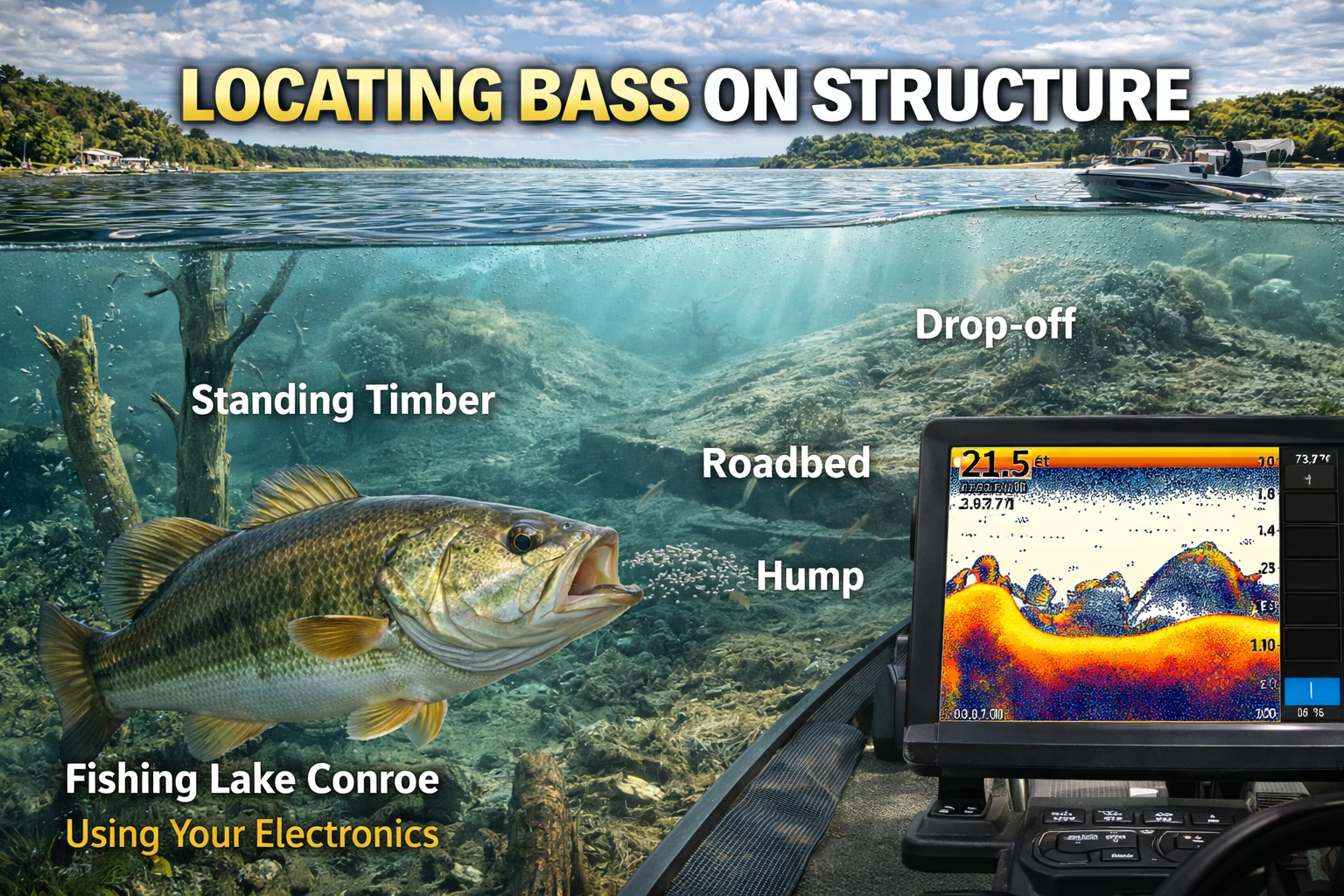
If you want to consistently catch bass, you have to start with one simple truth:
Bass live on structure.
And on lakes like Lake Conroe, where aquatic vegetation is limited, structure isn’t just important—it’s everything.
Where Bass Set Up
Without heavy grass to hold fish, bass on Lake Conroe relate almost entirely to underwater structure. That means you’ll find them holding on:
- Drop-offs
- Creek channels
- Roadbeds
- Pond dams
- Humps
- Rock piles
- Standing timber
These are the places where fish gather, feed, and move with changing conditions.
The challenge?
Most of it is invisible from the surface.
Your Window Below the Surface
That’s where your electronics come into play.
A good graph—or depth finder—isn’t just helpful on Lake Conroe, it’s essential. It’s your only real window into what’s happening beneath the boat.
Understanding how to read that screen is one of the most valuable skills an angler can develop.
At the heart of the system is the transducer, mounted either in the hull or on the transom. It sends out a sonar signal in the shape of a cone and receives the return signal, which is then displayed on your screen.
Anything inside that cone shows up on the graph.
Seeing the Bottom in Your Mind
Here’s a simple way to picture it.
Forget the water for a moment.
Imagine you’re standing in a dark field at night. A helicopter hovers just ahead, shining a Q-Beam straight down. The only thing you can see is what falls inside that beam of light.
That’s exactly how your graph works.
Your boat is the helicopter.
The transducer is the light.
And the screen shows you a side-view profile of everything inside that cone.
Once you start thinking of it that way, the picture begins to make sense.
Reading What the Graph Tells You
To get the most accurate information, it’s best to run your unit in manual mode. This disables the “fish symbol” feature and forces you to interpret what you’re seeing—something every serious angler needs to learn.
Here’s what to look for:
- Fish appear as inverted “V” shapes (arches)
- A longer, more defined arch usually indicates a larger fish
- Baitfish schools show up as clouds or dense balls
- Small groups of bait appear as scattered specks or darker patches
The more time you spend watching your graph, the more those shapes begin to tell a story.
Putting It All Together
Finding structure is the first step.
Understanding what’s on it is the next.
When you combine the two—locating a creek channel bend, spotting baitfish nearby, and seeing arches suspended along the drop—you’re no longer guessing.
You’re fishing with purpose.
Final Cast
There’s no shortcut to learning electronics.
But once it clicks, everything changes.
You stop fishing water you can see… and start fishing what’s actually there.
And on a lake like Conroe, where the best structure lies hidden below the surface, that knowledge is the difference between casting and catching.
Because in the end, the angler who understands what’s beneath the boat will always have the advantage over the one who doesn’t.


0 Comments