

Every angler has a story about the one that got away.
This isn’t one of them.
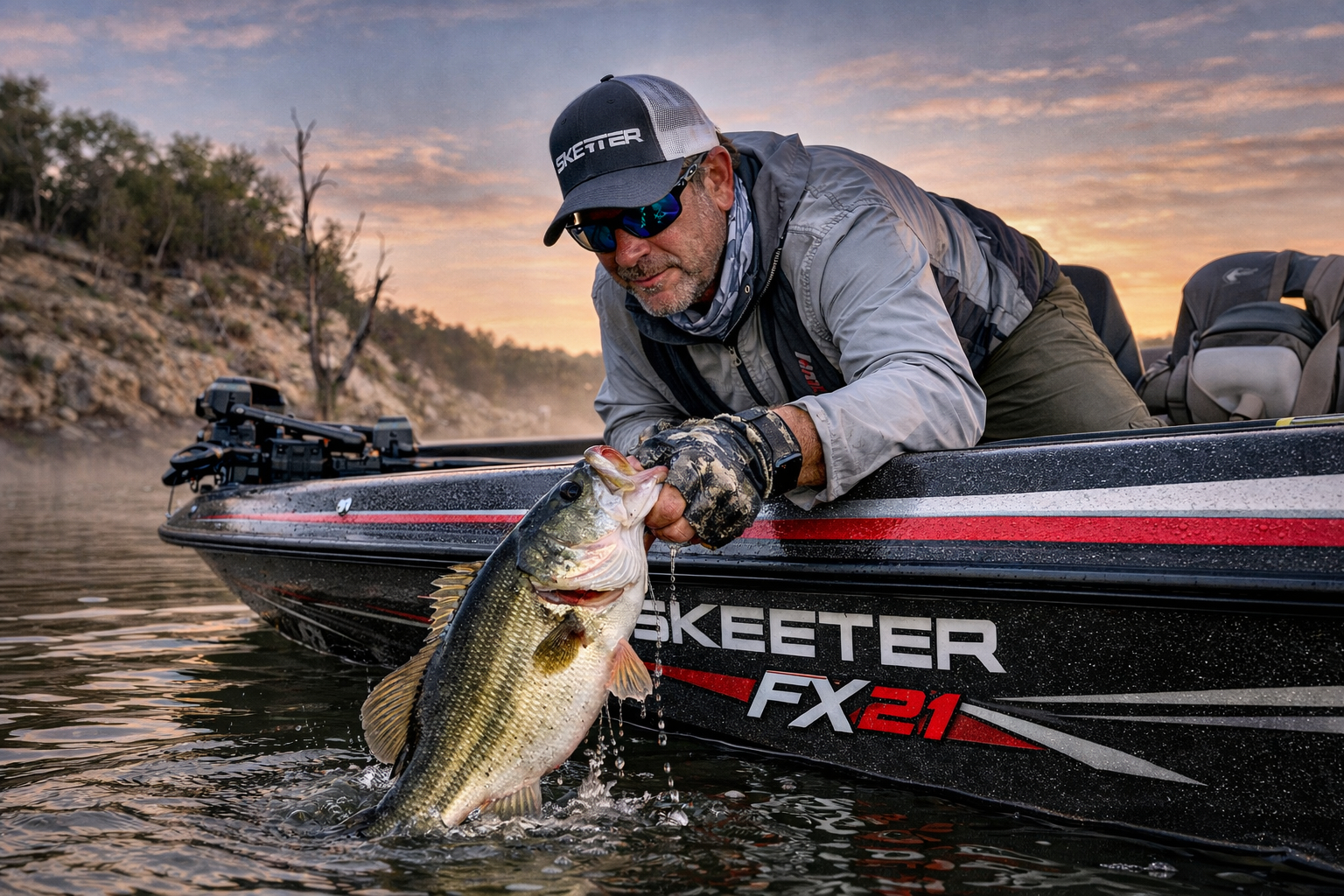
On a cool March morning at Lake Fork Reservoir, a bass that could have easily become another whispered legend instead became something far more meaningful, a reminder of what real sportsmanship looks like when nobody’s watching.
David Campbell, longtime manager of Texas’ renowned ShareLunker program, often says that anglers who donate big bass are among the finest conservationists in the state. What happened that Saturday proved his point better than any speech ever could.
Guide James Caldemeyer was on the water with clients Brian Ketterer and Shannon Spear of Conroe, doing what folks come to Lake Fork to do in March, chasing big fish during the peak of the lunker season.
They eased into a small cove already dotted with nearly a dozen boats. It looked promising, but nothing out of the ordinary. Then Caldemeyer spotted something that didn’t sit right.
“With my polarized sunglasses, I could see a fish moving slowly near the surface,” he said. “She looked like she was struggling.”
What happened next had nothing to do with catching fish and everything to do with doing right by one.
Caldemeyer reached for his net.
“I scooped her up and immediately knew she was a giant, and in trouble. My concern wasn’t about landing a trophy. It was about saving the fish. I put her in the livewell and told my clients we needed to head in so her air bladder could be relieved. I didn’t have a needle with me.”
Now, asking paying clients to cut short a prime-time Lake Fork trip in March is a tall order. That’s like asking a hunter to step out of the deer woods on opening morning. But Ketterer and Spear didn’t hesitate.
“They couldn’t have been happier if they’d caught her themselves,” Caldemeyer said. “They were thrilled just to be part of helping that fish.”
Caldemeyer called ahead to Lake Fork Marina, an official ShareLunker holding station, where Cameron Burnett was ready when they arrived. The fish tipped Caldemeyer’s handheld scale at 14.5 pounds, already the kind of number that gets people talking.
Burnett quickly went to work “fizzing” the bass, carefully releasing air from the swim bladder so the fish could regain balance and return to deeper water.
“He let a lot of air out of her,” Caldemeyer said. “She started to right herself, floated up a couple of times, then swam back down. We kept an eye on her until David got there.”
On a certified scale, the fish officially weighed 14.68 pounds.
When Campbell arrived, he assumed the obvious.
“Who’s the lucky angler?” he asked.
Caldemeyer didn’t miss a beat.
“We all are.”
Then, away from the growing crowd, he quietly explained what had really happened. No hook. No cast. No fight. Just a fish in distress and a decision to help.
“I could have said I caught her,” Caldemeyer admitted. “But that wouldn’t have been right. My concern was for the fish, not for a story.”
After consulting with Texas Parks and Wildlife Department game wardens, who raised no objections, Campbell accepted the bass into the ShareLunker program.
“James Caldemeyer saved this fish,” Campbell said. “She looks very healthy.”
According to Allen Forshage of the Texas Freshwater Fisheries Center, if genetic testing confirms the bass as a pure Florida strain largemouth, she’ll play a role in selective breeding efforts. Those offspring will be stocked into public waters across Texas, continuing the long-standing push to grow bigger, better bass fisheries.
It’s a program built on patience, science, and anglers willing to think beyond the moment.
The fish was designated ShareLunker No. 465 and transported to Athens, where her legacy may one day swim in waters all across the state.
As for Caldemeyer and his clients, they went back to fishing.
The biggest bass they landed the rest of the day weighed around four pounds. Under normal circumstances, that might’ve felt like a letdown.
Not this time.
“We were on Cloud Nine all day,” Caldemeyer said. “Just because of how that morning started.”
And maybe that’s the real story here.
Not every great fishing tale ends with a grip-and-grin photo or a spot on the leaderboard. Some end with a quiet decision, a long run back to the marina, and a fish given another chance to swim.
We’ve all heard about the big one that got away.
This is the one that didn’t.

0 Comments