
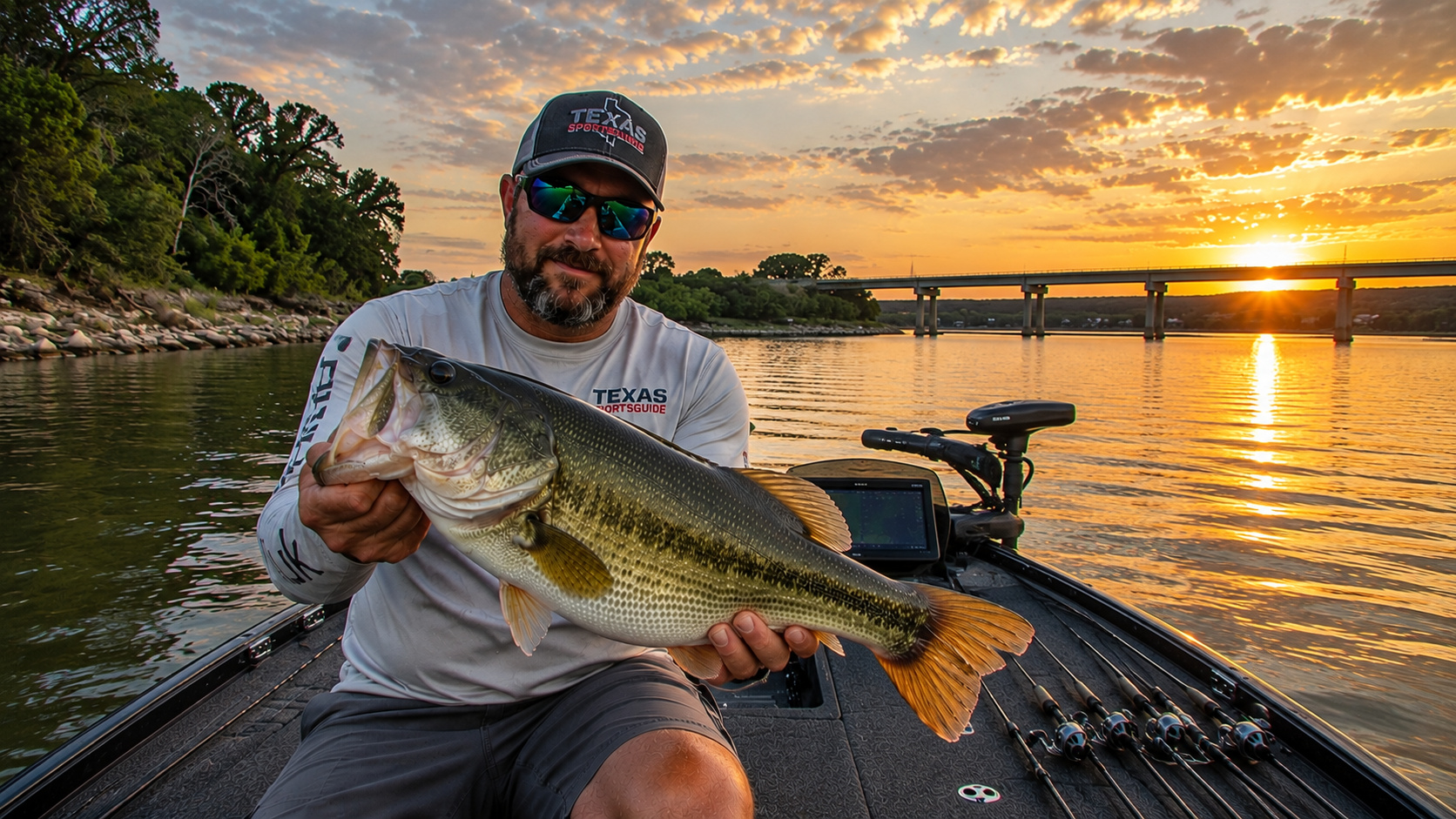
Timber, hydrilla, old roads, flooded stock ponds and a surprisingly wild bass lake hiding beneath the Dallas-Fort Worth skyline
Why Joe Pool Lake Is a Different Kind of Texas Bass Lake
There is something almost amusing about slipping a bass boat into Joe Pool Lake before sunrise.
Behind you lies one of the largest metropolitan areas in America. Millions of people are beginning another morning of alarm clocks, coffee, traffic reports, office buildings and brake lights.
In front of you there is water.
Quiet water.
The eastern sky is beginning to brighten behind the trees. A great blue heron lifts from a stump. Somewhere back in the standing timber a shad flips on the surface, followed a second later by the unmistakable hollow whump of a largemouth bass.
Suddenly Dallas seems a long way off.
That contrast is part of what makes Joe Pool Lake Texas Largemouth Bass Fishing such an interesting subject.
Joe Pool is not a giant Texas reservoir. It doesn't have the endless horizons of Sam Rayburn, the canyon country of Amistad or the sprawling river arms of Toledo Bend. What it does have is an unusually concentrated collection of bass habitat: hydrilla and pondweed, flooded timber, old roadbeds, submerged bridges, stock ponds, creek channels and man-made brush piles.
Texas Parks and Wildlife rates the largemouth bass fishery as good, and describes largemouth bass as the reservoir's most popular sport fish.
That's enough to make me want to put the trolling motor down.
But before we start casting, there's something important to straighten out.
How Big Is Joe Pool Lake?
Joe Pool Lake lies in the southern Dallas-Fort Worth Metroplex between Cedar Hill, Grand Prairie and Mansfield.
The U.S. Army Corps of Engineers describes it as roughly a 7,400-acre reservoir. It is relatively young by Texas reservoir standards, having filled during the 1980s.
That youth helps explain something bass fishermen immediately notice.
A tremendous amount of original structure was left beneath the surface.
Instead of bulldozing everything clean before inundation, much of the upper lake retained timber and other features that now function as fish habitat.
The result is a reservoir that can sometimes resemble a giant bass-fishing puzzle.
And I mean that as a compliment.
You can spend an entire day working visible timber and still pass over an old road, stock pond dam or submerged bridge that might hold the best five fish in the creek.
What Feeds Joe Pool Lake?
Joe Pool Lake lies within the Trinity River drainage and is principally associated with Mountain Creek and Walnut Creek, along with smaller tributaries and seasonal runoff.
Those creek systems are worth understanding because bass don't wander randomly around reservoirs.
Creek channels are underwater highways.
During winter and summer they provide access to deeper water. During spring they lead bass toward spawning habitat. During autumn they become routes for shad and feeding largemouth.
A fisherman who learns the old creek channels has already learned a good portion of Joe Pool's bass-fishing language.
What Fish Live in Joe Pool Lake?
Texas Parks and Wildlife highlights four especially important sport-fish populations:
- Largemouth bass
- White bass
- White crappie
- Channel catfish
Sunfish and other forage species round out the ecosystem, while threadfin and gizzard shad provide important forage for predatory fish.
TPWD currently rates largemouth bass, catfish, crappie and white bass as good angling opportunities.
For a bass fisherman, however, the most interesting feature is not merely the number of species.
It's the habitat those fish occupy.
What Makes Joe Pool Lake Such Good Bass Habitat?
This is where Joe Pool gets interesting.
TPWD reports that the upper third of both arms contains standing timber left when the reservoir filled.
The lower lake was cleared more extensively, but several large marked brush piles were constructed before inundation.
Beneath the surface are also:
- Flooded stock ponds
- Old bridges
- Roadbeds
- Creek channels
- Pond dams
- Submerged structural features
- Hydrilla
- Pondweed
Hydrilla occurs throughout portions of Joe Pool and has historically been particularly important near the dam.
That gives a fisherman several completely different games to play.
You can flip timber.
You can work grass.
You can crank roadbeds.
You can drag worms across old pond dams.
You can fish creek-channel edges.
Or you can spend the afternoon graphing submerged structure while everybody else beats the shoreline to foam.
That's my kind of lake.
Joe Pool Lake Water Levels
Water level deserves attention before every trip.
Joe Pool is managed as a flood-control and water-supply reservoir, and its elevation responds to rainfall, releases and seasonal conditions.
Rather than putting a lake-level number into an evergreen article that may be wrong next week, I recommend checking the current U.S. Army Corps of Engineers reservoir information shortly before leaving home.
Water movement matters to bass fishing.
When water rises into shoreline cover, largemouth often move with it.
When the reservoir falls, concentrate on the first substantial break, outside grass edge, creek channel or nearby submerged structure.
A falling lake doesn't necessarily ruin the fishing.
It simply moves the furniture.
What Is the Weather Like at Joe Pool Lake?
North Texas weather has never been accused of being dull.
Winter afternoons can be pleasantly mild, only to be followed by a blue norther that drops temperatures dramatically.
Spring brings some of the year's finest bass fishing along with wind, thunderstorms and rapidly changing barometric pressure.
Summer is hot. No point dressing that up.
July and August afternoons routinely climb into the 90s and occasionally beyond 100°F. During those months, dawn fishing becomes particularly attractive.
Autumn brings progressively cooler nights, declining recreational boat traffic and one of my favorite bass patterns of the year: shad moving into the creeks with hungry largemouth following behind them.
A good rule on Joe Pool is the same one I've followed on Texas reservoirs for decades.
Watch the wind.
Watch the clouds.
And never let a bass bite distract you from a thunderstorm building over your shoulder.
How Far Is Joe Pool Lake From Major Texas Cities?
One of Joe Pool's great advantages is accessibility.
From Dallas
Depending upon your destination ramp, expect roughly 20 to 30 miles from central Dallas.
A common route uses I-30 or I-20 toward Grand Prairie and Cedar Hill, followed by local access roads to the chosen park.
Allow approximately 30 to 45 minutes outside heavy traffic.
From Fort Worth
Joe Pool is roughly 30 to 40 miles from central Fort Worth.
I-20 east provides the most straightforward approach to the Grand Prairie side.
Expect approximately 40 to 55 minutes under favorable traffic conditions.
From Austin
Plan on roughly 190 to 210 miles.
The usual route follows I-35 north toward the Metroplex, then I-35E and local routes toward Cedar Hill or Grand Prairie.
Driving time is approximately 3 to 3½ hours.
From Houston
Figure approximately 250 miles, depending upon your destination around the lake.
I-45 north toward Dallas followed by I-20 and local roads is a practical route.
Allow roughly four hours, more when Metroplex traffic decides to remind you who's boss.
From San Antonio
The drive is approximately 275 to 290 miles.
Take I-35 north through Austin and Waco toward the southern Metroplex.
Plan on approximately 4¼ to 5 hours.
From Corpus Christi
Expect roughly 400 miles, give or take according to your route.
A common approach follows I-37 north to San Antonio, then I-35 north.
Allow approximately six hours plus stops.
A fisherman towing a boat should always allow extra time. Texas interstate construction has a remarkable ability to appear exactly where you least want it.
Where Can You Launch a Bass Boat on Joe Pool Lake?
Joe Pool has several well-developed access points, and TPWD identifies Cedar Hill State Park, Britton Park, Loyd Park, Lynn Creek Marina and Lynn Creek Park among the principal facilities.
Cedar Hill State Park
Address: 1570 FM 1382, Cedar Hill, TX 75104
Phone: 972-291-3900
Email: Use the TPWD park contact system
Website: Texas Parks and Wildlife, Cedar Hill State Park
Cedar Hill State Park sits on the eastern shore and offers two principal launch areas.
TPWD recommends the larger north ramp for bigger boats because the south ramp can experience siltation.
For a bass fisherman, this is also a fine location because it puts you close to varied lower-lake habitat.
Lynn Creek Marina
Address: 5700 Lake Ridge Parkway, Grand Prairie, TX 75052
Phone: 817-640-4200
Email: Contact through marina website
Website: Lynn Creek Marina
The marina offers a two-lane ramp and approximately 50 parking spaces according to TPWD access information.
This is convenient northern-lake access and puts an angler near productive creek and bridge structure.
Lynn Creek Park
Address: 5610 Lake Ridge Parkway, Grand Prairie, TX 75052
Phone: 817-633-6265
Website: City of Grand Prairie / Lake Parks
TPWD lists eight launch lanes with parking for approximately 100 vehicles.
For tournament-style bass boats, that capacity can be mighty welcome on busy weekends.
Loyd Park
Address: 3401 Ragland Road, Grand Prairie, TX 75052
Phone: 817-467-2104
Website: Loyd Park / City of Grand Prairie
Loyd Park offers a four-lane ramp and access to the western side of Joe Pool.
Britton Park
Location: Southern Joe Pool Lake near Mansfield
Phone: 817-467-2104
Website: City of Grand Prairie
Britton provides another southern access option. TPWD notes that fees apply and operating details can change, so check conditions before towing the boat there.
Marinas on Joe Pool Lake
Joe Pool has two principal marina areas.
Lynn Creek Marina
In addition to its launch ramp, Lynn Creek Marina provides wet and dry storage and other boating services.
Phone: 817-640-4200
Address: 5700 Lake Ridge Parkway, Grand Prairie, TX 75052
Joe Pool Marina at Cedar Hill State Park
Located inside Cedar Hill State Park, Joe Pool Marina provides convenient access to the eastern and lower portions of the reservoir.
Because marina ownership, operating hours, fuel availability and contact information can change, verify services before a trip.
Nothing makes a morning longer than discovering the gas dock you counted on isn't open yet.
Where Should Bass Fishermen Stay Near Joe Pool Lake?
Joe Pool's Metroplex location provides far more lodging than most Texas bass reservoirs.
Fairfield Inn & Suites Dallas Cedar Hill
Address: 409 N. Clark Road, Cedar Hill, TX 75104
Phone: 469-575-0221
Email: Use Marriott's property contact/reservation system
Website: Marriott Fairfield Inn & Suites Dallas Cedar Hill
This property is only a few miles from Joe Pool and provides quick access to Cedar Hill State Park.
Sleep Inn Cedar Hill
Address: 1439 N. Highway 67, Cedar Hill, TX 75104
Phone: 469-780-2742
Email: Use Choice Hotels' property contact system
Website: Choice Hotels
The location is convenient to Highway 67 and Joe Pool Lake.
Camping at Cedar Hill State Park
For fishermen who would rather sleep closer to the boat than the breakfast buffet, Cedar Hill State Park offers camping opportunities directly beside Joe Pool Lake.
There's something satisfying about waking before daylight, stepping outside into cool air and knowing the boat ramp is only minutes away.
Spring Bass Fishing on Joe Pool Lake
Where Do Largemouth Bass Go During the Prespawn?
Spring is when Joe Pool begins showing its teeth.
As water temperatures climb through the 50s, bass begin moving from winter holding areas toward spawning habitat.
Look first at:
- Creek-channel swings
- Secondary points
- Timber edges
- Outside hydrilla
- Old pond dams
- Roadbeds leading toward spawning flats
Start around 8 to 15 feet and gradually work shallower as warming trends develop.
A 3/8- to 1/2-ounce jig in green pumpkin, brown or black-and-blue is an excellent search bait around timber and hard structure.
A 4½- to 5-inch suspending jerkbait in shad or translucent colors can be deadly when fish suspend beside timber or grass.
On cloudy, windy days, try a 3/8- or 1/2-ounce spinnerbait in white, white/chartreuse or shad patterns.
Don't burn it.
Slow-roll it beside cover and let those blades work.
How Should You Fish the Spawn?
As water moves into the 60s, largemouth push toward protected pockets, flatter banks, shallow wood and openings within vegetation.
Good choices include:
- 5-inch stick worms
- 6-inch lizards
- 4-inch creature baits
- Compact jigs
- Weightless soft plastics
Green pumpkin and watermelon red are dependable in clear to moderately stained water.
In muddy runoff, black-and-blue becomes difficult to beat.
Pitch quietly.
Joe Pool receives plenty of fishing pressure, and shallow bass have seen more than a few trolling motors.
Summer Bass Fishing on Joe Pool Lake
Where Do Bass Go When North Texas Gets Hot?
By June, postspawn fish begin leaving the shallow spawning areas.
Early mornings can still produce fine action around grass edges, timber and points.
Try a 4- to 5-inch walking bait in bone or shad colors.
A buzzbait can also produce around shallow cover when there's enough chop to break up the surface.
Once the sun climbs, start looking deeper.
Productive summer depths commonly range from 10 to 25 feet, although fish may be shallower around shaded timber or deeper when following bait.
This is when Joe Pool's submerged structure becomes particularly important.
Look for:
- Old roadbeds
- Stock pond dams
- Creek-channel intersections
- Bridge remnants
- Brush piles
- Outside hydrilla edges
A 10-inch Texas-rigged worm in plum, junebug, black grape or green pumpkin is an old Texas summer standard for good reason.
So is a 1/2- to 3/4-ounce football jig.
Deep crankbaits in shad patterns can cover water quickly when fish are positioned on hard structure.
Fall Bass Fishing on Joe Pool Lake
Why Is Autumn Such a Good Time to Fish Joe Pool?
Fall is a baitfish story.
As nights cool, shad begin migrating toward creek arms.
Bass follow the groceries.
This is when I'd spend more time watching the water than staring at a map.
Look for:
- Flickering shad
- Diving birds
- Surface activity
- Wind pushing into a creek
- Bass schooling near points
A 3- to 4-inch paddle-tail swimbait in pearl, white or shad colors can be excellent.
So can a 1/4- to 3/8-ounce lipless crankbait in chrome/blue or chrome/black.
Around shallow wood and rock, use a 1.5- to 2.5-size squarebill in shad colors.
Fall fish may be anywhere from 2 feet to 15 feet deep, so keep moving until the bait tells you where to stop.
Winter Bass Fishing on Joe Pool Lake
How Deep Should You Fish in Winter?
Winter slows the metabolism of largemouth bass, but it doesn't stop them from eating.
Start around:
- Creek-channel bends
- Deep timber
- Pond dams
- Roadbeds
- Brush piles
- Main-lake structure
Depths of 15 to 30 feet provide a sensible starting range.
Try a 3/8- to 1/2-ounce football jig, a 4- to 6-inch finesse worm on a drop shot, or a suspending jerkbait around vertical cover.
When fish are directly beneath the boat, a jigging spoon can be effective.
Winter is not the time to fish every piece of cover at tournament speed.
Slow down.
Make repeated casts.
A December bass may be perfectly willing to eat.
She just isn't willing to chase your lure halfway across Dallas County.
How Important Is Aquatic Vegetation at Joe Pool Lake?
Very.
TPWD specifically identifies hydrilla and pondweed as important largemouth habitat and notes hydrilla particularly around the dam.
When vegetation is healthy, don't simply cast randomly across it.
Fish the differences.
Look for:
- Inside grass lines
- Outside grass edges
- Points in the vegetation
- Holes
- Isolated clumps
- Creek channels intersecting grass
- Hard-bottom transitions beneath vegetation
A grass line combined with a creek channel is better than grass alone.
A grass point beside a submerged roadbed is better still.
Bass fishing is often about finding two pieces of habitat touching each other.
What Are the Best Bass Areas on Joe Pool Lake?
Rather than naming a single stump and sending half of Dallas there Saturday morning, think in terms of habitat zones.
Upper Creek Arms
The upper portions of both major arms contain extensive standing timber.
These areas shine during spring and fall and can also hold summer fish along deeper channel edges.
Lower Lake Near the Dam
The lower reservoir contains clearer water, hydrilla and constructed brush piles.
Natural-colored soft plastics, jerkbaits and finesse presentations become especially useful when visibility increases.
Bridges and Roadbeds
Old transportation corridors create hard structure and depth changes.
Bass use these features throughout the year, especially when they intersect creek channels.
Flooded Stock Ponds
These are among my favorite reservoir structures anywhere.
The old pond dam creates an abrupt depth change.
The original pond basin offers deeper water.
And any surviving timber or brush adds another layer.
Find one near a creek channel and I'd make a few casts before leaving.
What Is the Joe Pool Lake Largemouth Bass Record?
Here's a number worth remembering.
According to the Texas Parks and Wildlife Department's lake-record database, updated July 26, 2026, the Joe Pool Reservoir rod-and-reel largemouth bass record is:
14.45 pounds
The fish measured 26.75 inches and was caught by Rick Vallejo on April 8, 2008, using a worm.
Fourteen pounds and change from a reservoir sitting in the Dallas-Fort Worth Metroplex will get my attention every time.
And it proves something else.
Joe Pool isn't merely a convenient place to go bass fishing.
It has legitimate trophy potential.
Five More Texas Bass Lakes Worth Exploring
Joe Pool is only one chapter in the Texas bass-fishing story.
If rocky structure and smallmouth bass genuinely interest you, read the Texas SportsGuide guide to Belton Lake Texas Largemouth and Smallmouth Bass Fishing.
For clear water and limestone structure, our Lake Whitney Texas Largemouth and Smallmouth Bass Fishing guide makes a natural next stop.
Anglers wanting dramatic canyon country can explore Possum Kingdom Lake Texas Largemouth and Smallmouth Bass Fishing.
For something decidedly more West Texas, visit our Hubbard Creek Lake Texas Largemouth and Smallmouth Bass Fishing guide.
And if Highland Lakes structure is more your speed, take a look at Buchanan Lake Texas Bass Fishing.
Together those lakes illustrate just how varied Texas bass fishing can be.
Frequently Asked Questions About Joe Pool Lake Bass Fishing
Is Joe Pool Lake Good for Largemouth Bass?
Yes. Texas Parks and Wildlife currently rates the largemouth bass angling opportunity as good and calls largemouth the reservoir's most popular sport fish.
Are There Smallmouth Bass in Joe Pool Lake?
Joe Pool should not be promoted as an established smallmouth bass fishery. TPWD does not currently list smallmouth bass among its principal angling opportunities, and there is no smallmouth entry in the current Joe Pool lake-record table.
What Is the Best Time to Bass Fish Joe Pool Lake?
March through May offers excellent opportunities as bass move through prespawn, spawning and postspawn patterns.
Fall can also be excellent as shad migrate into creek arms.
What Is the Best Bass Habitat?
Standing timber, hydrilla, pondweed, creek channels, flooded stock ponds, roadbeds, old bridges and constructed brush piles are all important.
What Is the Best Bass Lure for Joe Pool Lake?
There isn't one magic lure, but if I could carry only five I'd take a Texas-rigged worm, jig, spinnerbait, squarebill crankbait and walking topwater.
That little collection will get you through most seasons.
Final Thoughts on Joe Pool Lake Texas Largemouth Bass Fishing
If I were backing my Skeeter down the ramp at Joe Pool tomorrow morning, I'd want to be floating before the eastern sky turned orange.
I'd have a walking bait on the deck.
A spinnerbait beside it.
A Texas-rigged worm ready for timber.
And somewhere in the rod locker there would be a football jig waiting for the sun to push those fish deeper.
I'd probably start around vegetation or a creek-channel transition and listen.
That's something fishermen sometimes forget to do.
Listen.
Listen for shad flipping.
Listen for a bass feeding beneath a willow.
Watch a heron staring into shallow water.
Notice where the wind has been pushing all morning.
Electronics are wonderful tools. I've watched bass fishing change from flashers and paper graphs to electronics that can practically tell you what a fish had for breakfast.
But the lake still talks the old-fashioned way.
Joe Pool is particularly good at that.
Underneath its surface lie the remains of another landscape: roads where pickups once traveled, stock ponds where cattle drank, bridges that crossed creeks, timber that stood on dry ground.
Today those forgotten pieces of Texas countryside belong to the fish.
And somewhere beside one of those old roads, along the edge of a pond dam or beneath a wall of standing timber, another big Joe Pool largemouth is waiting.
Maybe not the smallmouth implied by our search phrase.
But perhaps something considerably larger.
After all, the lake record weighs 14.45 pounds.
I'd say that's reason enough to make another cast.
Texas SportsGuide destinations on the matching anchor text in the draft: Belton Lake Texas Largemouth and Smallmouth Bass Fishing, Lake Whitney Texas Largemouth and Smallmouth Bass Fishing, Possum Kingdom Lake Texas Largemouth and Smallmouth Bass Fishing, Hubbard Creek Lake Texas Largemouth and Smallmouth Bass Fishing, and Buchanan Lake Texas Bass Fishing.


0 Comments