

Hydrilla, standing timber, creek channels, East Texas largemouth bass and memories from a lake where I once spent tournament days trying to solve the same puzzle we are about to explore
Lake Palestine Texas Bass Fishing Has Always Felt Like East Texas Bass Country
There are reservoirs I remember for one particular feature.
Some are rock lakes. Some are grass lakes. Some are deep-water lakes where I spent almost as much time watching electronics as watching my line.
Lake Palestine has always struck me as a little bit of everything I like about East Texas bass fishing.
There is hydrilla and other aquatic vegetation. There is standing timber. There are creek channels, brush piles, bridges, flats, points and enough stained-to-moderately-clear water to make a spinnerbait feel right at home.
And there are largemouth bass.
Plenty of them.
Texas Parks and Wildlife currently rates the Lake Palestine largemouth bass fishery good and notes that the reservoir remains popular with bass tournaments because of its consistent success. Spotted bass also receive a good rating. (Texas Parks & Wildlife Department)
That tournament connection carries a few memories for me.
I fished Lake Palestine during my tournament years, and returning to it in my mind brings back that familiar business of standing on the front deck before daylight, rods lined up, trying to decide which part of a sprawling East Texas reservoir would tell me the truth first.
Grass?
Timber?
A creek channel?
Maybe a spinnerbait around shallow cover?
Or perhaps the bigger fish had already backed away from the bank and were waiting along a channel edge.
Bass fishing has always been a conversation conducted through a fishing rod. Some mornings the bass are downright talkative.
Other mornings they apparently have nothing to say.
Lake Palestine can provide both.
So let's launch the boat, buckle the life jacket, attach the kill-switch lanyard and spend a day exploring Lake Palestine Texas Bass Fishing.
Where Is Lake Palestine Texas?
Lake Palestine lies on the Neches River approximately 15 miles southwest of Tyler along Texas Highway 155.
According to Texas Parks and Wildlife, the reservoir covers 25,560 surface acres, reaches a maximum depth of approximately 58 feet, and was impounded in 1962. Conservation pool is 345 feet above mean sea level. TPWD describes normal water clarity as moderately clear and typical fluctuation as about 2.2 feet. (Texas Parks & Wildlife Department)
The reservoir is controlled by:
Upper Neches River Authority
PO Box 1965
Palestine, TX 75802
Phone: 903-876-2237
That 25,000-plus-acre size puts Palestine in an interesting category.
It is large enough to provide many completely different fishing environments, but not so enormous that learning the lake becomes a lifetime construction project.
You can fish shallow vegetation in one area, timber somewhere else, move onto creek-channel structure and eventually spend the afternoon graphing offshore brush.
That's my kind of bass lake.
What Rivers and Creeks Feed Lake Palestine?
The Neches River Is the Main Artery
Lake Palestine is an impoundment of the Neches River, one of the great rivers of East Texas.
But bass fishermen should also become familiar with its tributary arms and creeks.
Among the important names are:
Kickapoo Creek
Flat Creek
Highsaw Creek
Ledbetter Creek
Saline Creek
Cobb Creek
Stone Chimney Creek
Those tributaries create an underwater network of channels, drains, flats, points and intersections.
That's where the fishing lesson begins.
When I study a reservoir map, I don't simply see a creek.
I see a highway.
Bass use creek channels to move between seasonal habitats. A channel may take a prespawn female from her winter holding area toward a shallow spawning flat. The same channel can provide deeper summer refuge several months later.
And wherever that channel touches something different, I pay attention.
A channel against hydrilla.
A channel beside standing timber.
A bend beside a point.
A ditch intersecting a flat.
A creek mouth opening onto the main lake.
Bass fishing is frequently about intersections.
What Fish Species Live in Lake Palestine?
Texas Parks and Wildlife identifies the predominant species as:
-
Largemouth bass
-
Spotted bass
-
White bass
-
Hybrid striped bass
-
Crappie
-
Catfish
-
Sunfish
TPWD rates largemouth and spotted bass fishing good, crappie good, and both catfish and white/hybrid striped bass excellent. (Texas Parks & Wildlife Department)
For this trip, however, we're after largemouth.
And Lake Palestine has demonstrated that it can grow a very respectable one.
We'll get to that 13-pounder shortly.
What Is the Current Lake Palestine Water Level?
Water level is one of the first things I want to know before fishing a vegetation-and-timber reservoir.
As of September 7, 2026, Water Data for Texas reported Lake Palestine at approximately 92.0 percent full, with a mean water elevation of 343.69 feet. Conservation pool is 345 feet, putting the reservoir roughly 1.3 feet below conservation pool. Surface area at that elevation was approximately 21,941 acres. (Water Data for Texas)
Check the current Lake Palestine water level
A foot or so may not sound important.
To a bass fisherman, it can be.
Falling water can pull fish from shoreline cover toward the first available break, outside grass edge or channel.
Rising water can flood fresh terrestrial vegetation and create new shallow feeding opportunities.
A patch of hydrilla that was perfect in June may fish completely differently in September.
The bass haven't disappeared.
Their furniture moved.
Aquatic Vegetation and Bass Habitat on Lake Palestine
Hydrilla Is One of the Lake's Defining Bass Habitats
TPWD reports hydrilla along with native submerged, emergent and floating vegetation, with moderate vegetation particularly in the upper reservoir and creek arms, including Kickapoo Creek. (Texas Parks & Wildlife Department)
Hydrilla gives us several different fishing targets.
There is the inside edge, where grass begins away from shore.
There is the outside edge, where vegetation meets deeper water.
There are grass points, where vegetation extends farther toward a channel.
There are holes and pockets.
And there are places where grass intersects wood.
Those intersections are the places I particularly like.
Standing Timber Is Equally Important
TPWD identifies most vegetation and inundated timber above the Highway 155 bridge, including the main lake, Highsaw and Ledbetter arms, Kickapoo and Neches River arms, and Flat Creek. (Texas Parks & Wildlife Department)
Don't make the mistake of fishing every tree.
There are too many.
Look for the different tree.
One standing on a channel edge.
A cluster sitting farther outside.
A big stump beside grass.
A laydown extending toward deeper water.
Bass don't necessarily want more cover.
They often want the best piece of cover.
Lake Palestine Bridges, Brush Piles and Offshore Structure
TPWD says anglers have established numerous brush piles between the dam and Highway 155, and many can be found using sonar.
The Highway 155 bridge itself provides excellent structure both on the main crossing between Dogwood City and Coffee City and across Highsaw and Ledbetter creeks. (Texas Parks & Wildlife Department)
That gives the offshore fisherman plenty to investigate.
Look for:
-
Brush piles
-
Creek-channel bends
-
Bridge pilings
-
Roadbeds
-
Points
-
Dropoffs
-
Timber
-
Humps
-
Hard-bottom transitions
One of the great developments in modern bass fishing is our ability to see this structure with electronics.
But the graph shouldn't fish for us.
It should answer questions.
Is there bait?
Does the brush actually contain fish?
Is the channel edge sharp?
Are bass suspended or sitting on bottom?
The electronics provide evidence.
The fishing rod still delivers the verdict.
Where Does TPWD Recommend Fishing for Lake Palestine Largemouth Bass?
This is one of the more useful pieces of information on TPWD's Lake Palestine page.
The department specifically says largemouth anglers report their greatest success:
In the upper end above the pipeline
Cobb Creek
Stone Chimney Creek
Saline Bay (Texas Parks & Wildlife Department)
I would add those to my map before leaving home.
Not because bass remain permanently stationed there, but because TPWD has identified these as historically productive largemouth areas.
Then I would begin looking for the reason within those areas.
Grass?
Channel?
Wood?
Bait?
Water clarity?
Put several of those together and the trolling motor slows down.
Lake Palestine Weather
East Texas weather gives Lake Palestine four recognizable fishing seasons, although summer occasionally seems determined to occupy more than its allotted share of the calendar.
Winter
December through February brings cool weather with periodic hard cold fronts.
Afternoon warming can become important, especially around protected water, timber and rock.
Spring
March through May is prime bass-fishing weather.
Expect warming temperatures, thunderstorms, wind and rapidly changing conditions.
Spring rain can raise the reservoir and push stained runoff into tributaries.
That can be wonderful spinnerbait water.
Summer
June through August is hot and humid.
Daytime highs routinely reach the 90s.
Fish early.
Fish late.
Or learn to love shade, sunscreen and deep-water structure.
Fall
September through November brings cooling nights and increasingly comfortable fishing.
Shad movements become particularly important.
Fall is one of those seasons when I like having several moving baits ready because the bass can suddenly turn a quiet morning into a feeding frenzy.
Driving Distance to Lake Palestine From Major Texas Cities
These are approximate distances to the central Lake Palestine/Tyler area. Your exact mileage depends on which ramp you're using.
Dallas to Lake Palestine
Approximately 110 to 120 miles.
A common route follows I-20 east toward Tyler, then south toward the reservoir.
Allow roughly two hours.
Fort Worth to Lake Palestine
Approximately 145 to 160 miles.
Take I-20 east through the Metroplex toward Tyler and continue south toward the lake.
Allow approximately 2½ hours.
Austin to Lake Palestine
Approximately 210 to 230 miles.
Routes commonly run northeast through Central Texas toward Palestine or Tyler.
Allow roughly 3½ to 4 hours.
Houston to Lake Palestine
Approximately 180 to 200 miles.
Travel north through East Texas toward Palestine/Frankston and the southern end of the reservoir.
Allow approximately three hours.
San Antonio to Lake Palestine
Approximately 290 to 315 miles.
Travel northeast through Central Texas toward the Palestine/Tyler area.
Allow roughly five hours.
Corpus Christi to Lake Palestine
Approximately 410 to 440 miles.
A practical route runs north toward San Antonio and then northeast through Central Texas.
Plan on roughly 6½ to 7 hours when towing a boat.
After that many miles, I don't rush the launch.
Lake Palestine has been there since 1962.
It can wait another five minutes while I make sure the drain plug is installed.
Boat Ramps on Lake Palestine
TPWD says five public boat launches provide access to Palestine, while more than a dozen private marinas, motels and campgrounds offer additional ramps. (Texas Parks & Wildlife Department)
Kickapoo Public Ramp
Location: FM 315 south from Texas 31 in Chandler, at the first bridge
Fee: None
Parking: Approximately 50 vehicles
Facilities: Boat ramp and bank-fishing access
Email: Not publicly listed
Website: TPWD Lake Palestine access page
TPWD identifies this as a free public access point. (Texas Parks & Wildlife Department)
Flat Creek Public Ramp
Address: Near 20758 Twin Oaks Drive, Chandler, TX 75758
Phone: 903-849-6356 for adjacent marina information
Fee: TPWD currently lists the public ramp as free
Email: No public email located
Website: TPWD Lake Palestine access information
The public ramp lies off FM 315 at Flat Creek. TPWD lists year-round access. (Lake Palestine Guide)
Deep End Public Ramp
Location: West end of the dam, reached from US 175 and FM 1892
Fee: None
Ramp: Two lanes
Email: Not publicly listed
Website: TPWD Lake Palestine access page
TPWD says this ramp accommodates boats of all sizes and remains open year-round. (Texas Parks & Wildlife Department)
Saline Bay Ramp
Location: CR 189W east from Texas 155 near Dogwood City
Fee: None
Ramp: Two lanes
Email: Not publicly listed
Website: TPWD Lake Palestine access page
This can be particularly convenient considering TPWD specifically identifies Saline Bay as a productive largemouth area. (Texas Parks & Wildlife Department)
Lake Palestine Marinas
Lake Palestine Marina
Address: 16541 FM 344 W, Bullard, TX 75757
Phone: 903-426-7740
Email: Contact through official website
The marina offers boat storage and lake access. TPWD lists a two-lane concrete ramp, parking for approximately 50 vehicles and year-round access. (Lake Palestine Marina)
Lake Palestine Resort South
Address: 8900 Ruby Lane, Frankston, TX 75763
Phone: 903-648-7864
Email: info.lakepalestineresort@gmail.com
The resort provides marina services, boat ramps, covered slips, fuel service, fishing supplies, cabins/tiny homes and RV accommodations. Its current resort material confirms the Ruby Lane address and published email. (Lake Palestine Resort)
That's a convenient combination for fishermen.
Launch.
Fish.
Come back.
Tie up.
Eat.
Sleep.
Repeat.
Some vacation itineraries don't need much improving.
Lodging Around Lake Palestine
Lake Palestine Resort South
Address: 8900 Ruby Lane, Frankston, TX 75763
Phone: 903-648-7864
Email: info.lakepalestineresort@gmail.com
Current resort information lists tiny homes and RV accommodations along with marina access, a store and restaurant. (Lake Palestine Resort)
Lake Palestine Resort North
Address: 17446 Pintail Drive, Flint, TX 75762
Phone: 903-648-7864
Email: info.lakepalestineresort@gmail.com
The northern location provides another option for fishermen concentrating on the upper and central reservoir. (Lake Palestine Resort)
For conventional hotels, Tyler also provides a large selection roughly 15 miles northeast of the lake. For a fishing trip, however, I have always appreciated lodging where the boat stays close.
At four-thirty in the morning, proximity beats architecture.
Spring Lake Palestine Texas Bass Fishing
February Through May: Follow the Channels Toward the Grass
This is the season when Palestine starts getting particularly interesting.
Bass begin leaving winter structure and moving toward spawning areas.
I start looking at:
-
Creek-channel bends
-
Outside hydrilla edges
-
Secondary points
-
Timber near spawning flats
-
Ditches
-
Protected creek arms
A TexasSportsGuide Lake Palestine report from the spring transition described water temperatures in the mid-50s with bigger female bass still feeding before spawning. A white-and-chartreuse spinnerbait slow-rolled along grass edges was productive, while a watermelon-red Texas-rigged stick bait around open timber in spawning areas was also catching bass. (Texas Fishing Guide)
That is classic Palestine.
Best Prespawn Lures
Spinnerbait: 3/8 to 1/2 ounce
Colors: white/chartreuse, white, shad
Lipless crankbait: 1/2 ounce
Colors: red craw, chrome/blue, shad
Bladed jig: 3/8 to 1/2 ounce
Colors: green pumpkin, white/shad
Texas-rigged creature bait: 4 to 6 inches
Colors: watermelon red, green pumpkin, black/blue
Jig: 3/8 to 1/2 ounce
Colors: black/blue, brown, green pumpkin
Start around 5 to 12 feet, then follow warming conditions shallower.
Spawning Lake Palestine Largemouth Bass
As water warms into spawning temperatures, move into protected pockets, creek arms and flats.
Look for:
-
Sparse hydrilla
-
Hard-bottom openings
-
Timber
-
Stumps
-
Laydowns
-
Protected pockets
-
Secondary drains
Productive depth may range from 1 to 6 feet.
Best Spawn Lures
Stick worm: 5 inches
Colors: watermelon red, green pumpkin
Creature bait: 4 inches
Colors: green pumpkin, watermelon, white
Lizard: 6 inches
Colors: watermelon red, black/blue
Wacky worm: 4 to 5 inches
Colors: green pumpkin, bubblegum in stained water when visibility helps
Slow down around isolated cover.
Sometimes that second cast matters.
Sometimes the fifth does.
Postspawn Lake Palestine Bass Fishing
May into early June is transition time.
Females recover.
Bluegill move shallow.
Shad become increasingly important.
Bass may remain around spawning areas temporarily before moving toward summer structure.
Try:
-
Grass points
-
Creek mouths
-
Secondary points
-
Timber
-
Channel edges
-
Brush piles
Best Postspawn Lures
Walking topwater: 4 to 5 inches
Colors: bone, shad
Popper: 2½ to 3 inches
Colors: shad, bluegill
Frog: standard hollow-body
Colors: black, white, natural frog
Wacky worm: 4 to 5 inches
Colors: green pumpkin, watermelon
Squarebill: 1.5 to 2.5 size
Colors: shad or bluegill
Topwater season is one of those rare periods when getting out of bed at four in the morning actually seems reasonable.
Summer Lake Palestine Texas Bass Fishing
June Through August: Fish the Morning, Then Follow the Channels
Historical TexasSportsGuide Lake Palestine reports provide some excellent clues here.
One June report described the morning bite as particularly good for bigger bass, including fish around seven pounds, with a frog producing larger bites. As the day heated up, bigger bass were found around deeper channels with brushy cover. Schooling bass chased shad during midday, while larger fish remained nearby along channels. (Texas Fishing Guide)
That sounds very familiar.
At daylight, I'd start shallow around:
-
Hydrilla
-
Emergent vegetation
-
Timber
-
Creek edges
Early Summer Lures
Hollow-body frog:
Colors: black, white, natural
Walking bait: 4 to 5 inches
Colors: bone or shad
Buzzbait: 3/8 ounce
Colors: black or white
Wacky worm: 4 to 5 inches
Colors: watermelon, green pumpkin
Then follow the fish outward.
A historical Palestine report put bass near channels and dropoffs in roughly 5 to 8 feet, with Senko-style baits producing and downsized presentations helping trigger reluctant fish. (Texas Fishing Guide)
As summer progresses, also investigate 10 to 20 feet around brush, channels and bridge-related structure.
Best Deep Summer Lures
Texas-rigged worm: 7 to 10 inches
Colors: plum, junebug, green pumpkin
Carolina rig: 6- to 8-inch worm or creature bait
Colors: watermelon red, green pumpkin
Football jig: 1/2 to 3/4 ounce
Colors: brown, green pumpkin
Deep crankbait: Match diving depth to grass or structure
Colors: shad, chartreuse/blue
The old report contained a particularly useful principle: if hydrilla grows a couple of feet off the bottom in eight feet of water, select a crankbait that runs above the grass rather than burying hopelessly into it. (Texas Fishing Guide)
That's still good fishing advice.
Fall Lake Palestine Texas Bass Fishing
September Through November: Follow the Shad
Fall is about groceries.
As nights cool, shad begin moving into creek arms.
Bass follow.
Look around:
-
Creek mouths
-
Flats
-
Grass edges
-
Timber
-
Windblown points
-
Bridge structure
Productive depths may range from 2 to 12 feet depending upon baitfish and weather.
Best Fall Lures
Squarebill: 1.5 to 2.5
Colors: shad, chartreuse/black
Lipless crankbait: 1/2 ounce
Colors: chrome/blue, shad
Spinnerbait: 3/8 to 1/2 ounce
Colors: white, white/chartreuse
Paddle-tail swimbait: 3 to 4 inches
Colors: pearl, shad
Walking topwater: 4 to 5 inches
Colors: bone, chrome
Keep your eyes open.
A quiet creek can suddenly erupt with shad.
That's not the moment to wonder where you left the topwater rod.
Winter Lake Palestine Bass Fishing
December Through February: Channels, Timber and Patience
Winter doesn't mean bass stop feeding.
It means I stop expecting them to cooperate with my preferred speed.
Start around:
-
Creek-channel bends
-
Deep timber
-
Brush piles
-
Bridge pilings
-
Points near channels
-
Remaining deep vegetation
Productive depths may range from 8 to 20 feet, sometimes deeper depending upon weather.
Best Winter Lures
Jig: 3/8 to 1/2 ounce
Colors: black/blue, brown
Suspending jerkbait: 4 to 5 inches
Colors: translucent shad
Texas-rigged worm: 6 inches
Colors: green pumpkin, junebug
Carolina rig: finesse worm or creature bait
Slow-rolled spinnerbait: 1/2 ounce
Colors: white/chartreuse or shad
Remember that the current Lake Palestine record largemouth was caught in February.
Winter deserves respect.
Lake Palestine Largemouth Bass Record
According to the current TPWD water-body record database, updated September 5, 2026:
Largemouth bass: 13.22 pounds
Length: 26.25 inches
Angler: Casey Lee Laughlin
Date: February 1, 2014
Lure: Zoom Speed Craw (Texas Parks & Wildlife Department)
Thirteen pounds and change.
In February.
On a soft-plastic craw.
That's enough information to keep me interested in cold-water channel edges and timber.
The lake also has a 2.65-pound spotted bass record, caught December 25, 2013 on a jig. (Texas Parks & Wildlife Department)
Apparently Lake Palestine bass don't observe Christmas vacation.
Catch and Release on Lake Palestine
I've spent enough years fishing tournaments, guiding and watching fisheries change to appreciate what releasing a quality bass can mean.
I especially encourage releasing large females.
Use a rubberized landing net if a net is necessary.
Wet your hands before handling the fish.
Support a big bass horizontally rather than hanging her unsupported for an extended period.
Have the camera ready before lifting her from the water.
Take the photograph.
Then let her go.
A trophy bass may have taken the better part of a decade to reach that size.
She deserves more than becoming yesterday's photograph and tonight's dinner.
Watching a big largemouth kick away beside the boat has always been one of my favorite parts of bass fishing.
There is something satisfying about knowing she is still down there.
Maybe I'll catch her again.
Maybe you will.
Wear Your Life Jacket and Use the Kill Switch
This part isn't optional advice.
Wear your life jacket when running the boat and attach the engine cutoff switch, or kill switch, before putting the boat on plane.
I've spent enough time in boats and airplanes to respect speed.
A modern bass boat can cover water astonishingly fast.
That's wonderful when you're running from Saline Bay toward another pattern.
It also means mistakes happen faster.
A submerged object doesn't care how experienced we are.
Neither does a steering failure.
Neither does another boater crossing unexpectedly.
Put on the PFD.
Connect the kill switch.
Then start the Yamaha.
It takes seconds.
Your family is worth considerably more than the few seconds saved by ignoring either one.
Five TexasSportsGuide Bass Fishing Articles to Read Next
Lake Palestine sits in wonderful bass-fishing country, and several articles from the TexasSportsGuide archive make natural companions.
For perhaps the most famous trophy-bass water in East Texas, read our Lake Fork Texas Bass Fishing guide. Fork's extensive vegetation, timber and creek-channel habitat makes it a particularly useful comparison with Palestine. (Texas Fishing Guide)
Travel northwest and Lake Tawakoni Texas Bass Fishing explores a much larger reservoir where standing timber, shoreline cover and fluctuating water levels create a different East Texas challenge. (Texas Fishing Guide)
Closer to Dallas, our Lake Ray Hubbard Texas Bass Fishing guide examines another hydrilla-and-timber fishery, with riprap and urban structure added to the equation. (Texas Fishing Guide)
For another North Texas structure lake, continue with Lavon Lake Texas Bass Fishing, where standing timber, lotus, water willow and dam riprap give bass fishermen an entirely different puzzle. (Texas Fishing Guide)
And our Gibbons Creek Texas Bass Fishing guide reaches back into another part of my own Texas bass-fishing history and explores a lake long associated with quality largemouth bass. (Texas Fishing Guide)
Those are five different bass lakes.
And five reminders that there really isn't such a thing as one universal Texas bass pattern.
Frequently Asked Questions About Lake Palestine Texas Bass Fishing
Is Lake Palestine a Good Largemouth Bass Lake?
Yes. TPWD rates largemouth bass fishing good and specifically notes that the reservoir is popular for bass tournaments because of its consistent success. (Texas Parks & Wildlife Department)
How Big Is Lake Palestine?
TPWD lists 25,560 surface acres and a maximum depth of 58 feet. (Texas Parks & Wildlife Department)
Where Are the Best Largemouth Bass Areas?
TPWD specifically identifies the upper lake above the pipeline, Cobb Creek, Stone Chimney Creek and Saline Bay as productive largemouth areas. (Texas Parks & Wildlife Department)
Does Lake Palestine Have Hydrilla?
Yes. TPWD identifies hydrilla along with native submerged, emergent and floating vegetation. Vegetation is moderate in the upper lake and creek arms, particularly Kickapoo Creek. (Texas Parks & Wildlife Department)
What Is the Lake Palestine Largemouth Bass Record?
The current TPWD record is 13.22 pounds, caught February 1, 2014 by Casey Lee Laughlin on a Zoom Speed Craw. (Texas Parks & Wildlife Department)
What Are the Best Spring Bass Lures?
I would start with spinnerbaits, lipless crankbaits, bladed jigs, Texas-rigged soft plastics and jigs. Historical Lake Palestine reporting specifically supports slow-rolling a white/chartreuse spinnerbait along grass edges and working watermelon-red plastics around timber during the prespawn. (Texas Fishing Guide)
What Are the Best Summer Bass Areas?
Start shallow around grass and timber early, then move toward channels, brush, bridge structure and deeper grass as the sun climbs. Historical reports document larger bass around deeper channel-related brush during summer. (Texas Fishing Guide)
Final Thoughts on Lake Palestine Texas Bass Fishing
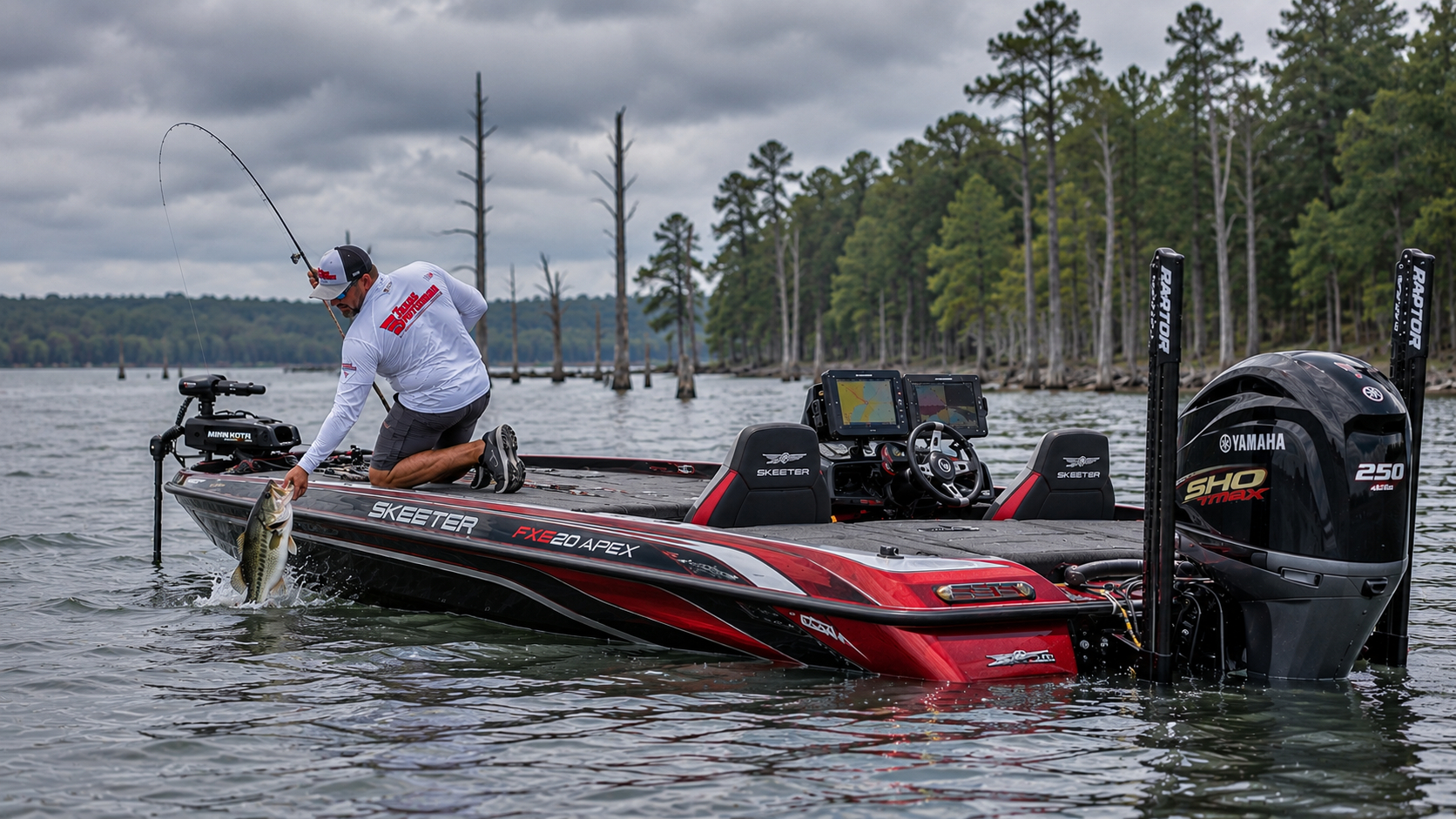
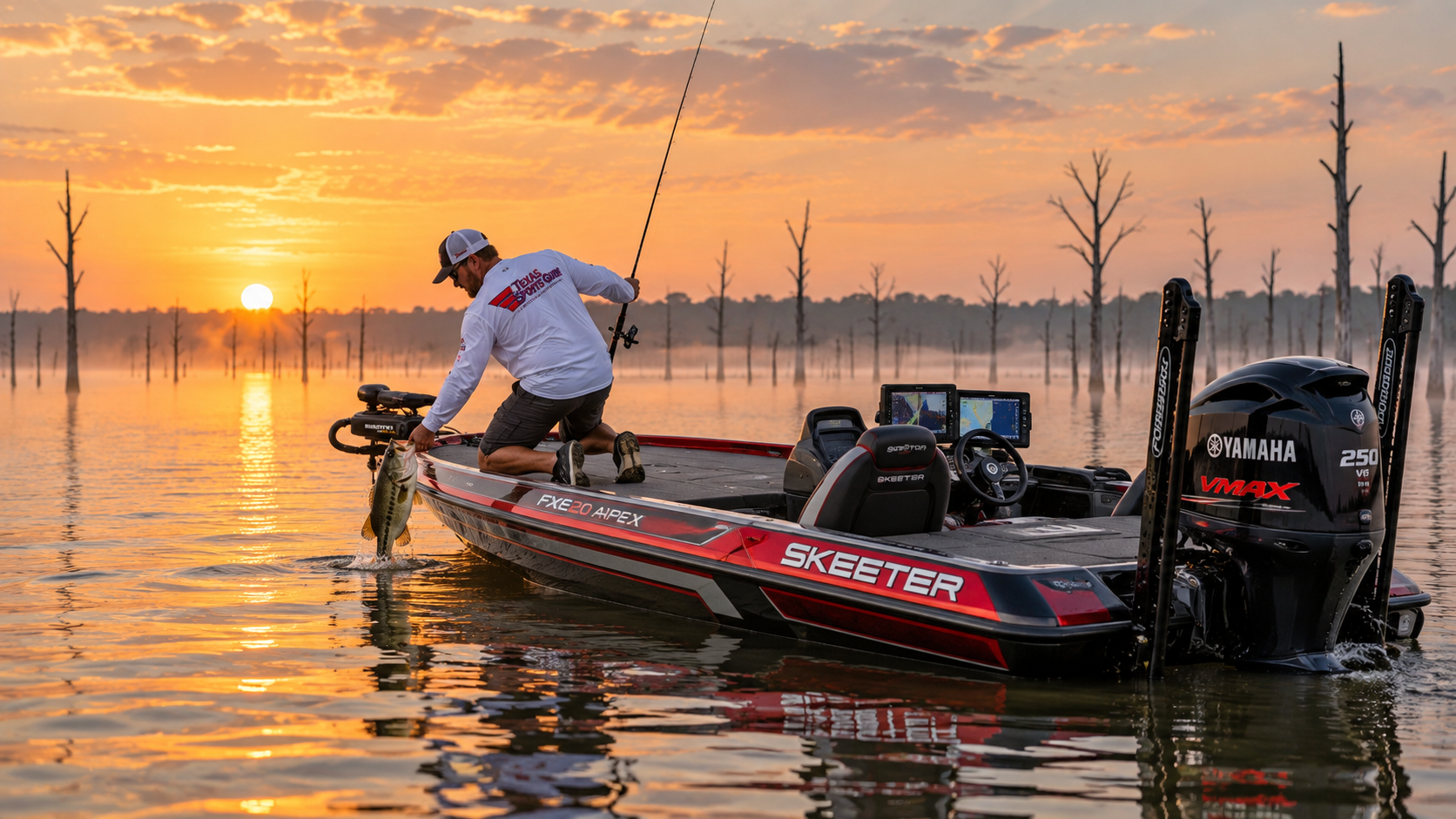
If I were backing my Skeeter into Lake Palestine tomorrow morning, I know pretty well what the front deck would look like.
There would be a spinnerbait.
Probably white and chartreuse.
A Texas-rigged watermelon-red creature bait would be nearby.
There would be a frog waiting for the grass.
A jig.
A crankbait.
And enough other rods scattered around the deck to make Paulette wonder whether I planned to fish for a morning or relocate permanently.
Before leaving the ramp, though, I'd do two things.
Life jacket on.
Kill switch attached.
Then I'd fire up the Yamaha and head toward the first piece of promising water.
Maybe the upper lake.
Maybe Saline Bay.
Maybe Cobb Creek.
I'd start looking for that combination I've chased across Texas bass lakes for decades.
Something different.
Hydrilla meeting a channel.
A big tree standing outside the others.
A little point in the grass.
A brush pile beside deeper water.
Shad flickering where they weren't flickering ten minutes earlier.
The more years I've spent fishing, the less interested I've become in magic spots.
I want to know why the bass are there.
Once I understand that, I can often find another place just like it.
That's particularly important on Lake Palestine because there is so much cover.
A fisherman could spend the entire day casting at attractive-looking timber and never really develop a pattern.
Instead, I want to ask questions.
What depth?
What water clarity?
What kind of grass?
How close is the channel?
Is there bait?
Are fish suspended?
Is this point receiving wind?
Where is the nearest spawning flat?
Bass fishing becomes much simpler when we stop asking, Where did somebody catch one yesterday? and start asking, Why would a bass want to live here today?
Lake Palestine is a wonderful place to practice that kind of fishing.
And for me there is another layer.
I've competed on this water.
That changes the way I remember a lake.
Tournament fishing compresses everything.
Decisions matter more.
Time moves faster.
A missed strike hurts more.
A five-pounder can transform an ordinary day into a memorable one.
Yet decades later, the part I remember most isn't necessarily a weigh-in.
It's being on the water.
A cool East Texas morning.
The smell of outboard exhaust at the ramp.
A tackle box rattling somewhere behind the seat.
The first light appearing over the trees.
The trolling motor going into the water.
And that first cast toward a piece of cover that looks just right.
Some things have changed dramatically since my tournament days.
Bass boats are faster.
Electronics are extraordinary.
Trolling motors can hold us on a spot almost magically.
We can see structure that once required hours of searching.
But the important part hasn't changed at all.
There is still a fisherman.
There is still a lure.
There is still a bass somewhere beneath the surface.
And there is still that wonderful moment when the line jumps, the rod loads and everything else disappears.
When that fish comes aboard, take your photograph.
Admire her.
Then ease her back into the water and let her swim away.
Maybe she'll become another 13-pound Lake Palestine giant.
Maybe another fisherman will catch her years from now.
Perhaps that fisherman will be a youngster making memories with his father or grandfather.
That's how a fishery becomes more than a reservoir.
It becomes a story passed from one generation to another.
And that's what Lake Palestine Texas Bass Fishing has always meant to me.

0 Comments