

Lake Texoma Largemouth and Smallmouth Bass Fishing
Rocky bluffs, standing timber, sprawling creek arms, Denison Dam and one of the finest smallmouth bass fisheries in Texas
Why Lake Texoma Largemouth and Smallmouth Bass Fishing Is Something Special
There are lakes where a fisherman spends most of his day looking at shoreline.
Lake Texoma makes you look at the horizon.
At nearly 75,000 acres, Texoma is big enough that the opposite shore can sometimes seem less like another fishing spot and more like another county. Add a hard south wind, a few miles of open water and a bass boat suddenly feels considerably smaller than it did sitting on the trailer that morning.
Yet somewhere among those rocky bluffs, stump beds, creek channels, secondary points and nearly 600 miles of shoreline live three species of black bass.
Largemouth.
Spotted.
And the fish that gives Texoma an especially interesting personality, smallmouth bass.
Texas Parks and Wildlife rates the largemouth and spotted bass fishery good, but rates Texoma's smallmouth fishery excellent. Previous Texas state-record smallmouth have come from both the Texas and Oklahoma sides of the reservoir. (Texas Parks & Wildlife Department)
That gets my attention.
I've always enjoyed lakes where I don't know exactly what kind of bass is going to eat the lure. Throw a crankbait along a rocky bank and the next strike might come from a largemouth tucked beside a stump or a bronze-backed smallmouth roaming the rocks.
And a Texoma smallmouth can make an ordinary bass rod feel temporarily inadequate.
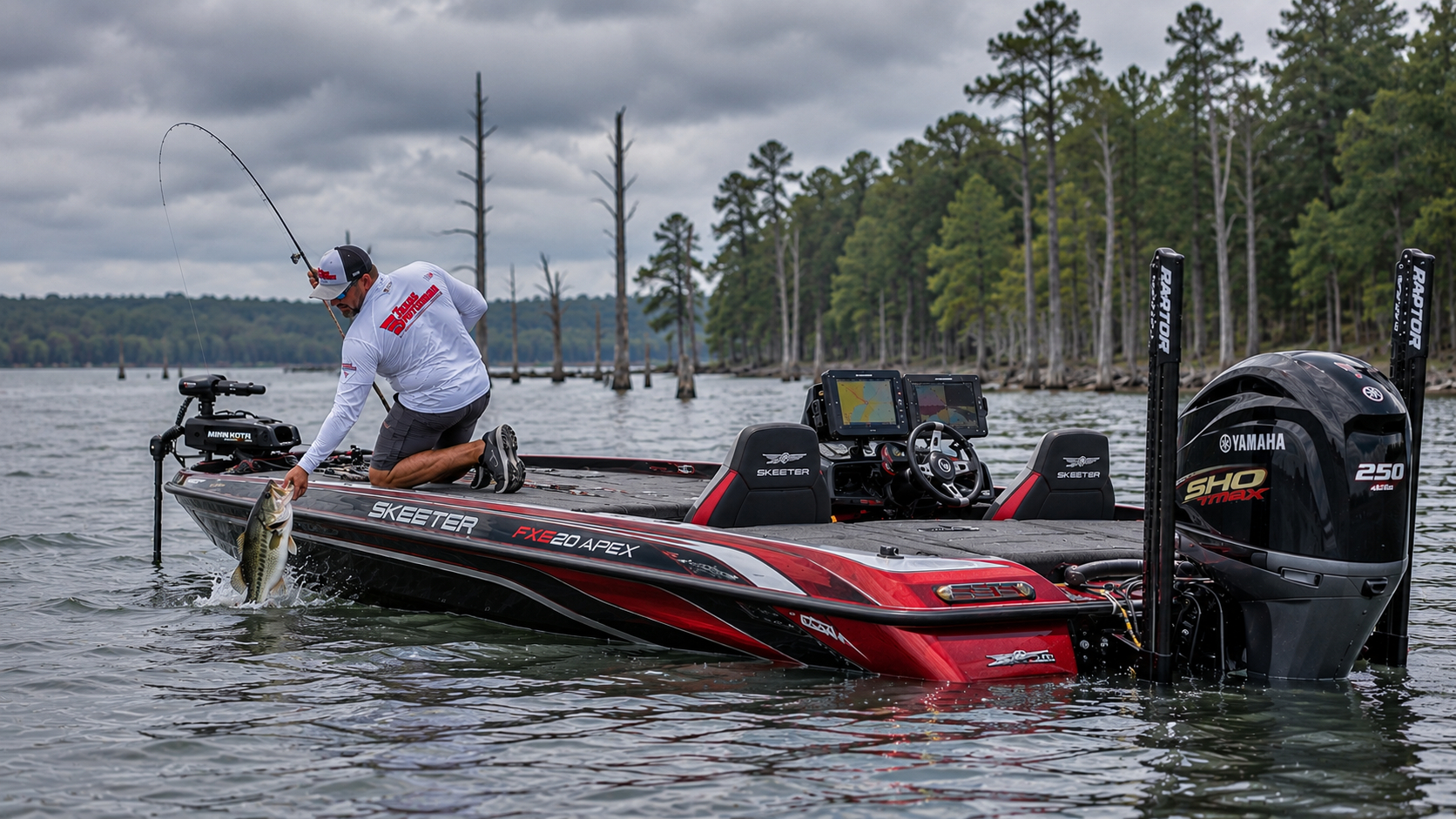
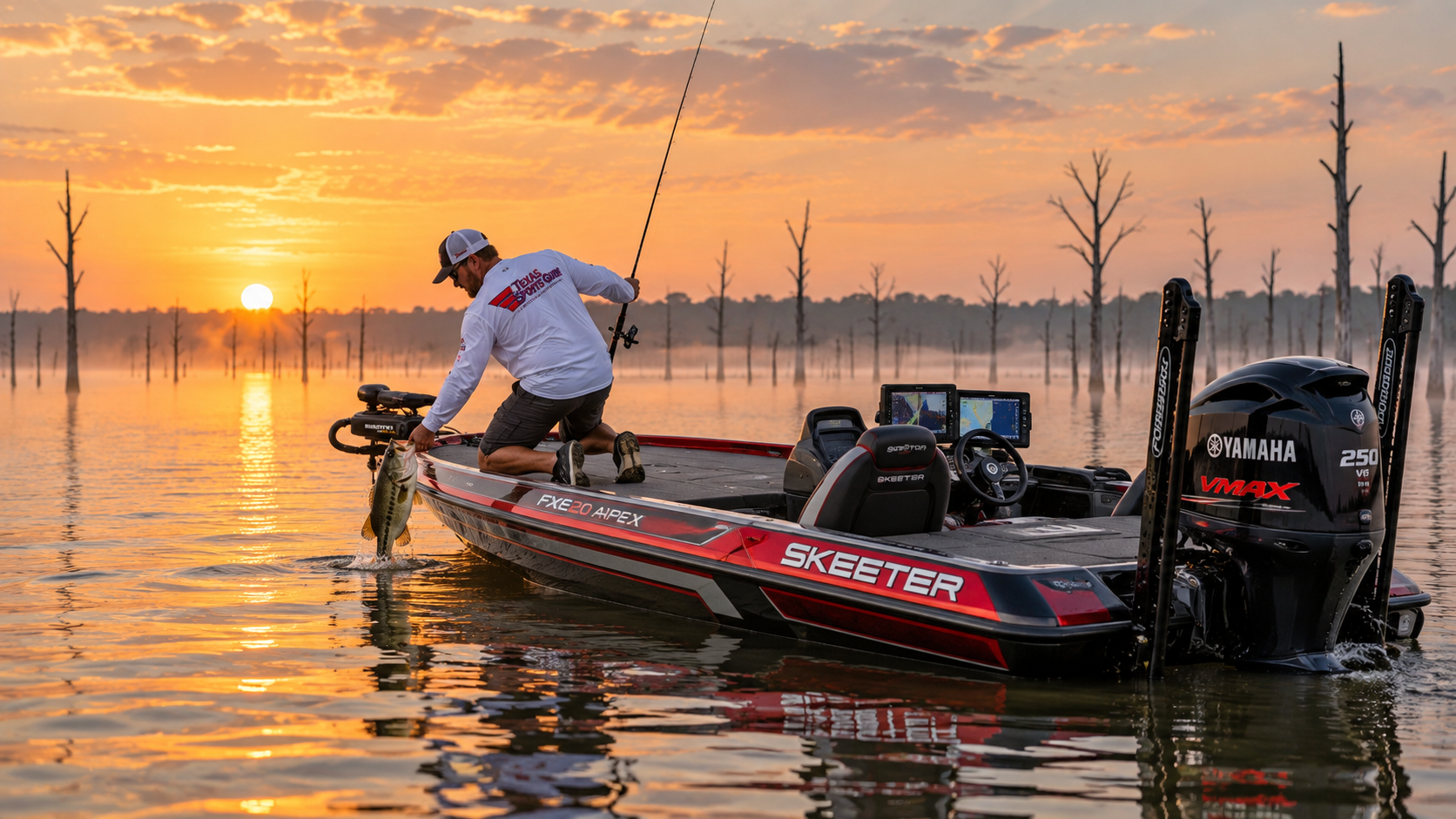
So let's launch near Denison, Texas, point the Skeeter toward the rocky country and spend a day exploring Lake Texoma Largemouth and Smallmouth Bass Fishing.
Where Is Lake Texoma?
Lake Texoma straddles the Texas-Oklahoma border northwest of Sherman and Denison, west of US Highway 75.
Texas Parks and Wildlife currently lists:
Surface area: 74,686 acres
Maximum depth: 100 feet
Impounded: 1944
Normal water clarity: Moderate to clear
Normal annual fluctuation: Approximately 5 to 8 feet
Shoreline: Approximately 580 miles (Texas Parks & Wildlife Department)
The U.S. Army Corps of Engineers controls the reservoir.
U.S. Army Corps of Engineers
Drawer A
Denison, TX 75020
Phone: 903-465-4990
Lake Texoma was created by Denison Dam and sits at the confluence of the Red and Washita Rivers. (Southwestern Division USACE)
That enormous watershed helps explain one of Texoma's most famous characteristics.
The Red and Washita provide enough suitable flow for Texoma to support one of the country's few naturally reproducing landlocked striped-bass populations. But for this trip, we'll leave the stripers to somebody else and stay closer to shore looking for green and bronze bass. (Texas Parks & Wildlife Department)
What Rivers Feed Lake Texoma?
The Red River and Washita River Are the Two Great Arteries
The Red River forms the major western arm of Lake Texoma.
The Washita River enters from Oklahoma and creates the great northern/eastern river arm.
Numerous smaller tributaries, creeks, coves and drains branch away from those two systems.
From a bass fisherman's perspective, those old river and creek channels are far more than blue lines on a map.
They're migration routes.
In late winter, bass use channel edges, bluff transitions and deeper structure while waiting for warming weather.
During prespawn, secondary channels and points become stepping stones toward spawning water.
During summer, those same channels provide quick access to deeper, cooler water.
Then fall reverses much of the movement as shad begin migrating into tributaries and bass follow.
I've always believed that learning the underwater geography of a reservoir pays better dividends than memorizing somebody else's favorite fishing spot.
Spots eventually change.
Structure keeps explaining why fish were there in the first place.
What Fish Species Live in Lake Texoma?
Texas Parks and Wildlife lists Texoma's predominant species as:
-
Largemouth bass
-
Smallmouth bass
-
Spotted bass
-
Striped bass
-
White bass
-
Blue catfish
-
Channel catfish
-
Black crappie
-
White crappie
-
Bluegill
TPWD's most recent reservoir survey also confirms healthy recreational fisheries for all three black-bass species. Smallmouth were introduced through four separate stockings between 1981 and 1987. Threadfin and gizzard shad provide a strong forage base, supplemented by bluegill and other sunfish. (Texas Parks & Wildlife Department)
That forage base is important.
Whether we're throwing a topwater over a rocky point, a crankbait beside a bluff or a Texas rig through timber, we're trying to imitate something a bass already expects to eat.
What Is the Current Lake Texoma Water Level?
This number deserves a date because Texoma can change considerably during a year.
As of September 8, 2026, Water Data for Texas reports Lake Texoma at 96.8 percent full, with a mean elevation of 615.92 feet and an estimated surface area of 72,702 acres. The current conservation-pool reference is 617 feet, putting the lake about 1.08 feet below conservation pool. (Water Data for Texas)
Check the current Lake Texoma water level
TPWD notes that Texoma commonly fluctuates approximately 5 to 8 feet annually. (Texas Parks & Wildlife Department)
That's enough movement to matter.
When Texoma rises, shoreline brush and limited vegetation become more attractive.
When it falls, concentrate more heavily on:
-
Outside structure
-
Rock transitions
-
Creek channels
-
Stump beds
-
Secondary points
-
Bluff ends
-
Riprap
The lake hasn't lost its bass.
The address simply changed.
What Aquatic Vegetation Grows in Lake Texoma?
This Is Primarily a Structure Lake, Not a Grass Lake
If you've just come from Lake Fork, forget the idea of spending all day hunting vast submerged grass beds.
TPWD describes Texoma's aquatic vegetation as not abundant, although some stands of water willow, American lotus, floating heart and bushy pondweed occur around the reservoir. (Texas Parks & Wildlife Department)
Texoma's real bass habitat is geology and flooded structure.
TPWD identifies:
-
Rocks and boulders
-
Standing timber
-
Submerged stump beds
-
Channels
-
Rocky bluffs
-
Sandy flats
-
Riprap
Of Texoma's approximately 580 miles of shoreline, TPWD estimates about nine miles are riprap and roughly 50 miles contain standing timber. (Texas Parks & Wildlife Department)
That is an enormous amount of bass country.
And because vegetation is limited, a little patch of grass can become disproportionately important.
One small stand of water willow beside rock or a channel can be worth far more than its acreage suggests.
Where Are Lake Texoma Smallmouth Bass?
Here's where the largemouth and smallmouth stories begin separating.
TPWD says largemouth and spotted bass occur throughout the reservoir, while smallmouth are concentrated primarily around the bluffs near Eisenhower State Park, Denison Dam and up the Washita River arm toward Willow Springs. (Texas Parks & Wildlife Department)
That's wonderfully specific information.
If I were launching specifically to catch smallmouth, I would start by studying those three environments:
Eisenhower State Park Bluffs
Rock.
Depth.
Bluff ends.
Broken shoreline.
Transitions.
This is classic smallmouth country.
Denison Dam
The dam provides extensive riprap and immediate access to deeper water.
TPWD specifically recommends fishing free-lined live threadfin shad off the dam riprap for smallmouth bass. (Texas Parks & Wildlife Department)
We'll adapt that information to artificial-lure fishing as well by concentrating jerkbaits, swimbaits, tubes and crankbaits around the same rocky habitat.
Washita River Arm Toward Willow Springs
This expands the smallmouth search well beyond the dam.
Rocky points, channel-related structure and suitable hard-bottom habitat throughout this area deserve attention.
Denison Texas and Lake Texoma
Denison is the natural Texas gateway to the eastern end of Lake Texoma.
Eisenhower State Park lies about five miles northwest of town, and Denison Dam is immediately nearby. TPWD directions from Dallas follow US-75 north, then Exit 72 to TX-91 toward Denison Dam and FM 1310. (Texas Parks & Wildlife Department)
That makes Denison particularly convenient for fishermen interested in Texoma smallmouth.
You're not driving halfway around the reservoir before launching.
You're already beside some of the best bronzeback habitat in the lake.
Lake Texoma Weather
North Texas weather has enough personality to keep fishermen humble.
National Weather Service climate normals for Denison Dam show average January temperatures around 50°F for the high and 31°F for the low. July and August average highs are around 93°F. Annual precipitation averages approximately 41 inches, with May historically among the wettest months. (National Weather Service)
Winter
December through February can range from pleasant sunny afternoons to freezing northers.
Cold-water smallmouth remain catchable, but slower presentations become important.
Spring
March through May means warming water, wind, thunderstorms and spawning bass.
It is one of the year's finest periods.
Summer
June through August brings heat, recreational boating and increasingly important early-morning fishing.
Fall
September through November gradually cools the reservoir and brings shad toward shoreline structure.
Crankbait season returns with enthusiasm.
And then there's the wind.
Texoma is enormous.
A strong wind running the length of an open basin can build serious waves. No bass, largemouth or smallmouth, is worth crossing unsafe water.
Driving Distance to Lake Texoma and Denison Texas
These are approximate distances to the Denison/Eisenhower State Park area and will vary with your exact starting point.
Dallas to Lake Texoma
Approximately 75 to 85 miles.
Take US-75 north through Sherman to Denison, then TX-91 and FM 1310 toward Eisenhower State Park and Denison Dam.
Allow about 1¼ to 1½ hours.
Fort Worth to Lake Texoma
Approximately 100 to 115 miles.
Travel north/east through the Metroplex toward US-75 and Denison.
Allow approximately two hours.
Austin to Lake Texoma
Approximately 260 to 280 miles.
Take I-35 north toward the Metroplex, then connect with US-75 north toward Denison.
Allow roughly 4¼ to 4¾ hours.
Houston to Lake Texoma
Approximately 300 to 320 miles.
Take I-45 north toward Dallas, then US-75 north to Denison.
Allow roughly five hours.
San Antonio to Lake Texoma
Approximately 340 to 365 miles.
Take I-35 north through Austin and Waco, then continue through the Metroplex and toward Denison.
Allow approximately 5½ to 6 hours.
Corpus Christi to Lake Texoma
Approximately 475 to 500 miles.
Take I-37 north to San Antonio, then I-35 north and continue toward Denison.
Allow approximately 7½ to 8 hours when towing a boat.
And after seven hours pulling a Skeeter, nobody will complain if you spend an extra ten minutes backing down the ramp carefully.
Well, somebody might.
Boat ramps have a way of attracting spectators with opinions.
Marinas and Boat Ramps on Lake Texoma
Texoma has extensive public and private access. TPWD lists facilities ranging from Eisenhower State Park and Corps recreation areas to large full-service marinas and resorts. (Texas Parks & Wildlife Department)
Eisenhower State Park
Eisenhower State Park
Address: 50 Park Road 20, Denison, TX 75020
Phone: 903-465-1956
Email: No public park-specific email currently listed by TPWD
Reservations: 512-389-8900
The park provides boat access, camping and direct proximity to some of Texoma's premier rocky smallmouth habitat. (Texas Parks & Wildlife Department)
Eisenhower State Park information and reservations
Grandpappy Point Resort & Marina
Grandpappy Point Resort & Marina
Grandpappy Point Resort and Marina Web Address: 132 Grandpappy Dr, Denison, TX 75020, United States Phone: +1 903-465-6330
Address: 132 Grandpappy Dr., Denison, TX 75020
Phone: 903-465-6330
Email: contact@grandpappy.com
Grandpappy Point is a full-service marina with more than 700 slips, cabins and lake access. (Grandpappy Point Resort & Marina)
Grandpappy Point Resort & Marina
Highport Marina
Highport Marina
Highport Marina Web Address: 120 Texoma Harbor Dr, Pottsboro, TX 75076, United States Phone: +1 903-786-7000
Address: 120 Texoma Harbor Drive, Pottsboro, TX 75076
Phone: 903-786-7000
Email: highport@waterviewmarinas.com
Highport provides slips, boat rentals, fuel and marina services from the Pottsboro side of the lake. (Highport Marina)
Lighthouse Marina
Lighthouse Marina
Lighthouse Resort & Marina Web Address: 300 Lighthouse Dr, Pottsboro, TX 75076, United States Phone: +1 903-361-5070
Address: 300 Lighthouse Drive, Pottsboro, TX 75076
Marina office: 903-786-2311
Fuel dock/boat rentals: 903-786-2250
Email: lighthousetexoma@gmail.com
The marina provides a ramp, slips, fuel, tackle and lodging/RV options. (Lake Texoma)
TPWD also lists Juniper Point West, Preston Recreation Area, Mill Creek, Little Mineral, Dam Site Park and additional facilities around the reservoir. (Texas Parks & Wildlife Department)
With Texoma's 74,000-plus acres, launching near the water you intend to fish can save both fuel and a rough ride.
Lodging Near Lake Texoma
Grandpappy Point Cabins
Grandpappy Point Resort & Marina
Grandpappy Point Resort and Marina Web Address: 132 Grandpappy Dr, Denison, TX 75020, United States Phone: +1 903-465-6330
Address: 132 Grandpappy Dr., Denison, TX 75020
Phone: 903-465-6330
Email: contact@grandpappy.com
Grandpappy offers more than 20 cabins at the marina, making it particularly convenient for fishermen wanting to keep the boat close to the room. (Grandpappy Books)
Tanglewood Resort
Tanglewood Resort
Tanglewood Resort on Lake Texoma, an Ascend Collection Resort Web Address: 290 Tanglewood Cir, Pottsboro, TX 75076, United States Phone: +1 903-265-3192
Address: 290 Tanglewood Circle, Pottsboro, TX 75076
Phone: 609-438-2929
Group email: sales@tanglewoodresort.com
Tanglewood offers hotel rooms, suites, villas, dining, pools and other resort amenities near Lake Texoma. (Tanglewood Resort)
Eisenhower State Park Camping
Eisenhower State Park
For fishermen who prefer staying almost within casting distance of the lake, Eisenhower offers campsites with water, water/electric sites, full hookups and screened shelters. (Texas Parks & Wildlife Department)
I like that arrangement.
Wake up.
Make coffee.
Look at the wind.
Launch.
No interstate required.
Spring Lake Texoma Largemouth and Smallmouth Bass Fishing
March Through May: Everybody Comes Shallow
TPWD says largemouth, spotted and smallmouth bass spawn in shallow water, making spring the best time to target all three species close to shore. The department recommends fishing around grass and brush with crankbaits, surface lures, spinner-type baits and Carolina-rigged worms. (Texas Parks & Wildlife Department)
Spring Largemouth Pattern
Concentrate on:
-
Protected coves
-
Secondary points
-
Brush
-
Standing timber
-
Stump beds
-
Creek-channel swings
-
Sparse vegetation
Start the prespawn search around 5 to 15 feet and progressively move shallower as water warms.
During the spawn, fish may be in 1 to 6 feet, particularly where protected pockets provide hard bottom and cover.
Best Spring Largemouth Lures
Spinnerbait: 3/8 to 1/2 ounce
Colors: White/chartreuse in stained water; white/shad in clearer water
Squarebill crankbait: 1.5 to 2.5 size
Colors: Crawfish early; shad patterns later
Texas-rigged creature bait: 4 to 6 inches
Colors: Green pumpkin, watermelon red, black/blue
Carolina-rigged worm or lizard: 6 to 7 inches
Colors: Watermelon, green pumpkin
Work the moving baits around brush and rock, then slow down with soft plastics when you locate fish.
Spring Smallmouth Bass Fishing on Texoma
Smallmouth require a slightly different eye.
Look for:
-
Rocky secondary points
-
Gravel transitions
-
Bluff ends
-
Dam riprap
-
Boulders
-
Windblown rock
-
Channel swings against hard shoreline
Best Spring Smallmouth Depths
Prespawn: 5 to 15 feet
Spawn: 2 to 8 feet
Postspawn: 5 to 20 feet
Best Spring Smallmouth Lures
Tube: 3 to 4 inches
Colors: Green pumpkin, smoke/purple, watermelon
Ned rig: 2.5 to 3 inches
Colors: Green pumpkin, goby/brown
Suspending jerkbait: 4 to 5 inches
Colors: Ghost shad, translucent minnow
Small crankbait: 2 to 3 inches
Colors: Crawfish, natural shad
Paddle-tail swimbait: 3 to 4 inches
Colors: Pearl, shad
On clear water and calm days, lengthen your casts.
When wind starts breaking the surface over a rocky point, I become considerably less worried about stealth.
Summer Lake Texoma Bass Fishing
June Through August: Follow Structure Offshore
TPWD says that as Texoma warms and black bass move offshore, fishermen should shift toward Texas-rigged worms and deep-diving crankbaits, while keeping surface baits handy early in the morning. Productive submerged structure includes rocks, boulders, stumps, logs, channels and secondary points. (Texas Parks & Wildlife Department)
That's our summer blueprint.
Summer Largemouth
Begin shallow at dawn around:
-
Timber
-
Brush
-
Rocky banks
-
Secondary points
-
Limited vegetation
A walking bait or buzzbait can be excellent during the first hour.
Then move offshore.
Start looking from approximately 12 to 25 feet, particularly where creek channels intersect points, timber or stump beds.
Summer Largemouth Lures
Texas-rigged worm: 7 to 10 inches
Colors: Plum, junebug, green pumpkin
Deep crankbait: Shad or chartreuse/blue
Football jig: 1/2 to 3/4 ounce
Colors: Brown, green pumpkin
Carolina rig: 6- to 8-inch worm or creature bait
Summer Texoma Smallmouth Bass
Smallmouth are wonderfully comfortable around rock and depth.
Look around the Denison Dam, Eisenhower bluffs and Washita arm.
Productive depth can range from 10 to 30 feet, depending on light, forage and water temperature.
Best Summer Smallmouth Lures
Drop shot: 4-inch finesse worm
Colors: Green pumpkin, morning dawn, natural shad
Tube: 3.5 inches
Colors: Smoke/purple, green pumpkin
Football jig: 3/8 to 1/2 ounce
Colors: Brown/craw
Small swimbait: 3 to 4 inches
Colors: Natural shad
Topwater: 3.5 to 4.5 inches at dawn
TPWD also specifically mentions night fishing around the bluffs near Eisenhower State Park for smallmouth. (Texas Parks & Wildlife Department)
On a hot July day, that suggestion has advantages for the fisherman as well as the fish.
Fall Lake Texoma Largemouth and Smallmouth Bass Fishing
September Through November: Put the Crankbait Back in Your Hand
TPWD describes fall bass fishing on Texoma as potentially very exciting and recommends working crankbaits around brush and rocky shorelines for largemouth and spotted bass. (Texas Parks & Wildlife Department)
Fall is a shad story.
As nights cool, bait begins moving toward tributaries and shallow structure.
Bass follow.
Fall Largemouth Areas
-
Creek mouths
-
Secondary points
-
Brush
-
Timber
-
Rocky shoreline
-
Windblown flats
Best Fall Largemouth Lures
Squarebill: 1.5 to 2.5
Colors: Shad, chartreuse/black
Lipless crankbait: 1/2 ounce
Colors: Chrome/blue, shad
Spinnerbait: 3/8 to 1/2 ounce
Colors: White/shad
Walking topwater: 4 to 5 inches
Colors: Bone, chrome
Fall Smallmouth
This is when I would spend plenty of time on windblown rock.
Try:
-
Bluff ends
-
Dam riprap
-
Rocky points
-
Boulders
-
Gravel transitions
A 3-inch swimbait, jerkbait or crankbait can cover water until you locate a concentration.
Then slow down with a tube or Ned rig.
Winter Lake Texoma Bass Fishing
December Through February: Rock, Depth and Patience
Winter is when the difference between largemouth and smallmouth behavior becomes especially interesting.
Largemouth generally become more structure-oriented around deeper wood, channels and rock.
Smallmouth remain strongly associated with rocky habitat.
Start around 15 to 30 feet, but don't assume every fish is deep.
Several warm sunny afternoons can move bass surprisingly shallow onto rock.
Winter Largemouth Lures
Jig: 3/8 to 1/2 ounce
Colors: Black/blue, brown
Texas rig: 6- to 8-inch worm
Colors: Green pumpkin, junebug
Suspending jerkbait: 4 to 5 inches
Colors: Natural shad
Deep crankbait: Crawfish or shad
Winter Smallmouth Lures
Football jig: 3/8 to 1/2 ounce
Colors: Brown, green pumpkin
Tube: 3 to 3.5 inches
Ned rig: 2.5 to 3 inches
Drop shot: 3- to 4-inch finesse worm
Jerkbait: 4 inches
Make the jerkbait pause longer as the water gets colder.
Sometimes painfully longer.
A fisherman may get impatient.
The smallmouth doesn't care.
Best Rods, Reels and Line for Lake Texoma Bass Fishing
Texoma is large enough and diverse enough that one rod won't comfortably cover everything.
Largemouth Texas Rig and Jig Setup
Rod: 7' to 7'3" medium-heavy fast-action casting rod
Reel: 7.1:1 baitcaster
Line: 15- to 17-pound fluorocarbon
This handles timber, brush and Texas rigs without becoming unnecessarily heavy.
Crankbait Setup
Rod: 7' medium or medium-heavy moderate-action casting rod
Reel: 5.4:1 to 6.4:1
Line: 10- to 12-pound fluorocarbon
The softer rod helps keep treble hooks pinned.
Smallmouth Finesse Setup
Rod: 6'10" to 7'2" medium-light or medium spinning rod
Reel: 2500-size spinning reel
Line: 10-pound braid with a 6- to 10-pound fluorocarbon leader
That setup is ideal for tubes, Ned rigs and drop shots.
Smallmouth Jerkbait and Swimbait Setup
Rod: 6'10" to 7' medium fast-action rod
Reel: 6.3:1 to 7.1:1
Line: 8- to 12-pound fluorocarbon
Texoma can be clear enough that lighter line and longer casts genuinely matter.
Lake Texoma Largemouth and Smallmouth Bass Records
Here's where things become interesting.
According to TPWD's Lake Texoma records, updated September 8, 2026:
Largemouth Bass Record
Weight: 11.90 pounds
Length: 25.50 inches
Angler: Don McFarlin
Date: February 17, 2013
Lure: Jig (Texas Parks & Wildlife Department)
Smallmouth Bass Record
Weight: 7.06 pounds
Length: 22.75 inches
Angler: Jay Fuller
Date: January 29, 2006
Lure: Jig (Texas Parks & Wildlife Department)
Seven pounds and change is a serious smallmouth anywhere.
In Texas, that's a bronzeback worth remembering.
And I can't help noticing something else.
Both records came in winter.
Both ate a jig.
Sometimes the fish tell us more than a tackle catalog ever will.
Lake Texoma Fishing Licenses and Regulations
Because Texoma straddles two states, licenses require a little more attention than they do on a typical Texas reservoir.
TPWD says roughly two-thirds of the lake lies in Oklahoma. A Texas fishing license covers the Texas portion. TPWD also identifies a Lake Texoma license option that allows fishing throughout the reservoir. Special size and bag limits apply to some species, so verify the current Outdoor Annual before fishing. (Texas Parks & Wildlife Department)
Current Texas freshwater fishing regulations
That state line is invisible from the boat.
The game warden's regulations are not.
Zebra Mussels and Lake Texoma
Texoma has zebra mussels.
TPWD requires anglers to CLEAN, DRAIN AND DRY boats, trailers, livewells, bait buckets and related equipment before traveling to another body of water. Draining water is required by Texas law, and possession or transport of zebra mussels is illegal. (Texas Parks & Wildlife Department)
That's particularly important for a traveling bass fisherman.
Texoma today.
Ray Roberts tomorrow.
Whitney next weekend.
Our boat shouldn't become transportation for anything except us and our tackle.
Five More Texas SportsGuide Bass Fishing Trips
If Texoma's largemouth-and-smallmouth combination appeals to you, several articles in the Texas SportsGuide archive make natural companions.
Our Lake Whitney Texas Largemouth and Smallmouth Bass Fishing guide explores another rocky reservoir where largemouth and smallmouth share clear water, limestone bluffs and offshore structure. (Texs)
The Belton Lake Texas Largemouth and Smallmouth Bass Fishing guide moves south into Central Texas for another structure-oriented fishery built around rock, bluff walls, channels and deep-water bass. (Texs)
Farther west, Hubbard Creek Lake Texas Largemouth and Smallmouth Bass Fishing offers a more rugged West Texas version of the same two-species challenge, with wind, rock and open country defining much of the experience. (Texs)
For a very different bass-fishing classroom, Lake Fork Texas Bass Fishing trades Texoma's extensive rocky smallmouth habitat for timber, vegetation, creek channels and one of the greatest trophy-largemouth histories in America. (Texs)
And the TexasSportsGuide sitemap also confirms our Buchanan Lake Texas Bass Fishing guide, where granite shoreline and Highland Lakes structure offer another completely different Texas bass experience. (Texs)
Five lakes.
Five personalities.
That's why a bass fisherman can spend a lifetime in Texas and still find unfamiliar water.
Frequently Asked Questions About Lake Texoma Largemouth and Smallmouth Bass Fishing
Is Lake Texoma Good for Smallmouth Bass?
Very much so.
TPWD currently rates the smallmouth fishery excellent, while largemouth and spotted bass receive a good rating. (Texas Parks & Wildlife Department)
Where Are the Smallmouth Bass in Lake Texoma?
TPWD specifically identifies the Eisenhower State Park bluffs, Denison Dam and Washita River arm toward Willow Springs as principal smallmouth areas. (Texas Parks & Wildlife Department)
Where Are Lake Texoma Largemouth Bass?
Unlike the more geographically concentrated smallmouth population, TPWD says largemouth occur throughout the reservoir. Concentrate on brush, standing timber, stump beds, channels, secondary points and rocky shoreline. (Texas Parks & Wildlife Department)
Does Lake Texoma Have Aquatic Vegetation?
Yes, but not much.
TPWD identifies water willow, American lotus, floating heart and bushy pondweed. Rock, timber, channels, stump beds, bluffs and riprap are generally more important. (Texas Parks & Wildlife Department)
How Big Is Lake Texoma?
TPWD lists 74,686 surface acres and a maximum depth of 100 feet. (Texas Parks & Wildlife Department)
What Is the Lake Texoma Smallmouth Record?
The current TPWD record is 7.06 pounds, caught by Jay Fuller on January 29, 2006, using a jig. (Texas Parks & Wildlife Department)
What Is the Lake Texoma Largemouth Record?
The current record is 11.90 pounds, caught by Don McFarlin on February 17, 2013, also on a jig. (Texas Parks & Wildlife Department)
Final Thoughts on Lake Texoma Largemouth and Smallmouth Bass Fishing
If I were launching the Skeeter near Denison tomorrow morning, I'd probably have more rods on the front deck than good judgment requires.
A crankbait rod.
A jig rod.
A Texas rig.
A jerkbait.
A spinning rod with a tube.
Another with a Ned rig.
And somewhere nearby, a topwater waiting for the first hint of schooling activity.
Then I'd point the boat toward rock.
The thing I enjoy about Lake Texoma Largemouth and Smallmouth Bass Fishing is that this isn't merely a matter of catching two species from the same lake.
You're fishing two personalities.
A largemouth might be buried beside a stump in a creek arm, waiting for a Texas-rigged worm to fall into her living room.
A smallmouth might be cruising a windblown bluff half a lake away, perfectly willing to travel several feet to murder a jerkbait.
One rewards precision around cover.
The other often rewards rock, movement and a little wind.
Of course bass are wonderfully inconsiderate about following our rules, which is why we keep fishing.
I'd begin around the Eisenhower bluffs while the morning was still cool.
Maybe throw a topwater across a rocky point.
Then a jerkbait.
Then slow down with a tube if the first two didn't produce.
If the wind picked up, I'd follow it onto rock.
If the sun climbed high, I'd start looking deeper.
And somewhere during the day I'd probably find myself looking across that enormous expanse of Texoma water and remembering why I enjoyed tournament fishing here in the first place.
Big lakes make you think.
They make you study wind.
They make you understand channels.
They make you pay attention to where the bait is.
They make you decide whether the next point is worth running five miles to fish.
Sometimes you're right.
Sometimes you're not.
And every once in a while you set the hook beside a boulder and the fish rockets away from the boat instead of digging into cover.
Then she comes airborne.
Brown sides.
Red eyes.
Bronze flashing in the sunlight.
Smallmouth.
That's when all those miles of open water, all that studying and all those casts suddenly become worthwhile.
Because somewhere between Denison Dam and Willow Springs, beneath the rocky bluffs and along those old river channels, another seven-pound Texoma smallmouth is entirely possible.
And there are plenty of largemouth waiting to interrupt the search.
That's Lake Texoma Largemouth and Smallmouth Bass Fishing.
And that's enough reason to come back tomorrow.

0 Comments