
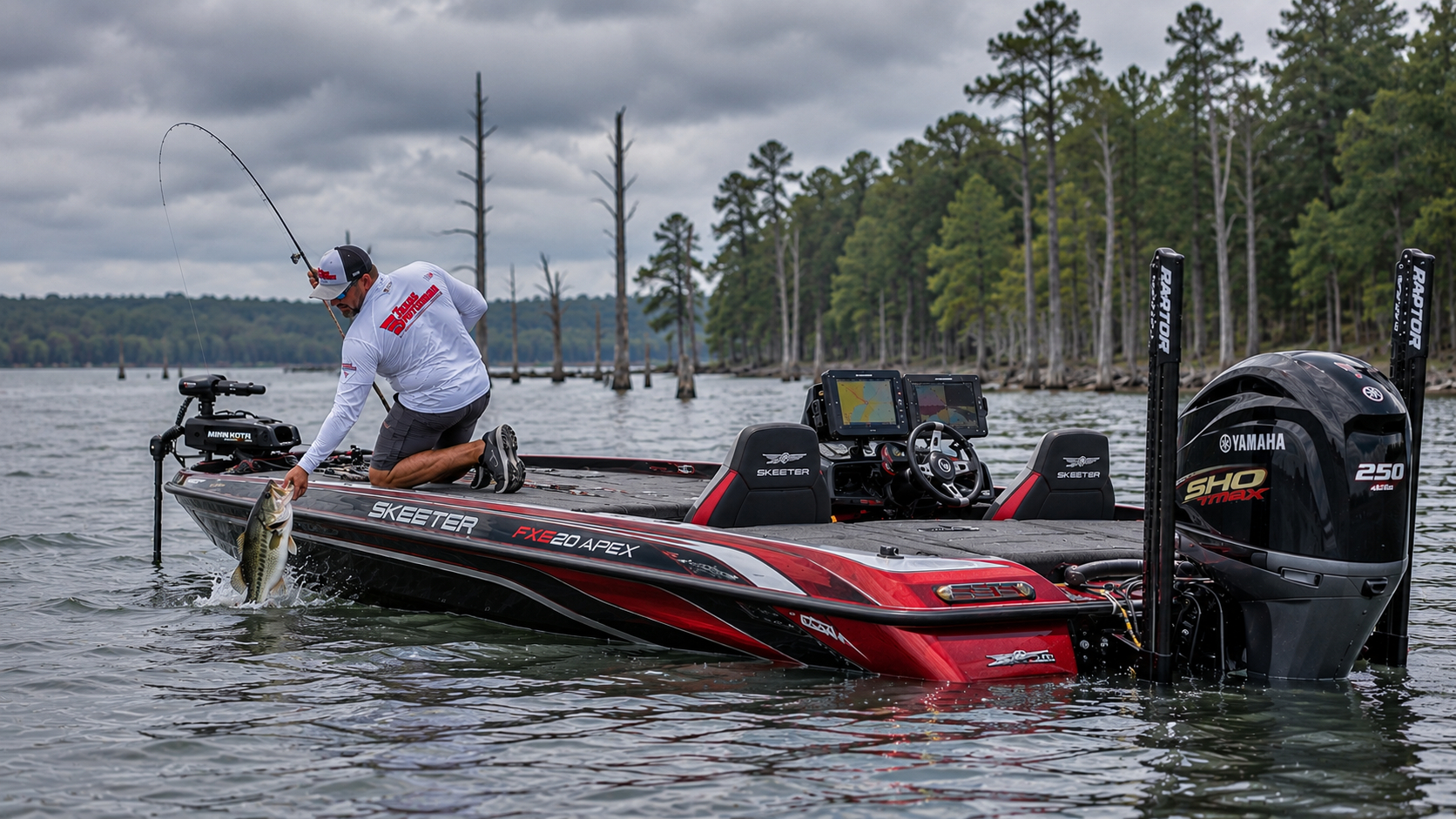
Hydrilla, flooded timber, Big Cypress Creek, East Texas pine country and a 15-pound largemouth that proves there are some mighty big green fish living beneath those quiet waters
Lake O' The Pines Texas Bass Fishing Begins in the Piney Woods
There are Texas reservoirs whose names tell you almost everything you need to know before you ever see the water.
Lake O' The Pines is one of them.
I can picture the scene before backing the trailer down the ramp: tall East Texas pines surrounding coves, flooded timber reaching from the water, patches of hydrilla beneath the surface and an old creek channel wandering through it all.
Then somewhere in that green maze is a largemouth bass.
Maybe a three-pounder.
Maybe five.
Or perhaps one of those old East Texas females that has spent years learning which stumps fishermen cast toward and which ones they overlook.
We know Lake O' The Pines can grow that kind of fish because its current Texas Parks and Wildlife lake record is a magnificent 15.13-pound largemouth.
Fifteen pounds.
That gets my attention anywhere.
TPWD currently rates the largemouth fishery excellent and describes the population as abundant, with many legal-size bass available. The lake also contains moderate densities of aquatic vegetation, with hydrilla being the dominant aquatic plant. (Texas Parks and Wildlife)
That's a combination I understand.
Give me hydrilla, timber, creek channels and largemouth bass and I'll happily spend a day trying to figure out how those pieces fit together.
So buckle the life jacket, clip on the kill switch and let's launch the Skeeter for a trip around Lake O' The Pines Texas Bass Fishing.
Where Is Lake O' The Pines Texas?
Lake O' The Pines lies in the Cypress River Basin approximately 25 miles northeast of Longview, spreading across Marion, Morris, Upshur and Camp counties.
The reservoir was created on Big Cypress Creek. Impoundment began in August 1957 and construction was completed in June 1958.
TPWD lists Lake O' The Pines at:
-
19,780 surface acres at summer pool
-
18,700 surface acres at winter pool
-
49.5 feet maximum depth
-
230 feet summer conservation pool
-
228.5 feet winter conservation pool
-
4 to 5 feet average annual fluctuation
-
Moderately clear normal water clarity (Texas Parks and Wildlife)
That seasonal pool deserves attention from bass fishermen.
From May 20 through September 15, TPWD identifies 230 feet as summer conservation pool. The winter pool is 228.5 feet. Water Data for Texas provides additional detail, noting that the reservoir is normally lowered from 230 to 228.5 feet between September 15 and September 30. (Texas Parks and Wildlife)
A foot and a half doesn't sound dramatic when you're sitting at the kitchen table.
It can look considerably more dramatic to a bass living in eighteen inches of water beside shoreline vegetation.
The controlling authority is:
U.S. Army Corps of Engineers
2669 FM 726
Jefferson, TX 75657
Information: 903-665-2336
Camping reservations: 877-444-6777 (Texas Parks and Wildlife)
What Is the Current Lake O' The Pines Water Level?
This is one number I always want dated because today's fishing article eventually becomes next year's archive.
As of September 9, 2026, Water Data for Texas reports Lake O' The Pines at 86.4 percent full, with an average elevation of 227.97 feet, reservoir storage of 232,113 acre-feet and an estimated surface area of 17,272 acres. (Water Data for Texas)
The current summer conservation pool is 230 feet, putting the lake approximately 2.03 feet below summer pool.
Check the current Lake O' The Pines water level
There is an interesting wrinkle here.
We're approaching the lake's scheduled transition toward its 228.5-foot winter pool, so comparing the September elevation only against summer pool can make conditions sound somewhat more abnormal than they will be after the seasonal change.
For fishing, however, the important fact remains: the lake is substantially lower than it was earlier in the year.
Water Data for Texas shows it was about 91.6 percent full on June 9 and 86.4 percent full today. (Water Data for Texas)
That can change where I begin fishing.
When water pulls out of shallow vegetation and bushes, I start looking toward:
outside hydrilla edges, creek channels, deeper timber, secondary drops and the first reliable cover outside the newly exposed shallows.
Bass haven't read the lake-level chart.
But they certainly notice when their living room becomes dry land.
Big Cypress Creek Is the Backbone of Lake O' The Pines
Lake O' The Pines was constructed across Big Cypress Creek, which forms the principal riverine artery through the reservoir.
That name matters well beyond this lake.
Water leaving Lake O' The Pines continues down Big Cypress Bayou toward the remarkable wetlands of Caddo Lake.
For the bass fisherman, however, I am interested in what the old creek system does under Lake O' The Pines.
Creek channels become travel corridors.
A largemouth may winter near deeper channel-related structure, stage along a bend during prespawn, move from that channel toward a shallow spawning flat, and return toward deeper water as summer arrives.
That's why I have always paid attention to places where a channel touches something else.
A hydrilla edge.
A point.
Standing timber.
A brush pile.
A flat.
Riprap.
An intersection between two ordinary pieces of habitat can become an extraordinary fishing spot.
What Fish Species Live in Lake O' The Pines?
Lake O' The Pines supports a remarkably diverse East Texas fishery.
TPWD lists the predominant species as:
Largemouth bass
Spotted bass
Blue catfish
Channel catfish
Flathead catfish
White bass
Crappie
Sunfish
Chain pickerel
The chain pickerel is an especially interesting member of the neighborhood. It adds a little toothy Piney Woods personality to a lake otherwise dominated by familiar Texas warm-water species.
For our purposes, however, the important rating is beside largemouth bass.
Excellent.
TPWD says the largemouth population is abundant and contains many legal-size fish. Crappie and channel catfish also receive excellent ratings. (Texas Parks and Wildlife)
The forage base helps explain the healthy predator population. TPWD's most recent survey material reports threadfin shad and gizzard shad, with plenty of gizzard shad available in sizes suitable for sportfish forage. (Texas Parks and Wildlife)
Where there are groceries, there will eventually be customers.
What Kind of Bass Habitat Is in Lake O' The Pines?
Hydrilla Is a Major Part of the Story
TPWD says aquatic vegetation can cover approximately 15 to 20 percent of the lake's surface, with dominant species including:
Hydrilla
Buttonbush
Water primrose
American lotus (Texas Parks and Wildlife)
The latest TPWD survey provides another useful snapshot. In 2022, native aquatic vegetation covered less than two percent of the reservoir, while invasive vegetation including hydrilla, water hyacinth and giant salvinia accounted for approximately 11 percent. Vegetation changes from year to year, so I wouldn't treat either percentage as a permanent map of today's grass. (Texas Parks and Wildlife)
For largemouth fishermen, hydrilla provides several completely different targets.
Inside Grass Edge
The gap between shoreline and submerged vegetation can become a highway for feeding bass.
Outside Hydrilla Edge
This may be one of my first summer and early fall targets.
Find where hydrilla stops at deeper water.
Then find something different along that edge.
Hydrilla Points
A little finger of grass reaching toward a creek channel can be worth considerably more than hundreds of yards of straight vegetation.
Holes and Pockets
Bass use openings as ambush points.
A lure dropping into a hole can suddenly disappear before reaching bottom.
Grass and Wood Together
Now we're talking.
A stump or laydown sitting beside hydrilla gives a bass two forms of cover in one address.
I slow down there.
Flooded Timber, Brush, Creek Channels and Riprap
Lake O' The Pines is much more than a vegetation lake.
TPWD's survey describes habitat consisting of inundated timber, brush, creek channels and riprap. TPWD and the Corps of Engineers have also installed artificial fish habitat, and coordinates are available through TPWD's Habitat Structure Viewer. (Texas Parks and Wildlife)
That creates an enormous range of seasonal possibilities.
When fishing timber, I don't want to cast indiscriminately at every tree until my shoulder files for retirement.
I want the right tree.
Maybe it stands beside the old creek.
Maybe it's isolated from the others.
Maybe several trees form a little point.
Maybe one has a horizontal limb beneath the surface.
Maybe bait is holding around it.
The same principle applies to artificial brush.
A brush pile without fish is landscaping.
Electronics can help us tell the difference.
Where Should I Start Bass Fishing on Lake O' The Pines?
The lake can be divided broadly into riverine upper water, a transitional middle reservoir and more open lower-lake habitat near the dam.
Above Highway 155
This is classic territory for anglers who enjoy timber, creek-related cover and shallower habitat.
The Highway 155 area itself gives you a major structural transition and convenient access.
Johnson Creek and Alley Creek
These creek arms provide protected seasonal water and access to vegetation, flats, channels and spawning habitat.
Hurricane Creek
Another important creek arm on the north side, with Corps access nearby.
Mid-Lake Timber and Vegetation
Look for creek-channel relationships rather than fishing every attractive piece of cover.
Lower Lake and Dam Area
Deeper water, riprap, points and offshore structure become increasingly important during summer and winter.
And don't overlook TPWD's artificial habitat.
A fisherman with modern electronics and the TPWD habitat coordinates can turn a seemingly featureless section of lake into a much smaller search area. (Texas Parks and Wildlife)
Spring Lake O' The Pines Texas Bass Fishing
February Through Early March: Prespawn Bass Start Moving
The available 2026 TPWD report gives us an excellent snapshot of the spring transition.
With the water around 50 degrees, TPWD reported bass moving into approximately 3 to 6 feet and being caught on bladed jigs, rattletraps and Texas-rigged Senkos. (Texas Parks and Wildlife)
That tells me those fish are already thinking about shallow water.
I would concentrate on:
creek-channel approaches, secondary points, drains entering flats, hydrilla edges, isolated timber and staging cover just outside spawning pockets.
Best Prespawn Lures
Lipless crankbait: 1/2 ounce
Colors: red craw, orange craw, chrome/blue, shad
Bladed jig: 3/8 to 1/2 ounce
Colors: white/shad in clearer water, black/blue or chartreuse combinations when stained
Texas-rigged Senko or stick worm: 5 inches
Colors: green pumpkin, watermelon red, junebug
Spinnerbait: 3/8 to 1/2 ounce
Colors: white/chartreuse, white/shad
Jig: 3/8 to 1/2 ounce
Colors: black/blue, brown, green pumpkin
A January 2026 regional fishing report also described Lake O' The Pines bass holding around creek channels in 4 to 6 feet, with Carolina rigs, Alabama rigs, chatterbaits and rattle traps producing. (Creative Circle)
That's a useful clue.
The creek channels matter before the bass ever reach their spawning banks.
March and April: The Spawn
As water temperatures rise through the upper 50s and into the 60s, I begin moving farther into protected spawning areas.
Look for:
shallow vegetation, buttonbush, stumps, protected pockets, flats near channels and openings in hydrilla.
Depth may shrink from the prespawn 3 to 6 feet into 1 to 5 feet, depending upon water clarity, weather and lake elevation.
Best Spawning Lures
Texas-rigged creature bait: 4 to 5 inches
Green pumpkin, watermelon red, black/blue
Weightless stick worm: 5 inches
Green pumpkin or watermelon red
Wacky worm: 4 to 5 inches
Natural colors in clearer water
Soft-plastic lizard: 6 inches
Watermelon red, green pumpkin
Compact jig: 3/8 ounce
Black/blue around darker cover
Keep in mind the current water level.
At 227.97 feet in September 2026, areas that would have been flooded at a 230-foot spring/summer pool can look dramatically different. Next spring's water level will determine how much shoreline cover is available.
Check it before making your plan.
Late Spring and Postspawn Bass Fishing
After spawning, the bass don't all immediately disappear into deep water.
Some females recover near the first available cover.
Males may remain around fry.
Bluegill become important around shallow vegetation.
Shad movements begin influencing fish more strongly.
This is when I like:
Walking topwaters in bone or shad, 4 to 5 inches.
Poppers around isolated cover.
Swim jigs through grass, generally 3/8 ounce.
Frogs over hydrilla, lotus and surface vegetation.
Texas rigs around wood and outside vegetation.
And I particularly like early morning.
There is something about an East Texas lake at first light, with mist between the pines and a topwater moving across a quiet patch of grass, that makes the alarm clock considerably easier to forgive.
Summer Lake O' The Pines Texas Bass Fishing
June Through August: Start Shallow, Then Follow the Grass and Channels
Summer doesn't automatically mean every Lake O' The Pines largemouth moves deep.
Vegetation changes the equation.
At daylight, I would begin around:
inside hydrilla edges, grass points, flooded timber, creek mouths and shaded shoreline cover.
Early-Morning Summer Lures
Walking bait: 4 to 5 inches
Bone, chrome or shad
Buzzbait: 3/8 ounce
White or black
Frog: standard hollow-body
Black, white or natural
Swim jig: 3/8 ounce
White/shad or bluegill pattern
As the sun climbs, I start moving toward the outside vegetation.
If hydrilla tops out several feet beneath the surface, run a crankbait or swimbait just above it.
If the grass reaches the surface, punch openings or work the outside edge.
Best Deeper Summer Presentations
Texas-rigged worm: 7 to 10 inches
Colors: plum, junebug, green pumpkin
Carolina rig: 6- to 8-inch worm or creature bait
Colors: watermelon red, green pumpkin
Football jig: 1/2 to 3/4 ounce
Brown, green pumpkin, black/blue
Deep crankbait: match running depth to structure
Shad or chartreuse/blue
Drop shot: 4- to 6-inch finesse worm
Natural shad or green pumpkin
Depending on thermocline and oxygen conditions, productive summer bass may occupy roughly 8 to 20 feet, but I let the electronics and bait tell me rather than forcing an arbitrary depth onto the lake.
Find the shad.
Find usable oxygen.
Find structure.
Then start fishing.
Fall Lake O' The Pines Texas Bass Fishing
September Through November: Falling Water and Moving Shad
Fall on Lake O' The Pines has an additional ingredient that many reservoirs don't share in quite the same way.
The Corps operates a seasonal conservation pool.
Between September 15 and September 30, the target conservation level transitions from 230 feet toward the 228.5-foot winter pool. (Water Data for Texas)
That means falling water can combine with cooling temperatures and migrating baitfish.
I would pay particular attention to the outside edge of remaining vegetation and the first structure adjacent to shallow cover.
Look at:
creek mouths, grass points, channel bends, isolated timber, windblown shorelines and riprap.
Best Fall Lures
Lipless crankbait: 1/2 ounce
Chrome/blue, chrome/black, shad
Squarebill: 1.5 to 2.5 size
Shad, bluegill or chartreuse/black
Spinnerbait: 3/8 to 1/2 ounce
White or white/chartreuse
Paddle-tail swimbait: 3 to 4 inches
Pearl or natural shad
Walking topwater: 4 to 5 inches
Bone or chrome
When I see shad flickering against a grass line, I'm not interested in what was working last Tuesday.
The fish have just handed me today's clue.
Winter Lake O' The Pines Bass Fishing
December Through February: Creek Channels Become Important Again
Winter brings the reservoir toward its 228.5-foot seasonal conservation pool.
That can concentrate fish away from shallow shoreline cover.
I start looking at:
creek-channel edges, deep timber, brush piles, riprap, points and channel intersections.
The January 2026 report showing bass feeding around creek channels in 4 to 6 feet reminds us not to assume winter automatically means twenty feet of water. (Creative Circle)
East Texas winter weather swings.
Several sunny afternoons can move bass shallower.
A hard front can reverse that movement.
Best Winter Lures
Jig: 3/8 to 1/2 ounce
Black/blue, brown or green pumpkin
Texas-rigged worm: 6 to 8 inches
Junebug, green pumpkin, black/blue
Carolina rig: finesse worm or creature bait
Suspending jerkbait: 4 to 5 inches
Natural shad
Lipless crankbait: 1/2 ounce
Red craw during warming periods
Alabama rig: shad-colored swimbaits where legal and practical
Slow doesn't necessarily mean motionless.
I want enough movement to let the bass know dinner is available without asking a cold fish to chase it into the next county.
Best Rods, Reels and Line for Lake O' The Pines Bass Fishing
Grass and Texas Rigs
I like a 7-foot to 7-foot-3-inch medium-heavy fast-action casting rod with a roughly 7:1 baitcasting reel.
Use 15- to 17-pound fluorocarbon for general Texas-rig work.
Around particularly heavy vegetation or thick wood, I'll move toward braid.
Frogs and Heavy Vegetation
A 7-foot-3-inch heavy rod, high-speed baitcaster and 50- to 65-pound braid gives you the leverage needed to pull a good bass through vegetation.
This is no place for diplomatic negotiations.
Spinnerbaits and Bladed Jigs
A 7-foot medium-heavy rod and 6.3:1 to 7.1:1 reel with 15- to 17-pound fluorocarbon makes a versatile combination.
Crankbaits
Use a 7-foot medium or medium-heavy moderate-action rod, a slower 5.4:1 to 6.4:1 reel and 10- to 14-pound fluorocarbon.
Finesse Fishing
A 6-foot-10-inch to 7-foot-2-inch medium-light spinning rod, 2500-size reel, 10-pound braid and 6- to 10-pound fluorocarbon leader will handle drop shots and finesse worms nicely.
Lake O' The Pines Largemouth Bass Record
Now we come to my favorite number in this article.
According to the TPWD water-body record database, updated September 8, 2026, the Lake O' The Pines largemouth record is:
15.13 pounds
25.25 inches
Angler: Carl Clark
Date: March 26, 2010
Lure: Rat-L-Trap (Texas Parks and Wildlife)
Fifteen pounds, two ounces.
Caught in March.
On a lipless crankbait.
If that doesn't make you want to throw a red Rat-L-Trap across prespawn hydrilla, I'm probably not going to convince you.
The spotted-bass record is also impressive: 5.56 pounds and 21 inches, caught by Turner Keith on March 13, 1966. (Texas Parks and Wildlife)
The current catch-and-release largemouth record by length is 24 inches, caught February 25, 2017 by Travis Luttrell on a ChatterBait. (Texas Parks and Wildlife)
There is a pattern hiding in those records.
March Rat-L-Trap.
February ChatterBait.
Spring transition.
Moving baits.
Big bass.
I would remember that.
Lake O' The Pines Bass Regulations
Current TPWD regulations require largemouth bass to be at least 14 inches, with a daily black-bass bag limit of five fish in any combination. Spotted bass have no minimum length under the current regulation. (Texas Parks and Wildlife)
Always check current regulations before fishing because rules can change.
Current Lake O' The Pines fishing regulations
Texas also requires anglers to drain water from boats and onboard receptacles when leaving or approaching public fresh water to reduce the spread of invasive zebra mussels. (Texas Parks and Wildlife)
Clean.
Drain.
Dry.
Protect the next lake as carefully as the one you're leaving.
Boat Ramps on Lake O' The Pines
There are far more access points than I could reasonably need for one fishing trip.
TPWD says boating access is provided by the Corps of Engineers, Marion County and private marinas. The Corps maintains several free ramps in addition to developed park facilities. (Texas Parks and Wildlife)
Lone Star Landing
Location: FM 729 south of Lone Star near Big Cypress Creek
Operator: U.S. Army Corps of Engineers
Phone: 903-665-2336
Fee: None
Open: Year-round
Website: TPWD Lake O' The Pines access page
Email: No public ramp-specific email listed
The ramp handles boats of all sizes. (Texas Parks and Wildlife)
Cedar Springs Ramp
Location: South shore uplake, off Texas 155
Operator: U.S. Army Corps of Engineers
Phone: 903-665-2336
Fee: Required
Open: Year-round
Website: TPWD Lake O' The Pines access page
Email: No public ramp-specific email listed
This is a useful option for fishermen concentrating on the upper reservoir. (Texas Parks and Wildlife)
Pine Hill Ramp
Location: South shore, mid-lake, reached from FM 450 northwest of Harleton
Operator: U.S. Army Corps of Engineers
Phone: 903-665-2336
Fee: None
Open: Year-round
Website: TPWD access page
Email: No public ramp-specific email listed (Texas Parks and Wildlife)
Brushy Creek Park
Location: South shore near the dam, reached from FM 726 and FM 3001
Operator: U.S. Army Corps of Engineers
Phone: 903-665-2336
Fee: Required
Open: Year-round
Website: TPWD access page
Email: No public ramp-specific email listed (Texas Parks and Wildlife)
Hurricane Creek Park
Location: North shore at Hurricane Creek, off FM 729
Operator: U.S. Army Corps of Engineers
Phone: 903-665-2336
Fee: Required
Open: Year-round
Website: TPWD access page
Email: No public ramp-specific email listed (Texas Parks and Wildlife)
Johnson Creek Park
Location: North side of Lake O' The Pines on Johnson Creek
Operator: U.S. Army Corps of Engineers
Phone: 903-665-2336
Fee: Required
Open: Year-round
Website: TPWD access page
Email: No public ramp-specific email listed (Texas Parks and Wildlife)
That distribution lets us launch much closer to the water we intend to fish instead of making a long boat run simply because we chose the wrong ramp.
Marinas on Lake O' The Pines
Bullfrog Marina
Address: 469 Bullfrog Marina, Jefferson, TX 75657
Phone: 903-755-2712
Email: Contact through the official website
Bullfrog offers covered boat slips, launch facilities, a gas dock, bait and supplies, RV sites and cabins. Its official site says it has eight rental cabins. (Bullfrog Marina, LLC)
That's a particularly handy arrangement for a fisherman towing a boat.
Big Cypress Marina
Address: 1500 Big Cypress Marina Road, Jefferson, TX 75657
Phone: 903-665-8582
Email: No verified public email located
Website: Contact directly for current online information
The Corps lists boat storage and launch facilities, fuel, bait, RV hookups, restrooms and other services. (SWF-WC)
Lake O' Pines RV Park, Marina & Inn
Address: 16851 Hwy 155 North, Ore City, TX 75683
Phone: 903-968-3183
Email: fun@lakeopinesrv.com
Website: Official Lake O' Pines RV Park, Marina & Inn site
The property includes a large launch ramp, fish-cleaning house, bait and tackle shop, boat slips, motel rooms, cabins and RV sites. (Lake O' The Pines)
That's pretty close to a bass fisherman's definition of one-stop shopping.
Lodging Near Lake O' The Pines
Bullfrog Marina Cabins
Address: 469 Bullfrog Marina, Jefferson, TX 75657
Phone: 903-755-2712
Email: Contact through official website
Bullfrog's furnished cabins can be rented nightly, weekly or monthly, and the property also provides RV accommodations. (Bullfrog Marina, LLC)
Lake O' Pines RV Park, Marina & Inn
Address: 16851 Hwy 155 North, Ore City, TX 75683
Phone: 903-968-3183
Email: fun@lakeopinesrv.com
The property currently advertises seven motel rooms, six cabins and more than 20 RV sites, all close to the water. (Lake O’ Pines RV Park, Marina & Inn)
Jefferson also offers conventional hotels, historic inns and bed-and-breakfast accommodations for visitors who would rather stay in town.
For me, however, there is something mighty convenient about waking up with the boat already at the lake.
At four-thirty in the morning, charm takes second place to proximity.
What Is the Weather Like at Lake O' The Pines?
This is humid subtropical East Texas.
Winter can be surprisingly chilly when a north wind comes down the lake, but extended severe cold is uncommon.
Spring brings rapidly warming weather, thunderstorms, wind and substantial rainfall.
Summer is hot and humid, with afternoon temperatures commonly reaching the 90s.
Autumn gradually brings cooler nights and some of my favorite fishing weather of the year.
The practical fishing lesson is that East Texas weather changes water conditions quickly.
A spring thunderstorm can muddy a tributary.
Several calm sunny days can warm a protected pocket considerably faster than the main lake.
A north wind can change which shoreline is comfortable and which one is receiving the food-producing wave action.
Don't simply check the forecast to decide what shirt to wear.
Use it to decide where to fish.
Driving Distance to Lake O' The Pines From Major Texas Cities
These are approximate driving distances to the Jefferson/Lake O' The Pines area. Your actual mileage will depend upon the ramp or marina you choose.
Dallas to Lake O' The Pines
Approximately 150 to 165 miles, generally east on I-30 toward the Mount Pleasant area and then southeast toward Jefferson and the lake.
Allow roughly 2½ to 3 hours.
Fort Worth to Lake O' The Pines
Approximately 185 to 205 miles, generally using I-30 east through Dallas and onward toward East Texas.
Allow roughly 3 to 3½ hours.
Austin to Lake O' The Pines
Approximately 270 to 290 miles, generally northeast through East Texas toward Longview/Jefferson.
Allow roughly 4½ to 5 hours while towing.
Houston to Lake O' The Pines
Approximately 220 to 240 miles, generally north through East Texas toward Longview and Jefferson.
Allow approximately 4 hours.
San Antonio to Lake O' The Pines
Approximately 350 to 380 miles, traveling northeast through the Austin/Central Texas corridor toward East Texas.
Allow roughly 6 hours.
Corpus Christi to Lake O' The Pines
Approximately 480 to 510 miles, typically north toward San Antonio and then northeast through Central and East Texas.
Plan on 7½ to 8½ hours, particularly with a bass boat behind you.
After eight hours of towing, I don't need to prove anything at the ramp.
I'll take my time.
Install the plug.
Remove the transom straps.
Load the rods.
And preferably remember all of that before the Skeeter is floating away from the trailer.
Catch and Release on Lake O' The Pines
Texas regulations allow legal largemouth bass to be harvested within current limits, and there is certainly nothing improper about legally keeping fish.
But I'm particularly fond of releasing large bass.
A 15-pound largemouth didn't become a 15-pound largemouth overnight.
That fish survived droughts, floods, cold fronts, summers, fishing pressure, predators and probably enough artificial lures to stock a respectable tackle shop.
When you catch a trophy:
Wet your hands before handling her.
Support her body horizontally.
Keep her out of the water only as long as necessary.
Have the camera ready first.
Take the photograph.
Get her back into the water.
Then enjoy the best part.
Watch her disappear.
The next fellow who catches that bass might be a youngster who remembers the experience for the rest of his life.
That's a pretty good legacy for one fish.
Wear Your Life Jacket and Attach the Kill Switch
Before we make another cast, there's something more important than the bass fishing.
Wear your life jacket while running and attach your engine cutoff switch, or kill switch.
Lake O' The Pines has timber.
It has changing water levels.
It has boat traffic.
And modern bass boats are fast.
I've spent enough of my life around airplanes and high-performance boats to respect speed rather than fear it.
Speed itself isn't the problem.
Speed simply reduces the amount of time available when something goes wrong.
A submerged stump doesn't care how long you've been driving a bass boat.
Neither does an unexpected steering problem.
Neither does another boat crossing your path.
Put on the PFD.
Clip on the kill switch.
Then start the Yamaha.
The bass can wait another thirty seconds.
Five TexasSportsGuide Articles to Read Next
Lake O' The Pines belongs to a wonderful cluster of East and Northeast Texas bass waters, so these five TexasSportsGuide articles make natural companions.
For perhaps the ultimate Texas comparison between hydrilla, timber and giant largemouth bass, continue with Lake Fork Texas Bass Fishing. Fork's vegetation, creek channels and flooded timber provide a fascinating comparison with O' The Pines. (Texas Fishing Guide)
Our newly published Lake Palestine Texas Bass Fishing guide explores another East Texas reservoir where hydrilla, timber and creek channels play major roles. (Texas Fishing Guide)
Travel west with Lake Tawakoni Texas Bass Fishing, where fluctuating water, shoreline cover and comparatively limited bass habitat create a very different puzzle. (Texas Fishing Guide)
Closer to Dallas, Lake Ray Hubbard Texas Bass Fishing adds riprap, urban structure, hydrilla and standing timber to the equation. (Texas Fishing Guide)
And for another legendary East Texas trophy fishery, the TexasSportsGuide Lake Fork archive reaches back into our earlier coverage of one of the most famous largemouth lakes in America. (Texas Fishing Guide)
Different lakes.
Different personalities.
Same old green fish finding new ways to make fishermen question everything they thought they knew.
Frequently Asked Questions About Lake O' The Pines Texas Bass Fishing
Is Lake O' The Pines a Good Bass Fishing Lake?
Absolutely. TPWD currently rates largemouth bass fishing excellent and describes the population as abundant, with many legal-size fish. (Texas Parks and Wildlife)
How Big Is Lake O' The Pines?
TPWD lists 19,780 acres at summer pool and 18,700 acres at winter pool, with a maximum depth of 49.5 feet. (Texas Parks and Wildlife)
Does Lake O' The Pines Have Hydrilla?
Yes. TPWD identifies hydrilla as the dominant aquatic plant. Buttonbush, water primrose and American lotus are also important components of the lake's vegetation. (Texas Parks and Wildlife)
What Is the Lake O' The Pines Largemouth Bass Record?
The current record is 15.13 pounds, caught by Carl Clark on March 26, 2010 with a Rat-L-Trap. (Texas Parks and Wildlife)
What Are the Best Spring Bass Lures?
The 2026 TPWD report specifically documents bass moving into 3 to 6 feet and being caught with bladed jigs, rattletraps and Texas-rigged Senkos. Spinnerbaits, jigs and soft plastics are also logical presentations around the lake's grass, timber and spawning cover. (Texas Parks and Wildlife)
Does Lake O' The Pines Have a Seasonal Water Level?
Yes. The summer conservation pool is 230 feet and winter pool is 228.5 feet. The scheduled fall transition occurs in the latter half of September. (Texas Parks and Wildlife)
Final Thoughts on Lake O' The Pines Texas Bass Fishing
If I were launching my Skeeter onto Lake O' The Pines tomorrow morning, I'd already have too many rods on the front deck.
Some habits apparently survive retirement.
There would be a red lipless crankbait because I know what that 15.13-pound lake record ate.
A bladed jig would be lying beside it.
I'd have a Texas-rigged green-pumpkin stick bait ready for timber and grass.
There would be a frog because any lake with hydrilla automatically earns one.
And somewhere in the collection would be a jig because I've spent too many decades fishing bass to leave the ramp without one.
But before choosing a lure, I'd look at the lake.
At today's 227.97-foot elevation, I wouldn't expect shoreline cover to fish exactly as it would at 230 feet.
I'd look for where the missing water had moved the fish.
Maybe the first outside hydrilla edge.
Maybe a creek channel brushing against timber.
Maybe an isolated stump that was sitting in four feet instead of six.
Maybe an artificial brush pile farther outside.
That's one of the things all those years of bass fishing eventually taught me.
The bass aren't obligated to be where I want them.
They're not required to eat the lure I caught them on last year.
They don't care which rod I bought.
And they certainly haven't read this article.
Our job is to pay attention.
Water level.
Water temperature.
Weather.
Wind.
Vegetation.
Bait.
Depth.
Structure.
Put those clues together and a reservoir containing nearly 20,000 acres begins getting smaller.
Instead of fishing Lake O' The Pines, we're fishing one creek.
Then one point.
Then one grass edge.
Then one tree.
Eventually the whole enormous lake may come down to a cast no longer than forty feet.
That's bass fishing.
And Lake O' The Pines provides a wonderful classroom.
The lake has nearly seven decades of fishing history behind it. It has hydrilla and flooded timber. It has creek channels and riprap. It has shad, spotted bass, chain pickerel, crappie and catfish.
And somewhere beneath all of that East Texas water swims another largemouth capable of making a grown fisherman forget every clever thing he planned to say when the photograph was taken.
Maybe she weighs eight pounds.
Maybe ten.
Maybe somewhere in that hydrilla is another fifteen.
I'd like to think so.
I'd ease the trolling motor along the grass, make another cast, and keep looking.
Because after all these years, that's still the wonderful thing about Lake O' The Pines Texas Bass Fishing.
We never really know what's going to bite next.


0 Comments