
Lake Fork Texas Bass Fishing
Standing timber, hydrilla, creek channels, old roadbeds and the biggest largemouth bass ever officially recorded in Texas
Why Lake Fork Texas Bass Fishing Still Carries a Special Kind of Magic
There are good bass lakes.
There are great bass lakes.
And then there is Lake Fork.
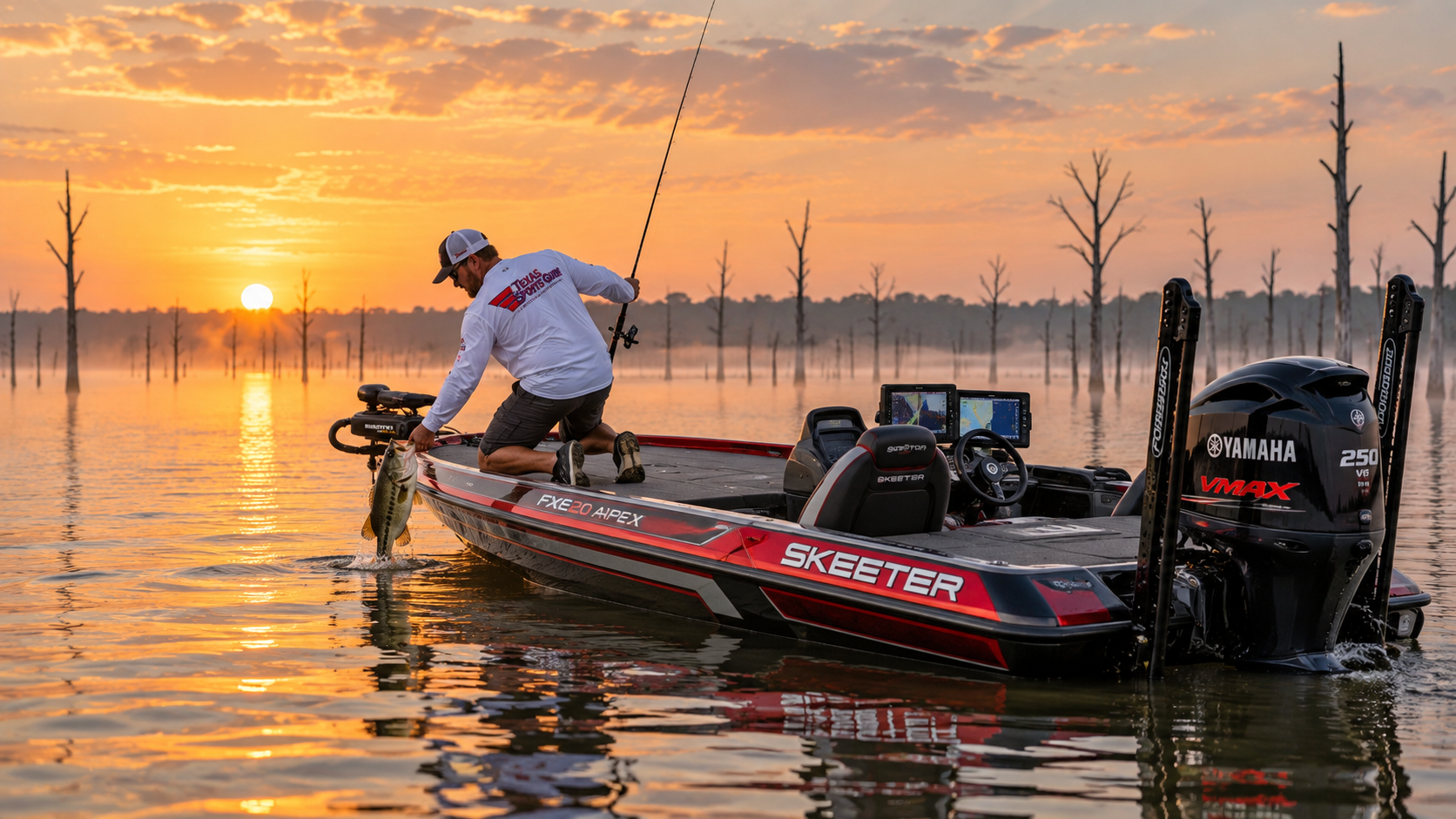
A fisherman can spend a lifetime chasing largemouth bass across Texas and still feel something a little different when the boat settles into the water at Fork before daylight. Maybe it is all those standing trees disappearing into the morning mist. Maybe it is knowing that the next grass point, creek-channel bend or submerged roadbed could hold a fish weighing more than some folks' Thanksgiving turkey.
Or perhaps it is simply history.
Texas Parks and Wildlife says more than 65 percent of the Texas Top 50 largest largemouth bass, including the current state record, came from Lake Fork. TPWD credits restrictive harvest regulations, Florida-strain largemouth stocking and abundant habitat for helping turn Fork into one of America's premier trophy-bass fisheries. (Texas Parks & Wildlife Department)
That history isn't merely something hanging on the wall of a tackle shop.
TPWD's 2026 stocking records show the investment continues. During 2026 alone, Lake Fork received 45,129 Florida largemouth fingerlings, 15,095 ShareLunker largemouth fingerlings and 518,406 Lone Star bass fingerlings. (Texas Parks & Wildlife Department)
Then there is the fish.
On January 24, 1992, Barry St. Clair caught an 18.18-pound largemouth bass from Lake Fork. That fish remains both the Lake Fork record and the Texas state-record largemouth bass. (Texas Parks & Wildlife Department)
Eighteen pounds and change.
I've spent enough years around bass fishermen to know that number doesn't require much embellishment.
So let's back the Skeeter down the ramp, idle carefully through the timber and spend some time exploring Lake Fork Texas Bass Fishing.
Where Is Lake Fork Texas?
Lake Fork Reservoir lies in Wood, Rains and Hopkins counties, approximately five miles northwest of Quitman.
Texas Parks and Wildlife currently lists:
Surface area: 27,264 acres
Maximum depth: 70 feet
Conservation pool: 403 feet above mean sea level
Normal water clarity: Moderately clear
Normal fluctuation: Approximately 2 to 4 feet
Impounded: 1980 (Texas Parks & Wildlife Department)
The Sabine River Authority of Texas owns and operates the reservoir. The lake was constructed primarily as a municipal and industrial water supply. (Texas Water Development Board)
Sabine River Authority, Lake Fork Division
353 PR 5183
Quitman, TX 75783
Phone: 903-878-2262
Sabine River Authority Lake Fork information
One thing becomes apparent almost immediately when fishing Fork.
This is not a reservoir where I'd recommend running cross-country through unfamiliar water just because the GPS says there's water between here and there.
Much of the timber was left standing when the reservoir filled. Established boat lanes provide safer travel, and newcomers should use them.
That timber is part of what makes Fork intimidating.
It is also part of what makes Fork magnificent.
What Rivers and Creeks Feed Lake Fork?
Lake Fork Creek and Caney Creek Built the Reservoir's Skeleton
Lake Fork Reservoir was built on Lake Fork Creek and Caney Creek, both tributaries within the Sabine River basin. The lake inundates portions of Wood, Rains and Hopkins counties. (Texas Water Development Board)
Those drainage systems and their smaller tributaries created the channels, bends, points, flats and submerged terrain that bass use today.
To a fisherman looking at a good contour map, those old channels are roads.
A creek-channel bend beside standing timber can become a winter holding area.
A channel leading toward a protected flat becomes a prespawn migration route.
A secondary ditch crossing a spawning flat can become a staging location.
In summer, a creek channel swinging against a point may give largemouth access to 20 or 25 feet of water without traveling far from their feeding grounds.
That's why I have always liked studying maps before studying lure boxes.
A lure catches the bass.
Structure tells us where to throw it.
What Fish Species Live in Lake Fork?
Lake Fork's reputation rests primarily on largemouth bass, but it supports a diverse fishery.
TPWD lists the predominant species as:
-
Largemouth bass
-
White and black crappie
-
Channel catfish
-
White bass
-
Sunfish
Yellow bass are also frequently caught during winter, sometimes in association with largemouth bass. TPWD rates the largemouth fishery excellent, as it does the catfish fishery. (Texas Parks & Wildlife Department)
For our purposes, however, everything begins and ends with that big green fish.
And Lake Fork has grown them about as well as anywhere in Texas.
What Is the Current Lake Fork Water Level?
This is one number I never want permanently carved into an evergreen fishing article.
Water levels change.
Fishing patterns change with them.
As of September 6, 2026, Water Data for Texas reported Lake Fork at 83.5 percent full, with a mean elevation of 399.03 feet. Conservation pool is 403 feet, putting the lake almost four feet below full pool. The estimated surface area at that elevation was approximately 23,655 acres. (Water Data for Texas)
The Sabine River Authority's near-real-time reading early September 7 was essentially the same at 399.02 feet. (Sabine River Authority of Texas)
Check the current Lake Fork water level
That roughly four-foot difference from conservation pool matters.
A grass bed that was wonderful shallow cover at 403 feet may be considerably different at 399.
A laydown may be exposed.
A creek-channel edge may become more pronounced.
A boat ramp may have less water.
And the bass may pull toward the outside grass, timber, ditches and first substantial depth change.
Water-level information is not housekeeping.
It is fishing information.
What Aquatic Vegetation Grows in Lake Fork?
Grass Is Part of Lake Fork's DNA
Lake Fork is blessed with considerably more vegetation diversity than many Texas reservoirs.
TPWD lists:
-
Hydrilla
-
Eurasian milfoil
-
Coontail
-
American lotus
-
Water primrose
-
Water hyacinth
-
Alligatorweed
-
Pennywort (Texas Parks & Wildlife Department)
The abundance of individual species changes with water level, weather and growing conditions, but aquatic vegetation has long been one of the foundations of the Fork bass fishery.
Grass gives bass:
Shade.
Oxygen.
Ambush cover.
Nursery habitat.
And groceries.
But don't simply look for grass.
Look for differences in the grass.
A point.
A pocket.
A drain.
An isolated clump.
A place where hydrilla meets timber.
An outside edge beside a creek channel.
A hole through an otherwise solid grass bed.
Those are the places I want to cast.
A hundred yards of uniform vegetation may hold bass.
One irregularity in those hundred yards may hold several.
What Structure Holds Lake Fork Largemouth Bass?
The Lower Lake Is a Grass-and-Structure Fishery
TPWD says the lower portion of Lake Fork is relatively clear and that game fish commonly relate to:
-
Vegetation edges
-
Flats
-
Humps
-
Creek channels (Texs)
Add submerged roadbeds, pond dams, points and standing timber and you've got enough structure to keep a bass fisherman occupied for several lifetimes.
The Upper Lake Is Different
Vegetation typically becomes less abundant in the upper third of the reservoir.
Here, TPWD identifies:
-
Timber
-
Brush
-
Laydowns
-
Creek channels
as important habitat. (Texs)
That distinction matters.
Don't try to fish the entire lake with one pattern.
Fork changes personality as you move through it.
A pattern built around deep hydrilla edges in the lower lake may have little relevance to bass buried beside wood in a stained upper-lake creek.
What Did the 2026 TPWD Lake Fork Fishing Reports Say?
TPWD's weekly reports are currently on hold while the agency works on improving its reporting system, but the archived 2026 Lake Fork reports provide excellent clues for the late-winter and prespawn transition. (Texas Parks & Wildlife Department)
On February 4, 2026, water temperatures were only 39 to 43 degrees and Fork was 3.05 feet below pool. Bass fishing was slow. Productive patterns included slowly worked Texas rigs and jigs around boathouses with brush, while squarebill and lipless crankbaits produced around flats with drains or ditches in 5 to 8 feet.
By February 25, temperatures had climbed into roughly 51 to 59 degrees.
The fish responded.
Bladed jigs, lipless crankbaits and squarebills were producing around covered flats in 3 to 5 feet, while bass were moving toward the backs of pockets. Larger fish were holding around big wood near channel edges, where Texas-rigged creature baits and jigs were producing in 5 to 7 feet. (Texas Parks & Wildlife Department)
That is classic Lake Fork prespawn behavior unfolding almost line by line.
Temperature rises.
Fish move.
The fisherman who moves with them catches bass.
Lake Fork Weather Throughout the Fishing Year
Lake Fork lies in East Texas, which gives it hot summers, relatively mild winters, substantial rainfall and some wonderfully unpredictable spring weather.
Winter
December through February can provide everything from sunny afternoons in the 60s to hard freezes.
Cold fronts can knock water temperature down quickly.
Spring
March through May is prime trophy-bass country.
Expect warming temperatures, thunderstorms, wind and rapid changes in water conditions.
Spring weather may frustrate fishermen.
It doesn't stop the bass from spawning.
Summer
June through August means East Texas heat and humidity.
Afternoons routinely reach the 90s.
This is when dawn, dusk and night fishing become increasingly attractive.
Fall
September through November gradually cools the reservoir.
Shad movements increase and bass begin feeding more aggressively.
Fall is one of Fork's most enjoyable seasons.
Driving Distance to Lake Fork From Major Texas Cities
Distances vary depending upon whether you're launching near Alba, Emory, Yantis or Quitman, but these estimates will get you reasonably close.
Dallas to Lake Fork
Approximately 80 to 90 miles.
A common route follows I-30 east, then US-69 and local highways toward Emory, Alba or Quitman.
Allow roughly 1½ hours.
Fort Worth to Lake Fork
Approximately 115 to 130 miles.
Travel east through the Metroplex, generally using I-30 before continuing toward the lake.
Allow approximately two hours.
Austin to Lake Fork
Approximately 250 to 270 miles.
A practical route runs north on I-35 toward the Metroplex and then east toward the lake.
Allow roughly four to 4½ hours.
Houston to Lake Fork
Approximately 220 to 240 miles.
Depending on your destination around the reservoir, routes commonly use I-45 north and East Texas highways toward Quitman.
Allow about 3½ to 4 hours.
San Antonio to Lake Fork
Approximately 330 to 350 miles.
Take I-35 north through Austin, then continue toward the Dallas/East Texas corridor.
Allow approximately 5½ hours.
Corpus Christi to Lake Fork
Approximately 455 to 480 miles.
Take I-37 north to San Antonio, then I-35 north before continuing east toward Lake Fork.
Plan on seven hours or more when towing a boat.
And remember, you're going fishing.
Lake Fork has been sitting there since 1980.
It can wait another ten minutes.
Lake Fork Boat Ramps
Lake Fork has an unusually large selection of public and private access facilities.
TPWD says the Sabine River Authority operates four public ramps, while numerous private marinas and resorts provide additional launches. (Texas Parks & Wildlife Department)
FM 17 Public Ramp
Location: West end of the FM 515 bridge on FM 17, Lake Fork Creek arm
Operator: Sabine River Authority
Phone: 903-878-2262
Fee: None
Ramp: Two-lane concrete
Open: Year-round
This is one of the straightforward public options for fishermen wanting access to the western portion of the reservoir. (Texas Parks & Wildlife Department)
Highway 515 East Public Ramp
Location: West side of Caney Creek at the Highway 515 East bridge
Operator: Sabine River Authority
Phone: 903-878-2262
Fee: None
Ramp: Two-lane concrete
Open: Year-round (Texas Parks & Wildlife Department)
Highway 154 Public Ramp
Location: Southeast end of the Texas 154 bridge on the Caney Creek arm
Operator: Sabine River Authority
Phone: 903-878-2262
Fee: None
Ramp: Two-lane concrete
Open: Year-round (Texas Parks & Wildlife Department)
Rains County Ramp and Collins Landing Marina
Location: North end of the FM 2946 bridge on the Lake Fork Creek arm
Public ramp: Single-lane concrete
Ramp fee: None
Marina phone: 903-456-1844
Open: Year-round
The ramp is operated by Rains County, while marina services are privately operated. (Texas Parks & Wildlife Department)
Because Lake Fork was nearly four feet below conservation pool in early September 2026, I would verify ramp conditions before towing any substantial distance.
Marinas on Lake Fork
Lake Fork Marina & Motel
Address: 275 County Road 1558, Alba, TX 75410
Phone: 903-765-2764
Email: lakeforkmarinamotel@gmail.com
This is a full-service fishing facility on the west arm of Lake Fork. It offers two launching ramps, non-ethanol gasoline, covered slips, tackle, fish-cleaning facilities, lodging and RV accommodations. (Lake Fork Marina)
For a fisherman traveling from several hundred miles away, having the ramp, fuel, room and tackle shop in one place simplifies life considerably.
Minnow Bucket Marina
Address: 3035 W. Highway 154, Quitman, TX 75783
Phone: 903-878-2500
Email: minnowone@minnowbucketmarina.com
Minnow Bucket provides a boat ramp, fishing dock, cleaning station, gas dock, tackle, bait, lodging, restaurant and guide-service connections. (Minnow Bucket Marina)
Lake Fork Resort
Address: 5004 FM 17, Alba, TX 75410
Phone: 903-765-2987
Email: info@lakeforkresort.com
TPWD lists the facility's ramp as a single-lane concrete launch open year-round, while the resort provides lodging and fishing-oriented services. (Texas Parks & Wildlife Department)
Lodging at Lake Fork
Fork is fishing country.
That's reflected in its accommodations.
Instead of relying exclusively on conventional hotels miles from the ramp, fishermen can stay at resorts designed around boats, rods and early departures.
Lake Fork Marina & Motel
Address: 275 County Road 1558, Alba, TX 75410
Phone: 903-765-2764
Email: lakeforkmarinamotel@gmail.com
The property offers standard motel rooms, suites, cabins, lodges and RV accommodations. Standard rooms include outdoor electrical outlets for charging boat batteries, a small detail that tells me somebody understands fishermen. (Lake Fork Marina)
Minnow Bucket Marina and Motel
Address: 3035 W. Highway 154, Quitman, TX 75783
Phone: 903-878-2500
Email: minnowone@minnowbucketmarina.com
Motel rooms, larger lodges, RV accommodations and camping are available at the marina. (Minnow Bucket Marina)
Lake Fork Resort
Address: 5004 FM 17, Alba, TX 75410
Phone: 903-765-2987
Email: info@lakeforkresort.com
For current room availability and boat-trailer arrangements, contact the resort directly.
There is something to be said for staying right beside the lake.
The alarm rings.
Coffee goes into the thermos.
You walk outside and the boat is waiting.
That's the proper distance between breakfast and bass fishing.
Spring Lake Fork Texas Bass Fishing
February Through April: When Giants Move Toward Shore
TPWD identifies spring, particularly mid-February through April, as one of Lake Fork's most productive periods. Spinnerbaits, plastic worms and lizards, jigs and lipless crankbaits are among the agency's recommended choices. (Texs)
This is trophy season.
Early Prespawn
Start around:
-
Creek-channel bends
-
Secondary points
-
Drains
-
Ditches
-
Outside grass
-
Big timber near channels
-
Roadbeds leading toward spawning areas
Depth may begin around 6 to 15 feet, but don't get married to a number.
Warm rain and several sunny afternoons can pull bass remarkably shallow.
The February 25, 2026 TPWD report had fish moving into 3 to 5 feet, with larger bass around channel-edge wood in 5 to 7 feet. (Texas Parks & Wildlife Department)
Best Prespawn Lures
Lipless crankbait: 1/2 to 3/4 ounce
Colors: red craw, chrome/blue, shad
Rip it through sparse grass and allow it to fall into drains.
Bladed jig: 3/8 to 1/2 ounce
Colors: green pumpkin, white/shad
Squarebill crankbait: 1.5 to 2.5
Colors: crawfish, chartreuse/black, shad
Jig: 3/8 to 1/2 ounce
Colors: black/blue, green pumpkin, brown
Texas-rigged creature bait: 4 to 6 inches
Colors: green pumpkin, watermelon red, black/blue
Fishing the Lake Fork Spawn
As water temperatures climb into the 60s, bass move onto protected flats, coves and pockets.
Look for:
-
Hydrilla
-
Milfoil
-
Lotus
-
Stumps
-
Laydowns
-
Protected pockets
-
Hard-bottom openings
-
Ditches crossing spawning flats
An old Texas SportsGuide Lake Fork report described spawning bass concentrated in warm-water backs of major creeks, with fish moving onto flats and coves. Productive presentations included weightless or lightly weighted wacky worms in watermelon and green-pumpkin shades, while spinnerbaits worked on points and channel-related cover continued catching staging fish. (Texs)
Best Spawn Lures
Stick worm: 5 to 7 inches
Colors: green pumpkin, watermelon red
Creature bait: 4 inches
Colors: white for visibility, green pumpkin, watermelon red
Lizard: 6 inches
Colors: watermelon, green pumpkin
Compact jig: 3/8 ounce
Colors: black/blue or green pumpkin
Slow down.
Fork bass see a lot of lures.
Sometimes another cast to the same stump is more valuable than twenty casts to twenty different stumps.
Postspawn Lake Fork Bass Fishing
May Into Early June: Look Up Before Looking Down
Once the spawn winds down, Fork becomes one of my favorite kinds of bass lake.
Topwater season.
Postspawn fish begin recovering while bluegill, shad and other forage become active.
Start around:
-
Grass points
-
Timber
-
Secondary points
-
Creek-channel edges
-
Shallow humps
-
Fry-guarding areas
Best Postspawn Lures
Walking topwater: 4 to 5 inches
Colors: bone, chrome, shad
Popper: 2.5 to 3 inches
Colors: shad, bluegill
Buzzbait: 3/8 ounce
Colors: white or black
Frog: natural green, black or white
Wacky worm: 5 inches
Colors: green pumpkin, watermelon
An archived Texas SportsGuide May report described postspawn Fork bass around timbered points, pockets, secondary points and small coves from roughly 3 to 15 feet, with topwaters, Texas rigs and weightless presentations producing. (Texs)
Summer Lake Fork Texas Bass Fishing
June Through August: Dawn, Deep Water and Darkness
TPWD says summer fish activity becomes concentrated around early morning, late evening and nighttime. Topwaters are good during low light, while bass later concentrate around vegetation edges, brush piles, deep ledges and creek channels. Plastic worms, jigs and Carolina rigs become important. (Texs)
At dawn, I would begin shallow.
Try:
-
Grass edges
-
Lily pads
-
Timber
-
Pond dams
-
Points
Then watch the sun.
Once it gets high, start looking offshore.
Summer Deep-Water Structure
Lake Fork is famous for:
-
Main-lake points
-
Humps
-
Submerged roadbeds
-
Pond dams
-
Ridges
-
Creek-channel ledges
-
Timber on depth changes
Historical Texas SportsGuide reports repeatedly documented summer bass from roughly 15 to 30 feet, with Carolina rigs, Texas rigs, jigs and deep-diving crankbaits producing on these structures. (Texs)
Best Summer Lures
Carolina rig: 6- to 8-inch worm, lizard or creature bait
Colors: watermelon red, green pumpkin, junebug
Texas-rigged worm: 7 to 10 inches
Colors: plum, junebug, red shad, black grape
Football jig: 1/2 to 3/4 ounce
Colors: brown, green pumpkin, black/brown
Deep-diving crankbait: large profile
Colors: chartreuse/blue, shad, bluegill
Topwater: 4 to 5 inches
Colors: bone or shad
Night fishing deserves serious consideration.
The air is cooler.
Boat traffic declines.
And a big Texas-rigged worm crawling along a summer point after dark has been catching bass since long before anybody put a touch screen on a depth finder.
Fall Lake Fork Texas Bass Fishing
September Through November: Follow the Groceries
Fall begins with lingering summer patterns but gradually brings bass toward shallower water.
TPWD identifies late summer and early fall schooling activity as a productive period for crankbaits and topwater lures. (Texs)
Watch for shad around:
-
Creek mouths
-
Grass edges
-
Points
-
Timber
-
Humps
-
Windblown flats
An archived Texas SportsGuide September report recommended starting around trees, stumps, points, ledges and humps in roughly 10 to 15 feet, then working outward toward 25 to 30 feet when necessary. (Texs)
Best Fall Lures
Lipless crankbait: 1/2 ounce
Colors: chrome/blue, shad
Squarebill: 1.5 to 2.5
Colors: shad, chartreuse/black
Walking topwater: 4 to 5 inches
Colors: bone, chrome
Spinnerbait: 3/8 to 1/2 ounce
Colors: white, white/chartreuse
Wacky worm: 5 inches
Colors: junebug, watermelon, green pumpkin
Jig: 1/2 ounce
Colors: black/blue, black/brown/amber
Fall is one of those seasons when keeping several rods ready pays off.
A bass that ignores a slow jig beside timber may suddenly explode on a topwater thirty yards away because a school of shad made the mistake of appearing overhead.
Winter Lake Fork Texas Bass Fishing
December Through February: This Is Trophy Time
Don't put the rods away because it's cold.
Remember when Barry St. Clair caught the Texas record.
January 24.
Winter is absolutely capable of producing the bass of a lifetime.
Focus on:
-
Creek-channel bends
-
Submerged roadbeds
-
Pond dams
-
Ledges
-
Deep points
-
Timber
-
Grass near deeper water
An archived Texas SportsGuide winter report specifically identified S-bends in creek channels, deep drops, roadbeds, submerged bridges, points and pond dams as productive winter structure. (Texs)
Best Winter Lures
Jig: 1/2 ounce
Colors: black/blue, brown, black/brown
Jigging spoon: 1/2 to 3/4 ounce
Colors: silver or white
Suspending jerkbait: 4 to 5 inches
Colors: translucent shad
Carolina rig: finesse worm or creature bait
Colors: watermelon, junebug, pumpkin
Lipless crankbait: 1/2 ounce
Colors: red craw
And when a February warming trend starts pushing temperatures upward, don't remain stubbornly deep.
The 2026 TPWD reports show just how quickly Fork bass can move toward flats and pockets as conditions improve. (Texas Parks & Wildlife Department)
Best Areas for Lake Fork Texas Bass Fishing
Caney Creek
Caney Creek is one of the major arms of the reservoir and provides everything from spawning pockets to creek-channel structure.
Lake Fork Creek Arm
The western arm contains abundant access, timber, vegetation and channel-related habitat.
Little Caney Creek
Little Caney has a long history in Lake Fork fishing reports and provides classic creek-channel, point, timber and grass opportunities.
Main-Lake Humps and Roadbeds
Summer and winter are prime times to study these offshore structures.
Old Texas SportsGuide reports repeatedly identify submerged roadbeds, humps, ridges and pond dams as productive Fork bass structure. (Texs)
Highway Bridges
The FM 515, Highway 154 and FM 2946 crossings create channels, riprap, shade and structural changes.
Grass Near Deep Water
This combination deserves special attention.
Grass is good.
Deep water is good.
Put the two beside each other and my trolling motor slows down.
Lake Fork Largemouth Bass Record and Texas Trophy-Bass History
This section is where Lake Fork separates itself from almost every other reservoir in America.
TPWD's record database, updated September 6, 2026, lists:
Largemouth bass: 18.18 pounds
Length: 25.50 inches
Angler: Barry St. Clair
Date: January 24, 1992 (Texas Parks & Wildlife Department)
That fish remains the Texas state record.
But one giant isn't the whole story.
The current Texas Top 50 list begins:
-
Lake Fork, 18.18 pounds
-
Lake Fork, 17.67
-
Lake Fork, 17.64
-
Lake Fork, 17.63
-
Lake Fork, 17.29
-
Lake Fork, 17.08
Six straight.
Fork also holds additional fish throughout the Top 50, which explains TPWD's statement that more than 65 percent of the state's 50 largest bass came from this reservoir. (Texas Parks & Wildlife Department)
That's not reputation.
That's a record book.
Lake Fork Special Bass Regulations
Lake Fork has long been managed specifically to protect its trophy largemouth population, and anglers should check the current TPWD regulations before every trip rather than relying on an old article or fishing report.
That matters especially here because many archived Lake Fork reports refer to historical slot regulations.
Check current Texas fishing regulations before fishing Lake Fork
The safest practice with a trophy Fork largemouth is also the simplest.
Handle her carefully.
Support her body.
Keep her out of the water only as long as necessary.
Get your photograph.
Then watch her swim away.
A fish that took ten or fifteen years to grow deserves more respect than a few extra photographs.
Five Texas SportsGuide Articles to Read Next
Lake Fork belongs to a much larger Texas bass-fishing story, and the Texas SportsGuide sitemap contains several natural companion articles.
For another East Texas reservoir where timber, limited vegetation and creek structure play major roles, continue with Lake Tawakoni Texas Bass Fishing. The two lakes are geographically close but fish very differently. (Texs)
Closer to Dallas, Lake Ray Hubbard Texas Bass Fishing explores hydrilla, riprap and standing timber within sight of the Metroplex.
For a reservoir where standing timber dominates much of the bass habitat, Lavon Lake Texas Bass Fishing makes another natural North Texas companion. The current Texas SportsGuide sitemap confirms the article in the 2026 archive. (Texs)
Then head west with Possum Kingdom Lake Texas Largemouth and Smallmouth Bass Fishing, where rocky canyon structure and smallmouth bass provide an entirely different lesson. The article is listed in the Texas SportsGuide bass-fishing archive. (Texs)
Finally, the Lake Travis Bass Fishing guide takes us into clear Hill Country water where steep banks, points and deep structure require a very different approach from Fork's timber and vegetation. (Texs)
That's five lakes and five different bass-fishing classrooms.
Frequently Asked Questions About Lake Fork Texas Bass Fishing
Is Lake Fork Still One of the Best Bass Lakes in Texas?
Absolutely.
TPWD currently rates largemouth bass fishing excellent and describes Lake Fork as one of the country's premier trophy-bass lakes. (Texas Parks & Wildlife Department)
How Big Is Lake Fork?
Texas Parks and Wildlife currently lists Lake Fork at 27,264 surface acres with a maximum depth of 70 feet. (Texas Parks & Wildlife Department)
What Is the Current Lake Fork Water Level?
As of September 6, 2026, Lake Fork was approximately 83.5 percent full and nearly four feet below its 403-foot conservation pool. Because that changes continuously, check current data before traveling. (Water Data for Texas)
What Is the Best Bass Habitat on Lake Fork?
TPWD identifies submerged aquatic vegetation, standing timber and flooded terrestrial vegetation as the principal habitat. Lower-lake bass commonly relate to vegetation edges, flats, humps and creek channels, while upper-lake fish make greater use of timber, brush, laydowns and channels. (Texas Parks & Wildlife Department)
What Are the Best Spring Lures?
Spinnerbaits, plastic worms and lizards, jigs and lipless crankbaits are among TPWD's primary recommendations. The February 2026 reports also identified bladed jigs and squarebill crankbaits as productive during the prespawn transition. (Texas Parks & Wildlife Department)
What Are the Best Summer Depths?
There isn't one magic depth, but historic Lake Fork patterns repeatedly put offshore summer bass around 15 to 30 feet, particularly on points, roadbeds, humps, pond dams and creek-channel structure. Shallow grass and timber can continue producing early, late and at night. (Texs)
What Is the Lake Fork Largemouth Bass Record?
18.18 pounds, caught by Barry St. Clair on January 24, 1992. It remains the Texas state record. (Texas Parks & Wildlife Department)
Final Thoughts on Lake Fork Texas Bass Fishing
If I were launching my Skeeter on Lake Fork tomorrow morning, I think I'd feel something I don't feel on every lake.
Possibility.
I'd idle carefully through the boat lane while the eastern sky began turning gray.
There would be a lipless crankbait lying on the deck.
A jig beside it.
A Texas-rigged worm would be ready for the timber.
And because old habits earned honestly on bass water are worth keeping, there would certainly be a spinnerbait within reach.
Then I'd start looking.
Not just casting.
Looking.
Where does that creek channel turn?
Why does the hydrilla make a point right there?
Is that one stump sitting farther outside the others?
Does the old roadbed cross the creek channel?
Why are shad flickering beside that grass edge but nowhere else?
Is the water half a degree warmer in the back of this pocket?
Those questions are bass fishing.
The lure is merely how we ask for an answer.
Lake Fork makes those questions particularly interesting because every fisherman knows what has happened here before.
Eighteen pounds, three ounces in the old measurements.
Seventeen-pounders.
Sixteen-pounders.
A record book crowded with the name Lake Fork.
Hundreds of thousands of carefully selected bass fingerlings continue going into the reservoir. TPWD continues managing the fishery. Generations of fishermen continue releasing trophy fish so somebody else might someday feel that same violent pull on the other end of a line. (Texas Parks & Wildlife Department)
Yet none of those statistics matter very much when you're actually standing on the front deck.
At that moment there is only the next cast.
Maybe you're working a jig beside a big piece of channel-edge timber in February.
Maybe you're bringing a frog across hydrilla before sunrise in June.
Maybe you're crawling a Carolina rig over a 25-foot roadbed in July.
Or perhaps you're winding a lipless crankbait through a shallow grass flat on a warming March afternoon.
The rod suddenly stops.
For a fraction of a second you wonder whether you've hooked another stump.
Then the stump moves.
And somewhere beneath that moderately clear East Texas water, a very large largemouth bass begins shaking her head.
On most lakes, your first thought might be, That's a good one.
On Lake Fork another thought creeps in.
How good?
That's the question that has brought bass fishermen to this reservoir for more than forty years.
It's why we study maps.
Why we sharpen hooks.
Why we launch before daylight.
Why we keep one eye on the graph and another on the grass.
And why, no matter how many bass we've caught over a lifetime, we're still willing to make one more cast.
Because this is Lake Fork Texas Bass Fishing.
And here, perhaps more than anywhere else in Texas, the next bass really could be the fish of a lifetime.


0 Comments