
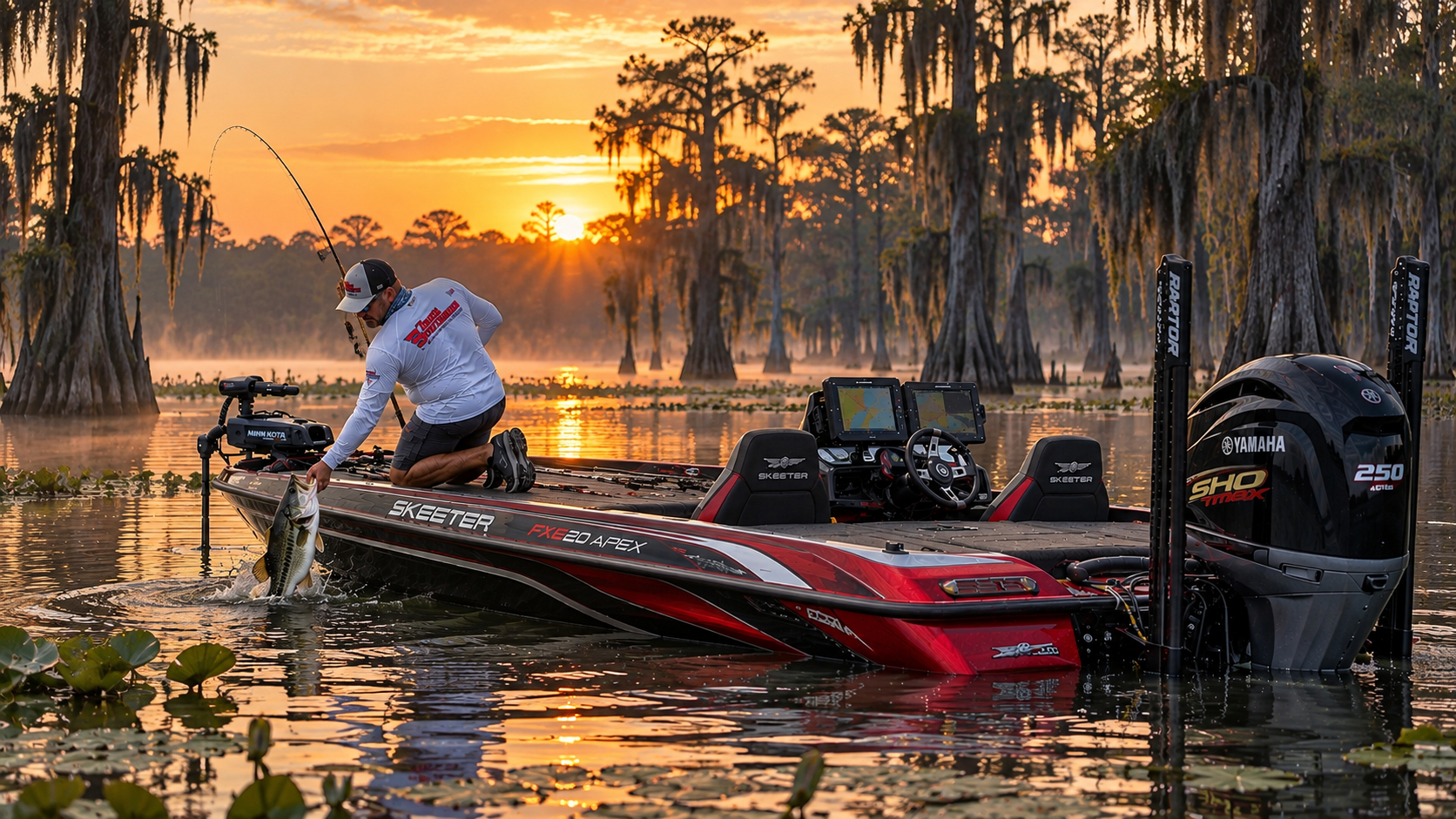
Caddo Lake Texas Bass Fishing
Bald cypress, Spanish moss, lily pads, twisting bayous, trophy largemouth bass and the only American eel I ever caught, which taught me one memorable lesson about looking before lipping.
Caddo Lake Texas Bass Fishing Is Unlike Fishing Anywhere Else in Texas
I've fished a lot of Texas water over the years.
I've guided Lake Conroe and Sam Rayburn, tournament fished Toledo Bend, Texoma, Amistad, Palestine and plenty of other lakes, and spent enough time staring across flooded timber to believe I'm reasonably familiar with what a Texas bass lake looks like.
Then there is Caddo Lake.
Caddo doesn't look like the others.
It doesn't really feel like the others.
You ease a boat between ancient bald cypress trees draped with Spanish moss, past lily pads and aquatic vegetation, through bayous and sloughs where the route ahead can appear more like a trail through a flooded forest than a conventional boat lane.
Some places make me think about fishing.
Caddo makes me look around.
And then, eventually, something pulls on the line.
Texas Parks and Wildlife calls largemouth bass the most popular sportfish on Caddo and currently rates the largemouth fishery excellent, noting that good numbers of trophy bass over eight pounds are available. TPWD also says spring is the premier trophy period, with March the most productive month. (Texas Parks and Wildlife)
That's reason enough to bring a bass boat.
But one of my strongest Caddo memories wasn't a largemouth at all.
It was the day I caught the only American eel of my life.
And, as is sometimes the case with fishing stories, I didn't immediately know what I'd caught.
The Day I Almost Lipped an American Eel
I was fishing a Texas-rigged tequila sunrise worm.
Those of us who fished through the great soft-plastic color experiments of earlier decades will remember tequila sunrise. It was one of those colors that didn't particularly resemble anything swimming around a Texas lake, but nobody bothered explaining that to the bass.
I made my cast, worked the worm along and eventually felt a bite.
I set the hook.
Whatever was attached to the other end started coming toward the boat, and I naturally went through the routine I'd repeated thousands of times.
Get the fish close.
Reach down.
Lip it.
Except this wasn't a bass.
When that creature came into view, there was a brief interruption in the normal landing procedure.
What in the world is THAT?
An American eel.
Long.
Slippery.
And equipped with a mouth that suddenly made sticking my thumb inside seem considerably less intelligent than it had about two seconds earlier.
Needless to say, I didn't put my fingers in that thing's mouth.
That eel remains one of my favorite examples of why fishing is never entirely predictable.
You can spend decades learning bass behavior, seasonal movements, structure, electronics and lure presentation.
Then Caddo Lake sends an eel up beside the boat to remind you who is really running the program.
I remember the lesson.
Look before you lip.
Particularly on Caddo.
What Makes Caddo Lake So Unique?
Caddo is one of those places where geology, hydrology and human history become tangled together almost as thoroughly as the cypress roots.
The lake began naturally, but TPWD notes that it was later dammed for flood control in the early 1900s. The first dam was constructed in 1914 and replaced in 1971. Today Caddo lies along Big Cypress Bayou on the Texas-Louisiana state line, northeast of Marshall in Harrison and Marion counties. (Texas Parks and Wildlife)
TPWD lists:
Surface area: 26,800 acres
Maximum depth: 20 feet
Conservation pool: 168.5 feet above mean sea level
Typical fluctuation: 4 to 8 feet
Normal clarity: moderately clear to stained (Texas Parks and Wildlife)
Twenty feet maximum depth tells us something immediately.
This is not Lake Travis.
We aren't spending the afternoon dropping baits down fifty-foot ledges.
Caddo is fundamentally a shallow habitat lake, and habitat is everywhere.
TPWD's current lake page estimates about 60 percent aquatic-vegetation coverage, dominated by native submerged and emergent vegetation. Its cover-and-structure section notes that vegetation on the Texas portion can be much more extensive and that inundated bald cypress trees provide exceptional fish habitat. Piers and duck blinds add still more cover. (Texas Parks and Wildlife)
In other words, the problem usually isn't finding cover.
The problem is determining which cover has bass.
That's an entirely different puzzle.
Big Cypress Bayou and the Waters Feeding Caddo Lake
Lake O' The Pines Is Upstream in the Same Cypress System
The principal artery feeding Caddo is Big Cypress Bayou, which flows downstream from Lake O' The Pines into the Caddo system.
That makes our previous Lake O' The Pines Texas Bass Fishing story especially relevant to understanding Caddo. Lake O' The Pines is an impoundment of Big Cypress Creek, and TPWD specifically notes that the special nongame-fish transport rule applies from Big Cypress Bayou below Ferrell's Bridge Dam downstream into the Texas waters of Caddo Lake. (Texas Parks and Wildlife)
Caddo also receives water through a complex web of bayous, creeks, sloughs and wetlands rather than behaving like the simple V-shaped river reservoir many Texas fishermen know.
That matters to a bass fisherman.
Current can be subtle.
A small drain can become important.
A bayou intersection can concentrate bait.
Water color can change from one section to another.
A little flow through a narrow passage can turn ordinary-looking cypress habitat into a feeding station.
On Caddo, I pay attention to moving water.
What Fish Species Live in Caddo Lake?
TPWD identifies the predominant species as:
-
Largemouth bass
-
Crappie
-
Blue, channel and flathead catfish
-
Chain pickerel
-
White bass
-
Yellow bass
-
Sunfish
And yes, American eels occur in the broader Caddo/Red River drainage, as I discovered personally at the end of that tequila-sunrise worm.
TPWD rates Caddo's largemouth, crappie, white bass and sunfish fisheries excellent, with catfish and chain pickerel rated good. Largemouth bass are the lake's most popular sportfish. (Texas Parks and Wildlife)
The latest TPWD survey also found that largemouth catch rates had improved from the preceding survey cycle. Bass showed moderate growth, reaching 14 inches at about 2.7 years, and largemouth remained the most sought-after fish among Caddo anglers. TPWD continues stocking Florida largemouth bass to support the trophy fishery. (Texas Parks and Wildlife)
That's not simply a scenic swamp with a few bass living in it.
It's a serious bass fishery.
What Is the Current Caddo Lake Water Level?
This is particularly important at Caddo because a few inches of water can change navigation and fishing habitat considerably on such a shallow lake.
The latest Water Data for Texas instantaneous reading available during my research, from September 8, 2026, showed Caddo at approximately 168.06 feet, compared with a conservation pool of 168.50 feet.
That's only about 0.44 foot below conservation pool. (Water Data for Texas)
The August monthly average had been 168.40 feet and approximately 94 percent of conservation storage. June had been at 100 percent. (Water Data for Texas)
Check the current Caddo Lake water level
Don't dismiss four or five inches as insignificant.
On a steep-sided reservoir it may barely be noticeable.
On Caddo, inches can determine whether a shallow pad field, cypress flat or little backwater has enough water to comfortably hold and reach bass.
And TPWD says the lake can fluctuate 4 to 8 feet. (Texas Parks and Wildlife)
At Caddo, water level isn't trivia.
It's part of the fishing pattern.
Caddo Lake Aquatic Vegetation Is a Bass Fisherman's Jungle
If you enjoy fishing vegetation, Caddo can make you feel as though somebody forgot to include the water between the plants.
TPWD describes extensive native and nonnative vegetation, while its paddling information identifies such plants as spatterdock, American lotus, Cabomba, American featherfoil and bladderwort in the Caddo ecosystem. (Texas Parks and Wildlife)
There is also a serious invasive-plant component.
Giant salvinia has been a major management problem. TPWD's fisheries survey notes that fishing effort increased as giant salvinia coverage declined from higher levels observed during the earlier survey period, and the agency continues annual invasive-plant surveys and management efforts. (Texas Parks and Wildlife)
For bass fishermen, all that vegetation creates several targets.
Pad Edges
Bass can sit beneath pads and ambush prey moving along the edge.
Open Holes
A hole surrounded by vegetation may be considerably more important than another acre of solid cover.
Cypress and Vegetation Together
This is one of my favorite combinations.
A cypress trunk beside submerged vegetation gives a bass shade, ambush cover and a hard object in the middle of softer habitat.
Bayou Edges
Where vegetation meets slightly deeper moving water, I slow down.
Duck Blinds and Piers
TPWD specifically identifies these man-made structures as fish-holding cover. (Texas Parks and Wildlife)
Caddo has almost too much good-looking habitat.
That's why I don't fish everything.
I look for something different.
Bald Cypress Trees Are the Signature Caddo Lake Bass Structure
Those magnificent bald cypress trees aren't simply scenery.
They're bass habitat.
Look at the trunk.
Look at the root system.
Look at adjacent depth.
Look for a little current.
Look for vegetation.
Look for bait.
And don't assume every cypress tree is equal.
A solitary tree beside a bayou can be more valuable than fifty nearly identical trees across a flat.
A cypress on a depth change can be special.
A tree with submerged vegetation beside it can be special.
One sitting at the mouth of a drain can be very special.
That's an old bass-fishing lesson that works everywhere.
Find the difference.
Navigating Caddo Lake Requires Respect
This deserves its own section.
TPWD explicitly says boating maps are highly recommended for this shallow lake. (Texas Parks and Wildlife)
I agree.
Caddo is a maze of bayous, sloughs, cypress trees, vegetation and shallow water. Established boat roads matter.
This is not a lake where I would casually point the bow toward something interesting in the distance, put the Yamaha on plane and assume there is open water between here and there.
Use a current map.
Follow marked boat roads.
Watch your electronics.
Learn the route.
When uncertain, slow down.
And on a lake beside a town actually named Uncertain, that last sentence seems especially appropriate.
Spring Caddo Lake Texas Bass Fishing
February: Prespawn Bass Begin Positioning
TPWD says spring is trophy season and March is the most productive month for trophy largemouth bass. (Texas Parks and Wildlife)
So by February, I'm already thinking about the routes those big females will use.
Look for:
bayou edges, cypress trees adjacent to deeper water, submerged vegetation, drains, secondary channels and staging cover near protected spawning flats.
Caddo is shallow, so "deep" is relative.
In many areas, 3 to 6 feet can be meaningful depth.
Best Prespawn Lures
Lipless crankbait: 1/2 ounce
Colors: red craw, orange craw, gold/black in stained water
Spinnerbait: 3/8 to 1/2 ounce
Colors: white/chartreuse, chartreuse/white, gold blades in stained water
Bladed jig: 3/8 to 1/2 ounce
Colors: green pumpkin, black/blue, white/shad
Texas-rigged worm: 6 to 7 inches
Colors: junebug, black/blue, watermelon red and, yes, tequila sunrise
Jig: 3/8 ounce
Colors: black/blue or brown
That tequila sunrise worm deserves a place on the list.
Just inspect whatever eats it before inserting your thumb.
March Is Trophy Largemouth Month on Caddo Lake
TPWD doesn't hedge much here.
March is the most productive month for trophy bass. (Texas Parks and Wildlife)
The record book backs that up spectacularly.
We'll get to the lake record shortly, but here's a preview:
16.17 pounds.
March 20.
And that isn't Caddo's only 16-pound bass in the Texas Top 50.
That's enough evidence for me.
During March, concentrate on protected cypress flats, submerged vegetation, pad stems, bayou pockets and the first hard cover inside spawning areas.
Productive depths may be only 1 to 5 feet.
Best March Lures
Weightless stick bait: 5 inches
Green pumpkin, watermelon red
Texas-rigged creature bait: 4 to 5 inches
Black/blue, green pumpkin
Wacky worm: 4 to 5 inches
Natural colors
Spinnerbait: 3/8 ounce
White/chartreuse
Lipless crankbait: 1/2 ounce
Red craw
Soft-plastic lizard: 6 inches
Watermelon red or black/blue
Make quiet presentations.
Caddo's shallow bass can know you're there before you know they're there.
Postspawn Caddo Lake Bass Fishing
April into May brings another transition.
Some bass remain near spawning areas.
Males guard fry.
Females begin recovering.
Bluegill and other forage become increasingly important around vegetation.
Now I want a topwater rod close at hand.
Best Postspawn Lures
Hollow-body frog: natural, black or white
Walking topwater: 4 to 5 inches, bone or shad
Popper: 2½ to 3 inches
Swim jig: 1/4 to 3/8 ounce, bluegill or white
Weightless stick worm: 5 inches, green pumpkin
Work pad edges, holes in vegetation, cypress shade and the mouths of little drains.
A frog disappearing through a hole in the pads is one of those bass-fishing sights that doesn't require much explanation.
Set the hook and sort out the philosophy later.
Summer Caddo Lake Texas Bass Fishing
June Through August: Shade, Vegetation and Moving Water
Summer bass don't have the option of dropping into forty feet.
There isn't forty feet.
Caddo's maximum depth is only about 20 feet. (Texas Parks and Wildlife)
That means shade, oxygen, vegetation, current and modest depth changes become especially important.
At daylight I would work:
pad edges, cypress flats, vegetation points, bayou mouths and shallow feeding areas.
As the sun rises, concentrate increasingly on:
cypress shade, deeper bayou edges, outside vegetation, docks, duck blinds and areas with moving water.
Best Summer Lures
Frog: black, white or natural
Texas-rigged worm: 7 to 10 inches
Junebug, plum, black/blue
Creature bait: 4 to 5 inches
Green pumpkin or black/blue
Swim jig: 3/8 ounce
Bluegill or shad
Spinnerbait: 3/8 ounce
White/chartreuse around stained moving water
Squarebill: compact 1.5-size
Chartreuse/black or bluegill
Summer is also a good time to remember that the most comfortable place for the fisherman isn't necessarily where the bass want to live.
That shady cypress canopy looks pretty inviting to both of us.
Fall Caddo Lake Texas Bass Fishing
September Through November: Follow the Bait
As nights cool, baitfish movements become increasingly important.
I begin watching bayou intersections, drains, vegetation edges and places where current funnels forage.
The lure selection gets a little faster.
Best Fall Lures
Spinnerbait: 3/8 to 1/2 ounce
White/chartreuse or shad
Squarebill: 1.5 to 2.5
Shad, chartreuse/black, bluegill
Lipless crankbait: 1/2 ounce
Gold/black, chrome/blue or shad
Paddle-tail swimbait: 3 to 4 inches
Pearl or shad
Walking topwater: 4 to 5 inches
Bone
Look for birds.
Watch for shad.
Pay attention to current.
A seemingly endless cypress swamp gets much smaller once the groceries reveal where they're going.
Winter Caddo Lake Bass Fishing
December Through January: Channels, Cypress and Patience
Winter doesn't shut Caddo down.
TPWD says largemouth fishing is good throughout the year. (Texas Parks and Wildlife)
I would slow my presentation and concentrate on slightly deeper bayou edges, submerged vegetation, cypress adjacent to channels and hard cover offering quick access to depth.
Best Winter Lures
Jig: 3/8 ounce
Black/blue or brown
Texas-rigged worm: 6 inches
Junebug or black/blue
Suspending jerkbait: 4 to 5 inches
Natural shad
Slow-rolled spinnerbait: 1/2 ounce
White/chartreuse with gold blades
Compact creature bait: 3 to 4 inches
After several warming afternoons, don't be afraid to look shallow.
Caddo bass live shallow lives compared with fish in deep reservoirs.
Best Rods, Reels and Line for Caddo Lake Bass
Caddo is not where I arrive with six-pound monofilament and an optimistic personality.
There is too much vegetation and wood.
For Texas rigs and jigs, I like a 7-foot to 7-foot-3-inch medium-heavy fast casting rod, a roughly 7:1 baitcaster and 15- to 20-pound fluorocarbon.
For frogs and genuinely heavy vegetation, move to a 7-foot-3-inch heavy rod, high-speed reel and 50- to 65-pound braid.
Spinnerbaits and bladed jigs work nicely on a 7-foot medium-heavy rod, 6.3:1 to 7.1:1 reel and 15- to 17-pound fluorocarbon.
For squarebills, use a 6-foot-10-inch to 7-foot moderate-action rod, 6:1-range reel and 12- to 15-pound line.
Around cypress and vegetation, I would rather be slightly over-equipped than watch a good bass wrap me around a root while I explain how sporting my light tackle was.
Caddo Lake Has Produced Some Enormous Largemouth Bass
Now we get to a remarkable part of the Caddo story.
The current TPWD Caddo Lake largemouth record, updated September 4, 2026, is:
16.17 pounds
26.50 inches
Angler: Keith Burns
Date: March 20, 2010
Lure: Senko (Texas Parks and Wildlife)
That fish currently sits at No. 20 on the Texas Top 50 largemouth list. (Texas Parks and Wildlife)
But Caddo wasn't finished.
A 16.07-pounder caught by Sean Swank on March 18, 2011 is No. 25.
A 16.01-pounder caught by Bobby Shaver on April 13, 1992 is No. 32.
And a 15.70-pounder caught by Ronnie Arnold on March 10, 2017 is No. 40. (Texas Parks and Wildlife)
Think about that.
Caddo has four largemouth bass currently represented in the Texas Top 50, three of them exceeding sixteen pounds. (Texas Parks and Wildlife)
And look at those dates.
March 10.
March 18.
March 20.
April 13.
TPWD says spring and especially March for trophies.
The bass apparently agree.
Caddo Lake Bass Regulations Are Different
Caddo deserves a regulation check before every trip because its largemouth rules are not the standard statewide pattern.
Current TPWD regulations establish a 14-to-18-inch slot limit for largemouth bass. Fish 14 inches and under or 18 inches and over may be retained. The daily bag for all black bass species is eight in combination, with no more than four largemouth bass 18 inches or longer. (Texas Parks and Wildlife)
Always verify current regulations before fishing.
Current Caddo Lake fishing regulations
TPWD also notes that black-bass limits apply on both the Texas and Louisiana portions, although regulations for certain other species can differ between states. (Texas Parks and Wildlife)
There is also a current fish-consumption advisory, so anyone planning to keep fish for the table should review the current advisory before doing so. (Texas Parks and Wildlife)
Catch and Release on Caddo Lake
A lake that can produce sixteen-pound largemouth deserves thoughtful fish handling.
I'm particularly inclined to release large females.
Wet your hands.
Support the fish horizontally.
Keep her in the water while preparing the camera.
Take the photograph quickly.
Then let her go.
The fish you release at eight pounds this spring may be considerably larger when somebody meets her again.
Perhaps sixteen.
And wouldn't that be something?
Caddo Lake Boat Ramps and Marinas
TPWD reports boat access at Caddo Lake State Park, two public ramps and several private marinas. (Texas Parks and Wildlife)
Caddo Lake State Park
Address: 245 Park Road 2, Karnack, TX 75661
Phone: 903-679-3351
Email: CaddoLakeSP@tpwd.texas.gov
Reservations: 512-389-8900
The park provides an improved boat ramp, fishing piers, camping and historic cabins. (Texas Parks and Wildlife)
Johnson's Ranch Marina
Johnson's Ranch Marina information
Address: 5131 Cypress Drive E, Uncertain/Karnack, TX 75661
Phone: 903-789-3213
Alternate phone listed by TPWD: 903-789-3268
Email: Contact through marina
Website: jrmarina.com
Johnson's Ranch has served Caddo fishermen since 1908 and offers a concrete launch, fuel, bait, tackle and boat/canoe/kayak rentals. TPWD also identifies it as an access point for the Turtle Shell and other Caddo paddling trails. (Caddo Lake Guide)
Shady Glade Resort
Address: 449 Cypress Drive, Uncertain, TX 75661
Phone: 903-789-3295
Email: Contact through official website
Website: Official Shady Glade Resort site
TPWD identifies the Shady Glade launch as the access point for its Cathedral Paddling Trail. (Texas Parks and Wildlife)
Highway 43 Public Ramp
This is one of the public-access facilities identified by TPWD.
Location: Highway 43 area on Big Cypress Bayou/Caddo system
Operator: Public access
Website: TPWD Caddo Lake access page
Email: No ramp-specific public email listed
TPWD Caddo Lake boat-access information
Because water level and vegetation can affect individual ramps, I recommend checking conditions immediately before towing to Caddo.
Lodging Around Caddo Lake
Caddo Lake State Park Cabins
Caddo Lake State Park cabins and camping
Address: 245 Park Road 2, Karnack, TX 75661
Phone: 903-679-3351
Email: CaddoLakeSP@tpwd.texas.gov
Reservations: 512-389-8900
The park has cabins constructed by the Civilian Conservation Corps more than 80 years ago, along with campsites and screened shelters. (Texas Parks and Wildlife)
Shady Glade Resort
Address: 449 Cypress Drive, Uncertain, TX 75661
Phone: 903-789-3295
Email: Contact through official website
This puts an angler right beside Caddo water and a launch, which is difficult to improve upon for an early-morning fishing trip. (First Design)
The City of Uncertain also maintains current visitor information covering additional local lodging. (City of Uncertain)
City of Uncertain visitor and lodging information
City visitor contact: 903-789-3443
Email: info@cityofuncertain.com
Uncertain may be one of the few places where telling your wife, "I'm not certain where we're staying tonight," could technically constitute a travel plan.
Caddo Lake Weather
Caddo sits in humid East Texas near the Louisiana line.
Winter can bring chilly northers, but prolonged severe cold is uncommon.
Spring is wonderfully productive for bass but can also bring thunderstorms, heavy rain and rapidly changing water conditions.
Summer is hot and humid, with temperatures commonly reaching the 90s.
Autumn gradually brings cooler nights and increasingly pleasant fishing weather.
Weather matters tremendously on a shallow lake.
A warm February afternoon can move bass.
A hard north wind can muddy exposed shoreline.
Heavy rain can create current and alter water color.
Several calm sunny days can warm protected backwaters faster than the main bayou.
On Caddo, I don't merely check weather to decide whether to bring a rain jacket.
I use it to decide which water to fish.
Driving to Caddo Lake From Major Texas Cities
Using the Uncertain/Karnack area as the destination, these are reasonable approximate towing distances and routes. Exact mileage changes with your chosen ramp.
Dallas to Caddo Lake
Approximately 170 to 185 miles, generally east on I-20 toward Marshall, then north/east toward Karnack and Uncertain.
Allow around 3 hours.
Fort Worth to Caddo Lake
Approximately 205 to 225 miles, generally I-30/I-20 east across the Metroplex toward Marshall.
Allow roughly 3½ to 4 hours.
Austin to Caddo Lake
Approximately 300 to 320 miles, generally northeast through East Texas toward Marshall.
Allow roughly 5 hours while towing.
Houston to Caddo Lake
Approximately 230 to 250 miles, generally north through East Texas toward Marshall and Karnack.
Allow around 4 hours.
San Antonio to Caddo Lake
Approximately 380 to 410 miles, generally northeast through the Austin/Central Texas corridor toward East Texas.
Allow 6 to 7 hours with a boat.
Corpus Christi to Caddo Lake
Approximately 500 to 530 miles, generally north toward San Antonio and then northeast across Central and East Texas.
Allow roughly 8 hours, depending upon traffic and towing speed.
After eight hours behind a boat trailer, I don't need to be the fellow who launches fastest.
Caddo isn't going anywhere.
Wear Your Life Jacket and Attach the Kill Switch
I emphasize this on every lake, but Caddo deserves additional respect.
Wear your life jacket when running and attach the engine cutoff switch, or kill switch.
Caddo is shallow.
There are submerged obstacles.
There are cypress trees.
There are narrow passages and boat roads.
Visibility can be limited around vegetation.
Modern bass boats are wonderful machines, but horsepower doesn't repeal physics.
Put on the PFD.
Clip on the kill switch.
Follow established navigation routes.
And slow down when you're uncertain.
I'd much rather arrive at the next fishing spot two minutes later than not arrive at all.
Five TexasSportsGuide Bass Fishing Articles to Read Next
Caddo is the downstream continuation of the same Big Cypress system, making Lake O' The Pines its most natural companion. Our Lake O' The Pines Texas Bass Fishing guide explores the hydrilla, timber and Big Cypress Creek habitat upstream. (Texas Parks and Wildlife)
For another East Texas lake dominated by vegetation and timber, continue with Lake Palestine Texas Bass Fishing. (Texas Fishing Guide)
Few comparisons are more interesting than Caddo and Lake Fork Texas Bass Fishing. Both grow enormous largemouth bass, but the habitat and personality of the two lakes could hardly be more different. (Texas Fishing Guide)
Move west for Lake Tawakoni Texas Bass Fishing, where comparatively scarce bass cover produces a completely different fishing problem. (Texas Fishing Guide)
And Lake Ray Hubbard Texas Bass Fishing takes us into a more urban environment where hydrilla, riprap, timber and man-made structure replace Caddo's seemingly endless cypress labyrinth.
Different lakes.
Different puzzles.
Same old green fish.
Frequently Asked Questions About Caddo Lake Texas Bass Fishing
Is Caddo Lake Good for Largemouth Bass Fishing?
Very good. TPWD currently rates the largemouth fishery excellent, says largemouth are the most popular sportfish on the lake and reports good numbers of trophy bass over eight pounds. (Texas Parks and Wildlife)
How Big Is Caddo Lake?
TPWD lists Caddo at 26,800 acres with a maximum depth of approximately 20 feet. (Texas Parks and Wildlife)
What Is the Best Month for Trophy Bass?
TPWD specifically identifies March as the most productive trophy-largemouth month. (Texas Parks and Wildlife)
What Is the Caddo Lake Largemouth Record?
The current TPWD lake record is 16.17 pounds, caught by Keith Burns on March 20, 2010 with a Senko. (Texas Parks and Wildlife)
What Is the Best Bass Habitat?
Cypress trees, submerged and emergent aquatic vegetation, pad fields, bayou edges, drains, piers and duck blinds all provide bass habitat. TPWD describes extensive vegetation and inundated bald cypress throughout the shallow lake. (Texas Parks and Wildlife)
Should I Use a Navigation Map?
Yes. TPWD specifically recommends boating maps for Caddo because of the shallow and complex nature of the lake. (Texas Parks and Wildlife)
Final Thoughts on Caddo Lake Texas Bass Fishing
If I were launching onto Caddo tomorrow morning, I wouldn't approach it quite the way I'd approach Lake Fork, Sam Rayburn or Toledo Bend.
I'd slow down.
Partly because navigation demands it.
Partly because the fishing demands it.
But mostly because Caddo Lake deserves to be seen.
There aren't many places where a bass fisherman can ease through Spanish moss hanging from bald cypress limbs while watching a great blue heron step through the shallows, hear a barred owl somewhere back in the timber and make the next cast beside a tree that may have been standing there long before any of us were born.
TPWD's Caddo paddling information describes a remarkable ecosystem containing more than 200 bird species, dozens of mammals, turtles, snakes and occasional alligators among those flooded cypress forests. (Texas Parks and Wildlife)
And beneath all that scenery swim some enormous largemouth bass.
A 16.17.
A 16.07.
A 16.01.
A 15.70.
Those aren't rumors whispered around a marina coffee pot.
They're in the Texas record book. (Texas Parks and Wildlife)
That combination makes Caddo special.
Yet if I returned tomorrow, I know one lure I'd be tempted to tie on.
A Texas-rigged worm.
Tequila sunrise.
Not because I believe it possesses some secret modern advantage.
Mostly because I'd like to see what happens.
Maybe a big largemouth would pick it up beside an old cypress tree.
Maybe I'd catch another American eel.
If that happened, I'd be considerably better prepared this time.
The rod would come up.
The creature would come alongside.
I'd look down.
And unlike that first encounter many years ago, there would be absolutely no confusion about what happened next.
Nope. I'm not lipping you.
Some fishing lessons are complicated.
That one wasn't.
And perhaps that's why Caddo has remained so vivid in my memory.
We fishermen spend years accumulating knowledge. We learn water temperature, seasonal movements, vegetation, structure, lure colors, retrieve speeds and electronics. We carry enough equipment aboard a modern bass boat to make an old tackle box feel almost quaint.
Then a strange fish eats a purple-orange worm and reminds us that the water still has surprises.
I hope it always does.
Because underneath the technology and tournament experience, that's one of the reasons I've kept fishing all these years.
We never know exactly what the next cast is going to bring.
At Caddo Lake it might be an eight-pound largemouth.
It might be a sixteen-pounder.
Or it might be something long, slippery and decidedly unsuitable for thumb insertion.
That's Caddo Lake Texas Bass Fishing.
Ancient cypress.
Spanish moss.
Vegetation everywhere.
Big bass.
An occasional alligator.
And, at least once in my life, one thoroughly unexpected American eel.
Different water. Different surprise. Same old green fish.
And I wouldn't have it any other way.
0 Comments